


América
Astronomical Knowledge of the Mayans: Predictions, Calculations, and Meanings
Systematic Sky ObservationThe Mayan civilization, which flourished from approximately 2000 BCE to the 16th century, d...




The Sinbad scimitar sword from Condor Tool & Knife is inspired by the legendary sailor from Arabian tales. Made of 1075 steel and with a wooden or Micarta handle, it...
Inspired by the legendary adventures of Sinbad the Sailor, the scimitar sword manufactured by Cóndor Tool & Knife combines classic Middle Eastern aesthetics with modern forging techniques. Although Sinbad is a fictional character, his figure has influenced popular culture for centuries, inspiring decorative and functional weapons such as this curved scimitar, a symbol of oriental exoticism and courage on the high seas. Origin and evolution of the scimitar The scimitar, a term that encompasses several types of swords such as the Persian shamshir , the Turkish kilij , or the Arabic saif , has its roots in the nomadic peoples of Central Asia and in Islamic cultures since the 9th century. With its sharp, curved blade, it was originally designed for combat from horseback, allowing clean cuts in quick movements. During the Crusades and later in the tales of One Thousand and One Nights, the scimitar became a romantic symbol of desert warriors and intrepid sailors. It thus entered the Western imagination through the figure of Sinbad, the legendary sailor from Baghdad whose adventures brought him face to face with sea monsters, mysterious islands, and hidden treasures. The Condor version: functionality and homage Headquartered in El Salvador, Cóndor Tool & Knife is world-renowned for its knives, machetes, and swords inspired by historical designs and traditional cultures. The Sinbad scimitar sword is one of their most iconic pieces: it pays homage to the world of Arabian tales, but with real combat quality. Featuring a hand-curved and polished 1075 carbon steel blade, this scimitar is not only decorative but also fully functional. The handle, made of walnut or Micarta depending on the version, guarantees a firm grip. Its design maintains the necessary balance to be used effectively in both training and historical reenactments. (Photo of the Scimitar Sword Sinbad CTK-61301 ) Parts and technical details Blade : Curved, forged in 1075 steel with heat treatment and hand sharpened. Guard : Simple, designed to protect the hand without interfering with movement. Handle : Ergonomic, made of hardwood or Micarta, weather resistant. Sheath : Made of durable leather with reinforced stitching, ideal for safe transport. Although inspired by a legend, its design is intended for functionality. It has become a popular piece among collectors, historical fencing practitioners, reenactors, and fans of the Arab world. Maintenance and care To keep this scimitar in perfect condition, it is essential to regularly apply mineral oil to the blade to prevent rust. After each use, it should be cleaned with a dry cloth. Mango wood should be occasionally treated with natural oil to prevent cracking. The leather sheath also requires hydration with specialized wax or oil. Thanks to their durability and careful workmanship, many of these swords can last for decades if stored in dry, well-ventilated areas. A weapon that evokes legends Sinbad's scimitar sword by Condor is a fusion of history, legend and contemporary craftsmanship. Although its origin is in the fantasy of Arabian tales, its realization is tangible and functional. It's one of those pieces that connects the wearer with an ancestral and adventurous imagination, ideal for both display and safe and responsible practice.
Read more
In The Rings of Power, Galadriel wields a sword that transcends combat: it is a symbol of her Elven lineage, her personal grief, and her determination. Forged with artistry in...
In the universe of The Lord of the Rings, swords are much more than weapons: they are reflections of the souls of those who wield them. This idea is strongly reflected in The Rings of Power, a series set in the Second Age of Middle-earth, where Galadriel, one of the most powerful elves in Tolkien's legendarium, is presented with a sword that not only marks her new facet as a warrior, but also her pain, her purpose, and her heritage. A different, but coherent Galadriel Unlike her wiser and more serene version shown in Peter Jackson's trilogy, The Rings of Power portrays Galadriel at a much more turbulent time in her life. She is a military leader, marked by loss and an almost obsessive drive to find Sauron. In this context, his sword takes on a central role: it is the tool with which he confronts his enemies, but also the symbol of his resistance, his struggle, and his Noldor heritage. The symbolism of his sword Galadriel's sword in The Rings of Power symbolizes several layers of her identity: her Elven nobility, her lineage among the Noldor, her grief at the fall of her people, and her desire for justice. He wields this blade in the name of his brother Finrod, slain by the forces of Morgoth, and every fight reflects his personal mourning. Being a weapon probably forged by elven artisans from Eregion, a region known for its refined metallurgy, her sword is no ordinary instrument of war: It is a piece of art, a physical extension of its wielder's soul. Physical characteristics of the sword In terms of design, Galadriel's sword is a masterpiece of Elven forging. Long, thin and slightly curved, its blade has a burnished silver finish that shines even in dim light. Along the edge are inscribed runes in Elvish (tengwar), which could refer to blessings, names or lineages. The guard is carved in the shape of a leaf, a recurring motif in elven art, and the pommel features engravings reminiscent of branches or vines, reinforcing the connection between elves and nature. Its handle is wrapped in dark leather, providing comfort and firmness. It's a lightweight sword, ideal for the elven combat style, combining speed, precision, and elegance. It's not designed for brutality, but for skill. Every movement Galadriel makes with this sword is graceful as a dance, but also deadly. (Photo of Galadriel's Sword from The Rings of Power, replica ) A weapon of the Second Age Although it does not appear in Tolkien's books with a specific description, the presence of this sword in the series is consistent with the legendarium canon. In the Second Age, Galadriel was still active militarily, and although it is not detailed that she used a sword, it is implied that she participated in armed conflicts alongside other Elven leaders. The decision to depict her with a sword responds both to the series' own narrative and to a logical visual interpretation of her character at that time: a warrior elf who has not yet adopted the contemplative and wise role she will later have in Lothlórien. A sword with a soul Galadriel's sword in The Rings of Power is more than just an object, it is a tangible testament to her character in the Second Age: her determination, her pain, and her power. In every battle, Galadriel fights not only against external enemies, but also against her own demons, and this weapon becomes an extension of that struggle. Through its design, symbolism, and functionality, the sword shows us a more human, more vulnerable, but also stronger and more determined Galadriel. An object of lethal beauty that embodies the essence of the elven spirit and its fight against the darkness that threatens Middle-earth.
Read more
Aerondight is not just a sword: it is the reflection of the chivalric ideal in the dark world of The Witcher. From its symbolic delivery by the Lady of the...
In the vast universe of The Witcher, few weapons possess the prestige, history, and power associated with Aerondight, the legendary silver sword that Geralt of Rivia can obtain in The Witcher 3: Blood and Wine. This mythical blade is not only one of the most powerful weapons in the game, but also hides a background rich in symbolism, honor, and reward. Origin of Aerondight Aerondight first appeared in the original The Witcher and reappeared, reimagined and more powerful, in The Witcher 3 expansion Blood and Wine. Its name suggests elven roots, and according to in-game legends, it was forged by the gods or given by a mystical figure as a reward to a worthy knight. In Blood and Wine, this sword is given to Geralt by the Lady of the Lake, in a clear reference to the Arthurian myth of Excalibur. Physical design and aesthetics Aerondight is a silver sword with a long, slender, and elegantly ornate blade. Its design evokes nobility and mysticism. The silver's shine is accentuated by a faint magical glow, and the pommel often features blue or gold detailing. In combat, it emits a unique light, which visually distinguishes it from other weapons. Unique mechanics and powers Aerondight is not only beautiful, but deadly. This sword improves its stats with every successful hit it lands without taking damage. It accumulates an additional damage stack with each successful hit, and when it reaches its maximum, the next hit can cause massive critical damage. Additionally, his power is permanently increased if Geralt kills enemies while his charge gauge is fully charged. This makes Aerondight a weapon that rewards skill, precision, and a methodical playstyle. It's not enough to simply wield it; you have to know how to handle it. (Photo of the replica: The Witcher Silver Sword with Scabbard ) Obtaining in Blood and Wine To get Aerondight, Geralt must complete the quest "There Can Be Only One." In it, the witcher must demonstrate that he embodies the virtues of a knight: compassion, honor, generosity, courage, and wisdom. Only those who live by these virtues will be able to wield the legendary blade. The quest takes Geralt through moral challenges and battles where his choices matter more than his sword. This approach reinforces the symbolic nature of Aerondight: more than a weapon, it's a reward for merit. Aerondight Symbolism The Lady of the Lake's gift of the sword has profound resonances with Arthurian myth, where Excalibur could only be wielded by a worthy king. In this case, Geralt isn't a king, but he is an honorable warrior whose reputation is earned every step of the way. Aerondight represents the ideal that power must be accompanied by virtue. In The Witcher universe, where morality is often gray and complicated decisions abound, Aerondight shines as a symbol of purity, justice, and excellence. It's a rarity in a dark world. Aerondight isn't just a sword. It's a symbol of what Geralt could be at his most ideal: a knight without a crown, a witcher with a code, a warrior who, despite living in the shadows, acts with nobility. Its design, history, mechanics, and emotional relevance make it one of the most iconic weapons in the world of The Witcher. Whether facing ancient vampires or creatures of chaos, to wield Aerondight is to wield legend itself. Don't miss all the other "The Witcher" products we have for you.
Read more
Sting may not have the size of Andúril or the history of Narsil, but she shines brightly. She represents inner strength, quiet courage, and light in the midst of darkness....
Within the vast universe of The Lord of the Rings, where legendary swords like Andúril and Narsil symbolize royalty and war, there is one small blade that shines for its value, not its size: Sting, the Elven sword that accompanied Frodo Baggins on his journey to Mount Doom. It was not only a useful weapon, but also a symbol of courage in the hands of someone who was never a warrior, but who became a hero. Here you can discover its history, origin, magic, and what makes it one of the most beloved weapons in the mythological universe created by Tolkien. (Photo of Dagger Sting The Lord of the Rings ) Origin of Sting: A Treasure of Gondolin Sting wasn't forged in the recent times of the Third Age. Its origins date back to the city of Gondolin, one of the most famous and tragic Elven kingdoms of the First Age. It was there that many magical weapons were forged, imbued with power, beauty and endurance. The curious thing is that Sting, being a short sword, was probably originally intended as an Elven dagger; however, in the hands of a hobbit like Bilbo—and later Frodo—its size, in proportions, resembled that of a sword. This made it a unique piece from the moment it was discovered. Bilbo and the Discovery in the Misty Mountains It was found by Bilbo Baggins in The Hobbit, during his adventure with the dwarves in the Misty Mountains, inside a troll cave. Also found beside her were Orcrist, Thorin's sword, and Glamdring, Gandalf's sword. All three were elven weapons, forgotten for centuries and recovered by chance. Bilbo chose Sting, unaware that he was starting a legacy. It was his first weapon, and although he initially wielded it with hesitation, he soon grew fond of it. He even gave it a name, as the great warriors of old did. (Photo of the Dart Sword ) Physical characteristics of Dardo Dardo is not big or intimidating, but his beauty is evident. The blade is thin and curved, with a sharp, flexible edge, made of a silvery Elven metal that never rusts. Its hilt is inlaid with Elven motifs, and some tales suggest it has a bluish or ivory hue. The most special thing about this weapon is its magical ability to detect orcs: when enemies of this race approach, the blade glows with a blue light. This detail not only serves as a warning, but also as a narrative device to generate tension, as we see at multiple moments in both The Hobbit and The Lord of the Rings. Frodo's Inheritance At the beginning of The Fellowship of the Ring, Bilbo gives his sword to Frodo, along with his mithril mail. Although Frodo was not a trained fighter, he soon learned to use Sting decisively. In the Shire, Bree, Moria or Cirír Angol, Dart was a constant and silent companion. Frodo used it to defend himself against the Nazgûl, Shelob—the fearsome giant spider—and the orcs of Mordor. Although it was not a powerful weapon in terms of damage, its lightness and reaction to danger made it invaluable. (Photo of Frodo's Sting Sword, The Lord of the Rings, Official Replica UC1264 ) A symbol of humble courage Sting became more than just a sword. In Frodo's hands, it symbolized the courage of the small in the face of the immense. The bravery of the humble who, without seeking glory, becomes the protagonist of the greatest events. Tolkien constantly emphasizes that power does not always reside in the great, but in those who resist with dignity. The Sting is that idea made of steel: a small blade, yes, but with a firm purpose. The end of the journey and Dardo's destiny After the fall of Sauron and the destruction of the One Ring, Frodo returns to the Shire and, some time later, sets out for Valinor, the kingdom beyond the sea. In some versions, Dart was given to Sam, others claim it was kept as a relic. Whatever its final fate, the sword remained forever associated with Frodo's name and the sacrifice he made for Middle-earth.
Read more
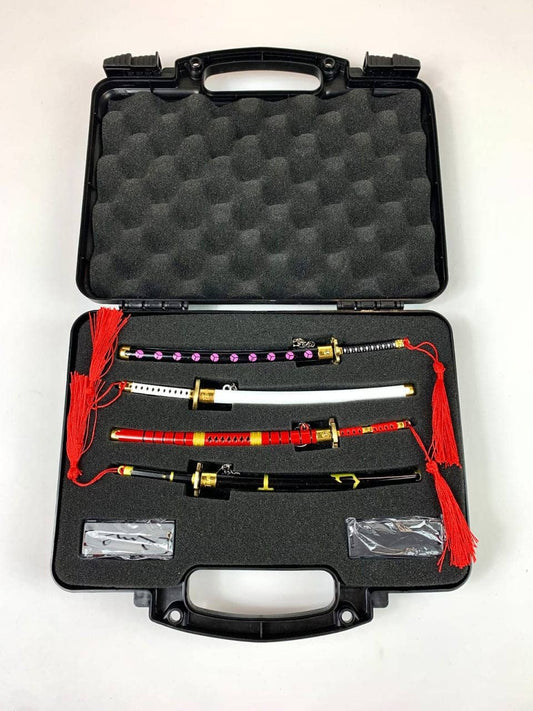
Mini katanas are miniature replicas of traditional Japanese swords, valued for their craftsmanship and cultural symbolism. Made from materials such as carbon or stainless steel, and with details faithful to...
Mini katanas have gained popularity among both collectors and fans of Japanese culture thanks to their detailed design and symbolic significance. These miniature replicas of traditional katanas not only capture the essence of the original weapon, but also function as decorative or collectible items. Despite their small size, many are made from quality materials and reflect the same craftsmanship as real swords. (Image of the Mini-Katana "The Last Samurai" ) What is a Mini Katana? Concept, origin and historical development A mini katana is a scaled-down reproduction of the Japanese katana. These retain the morphology, characteristic curvature, proportions of the handle and guard, as well as the polished finish of the blade, but all adapted to dimensions that generally range between 15 cm and 40 cm. Its current function is primarily ornamental and educational: it allows one to appreciate the metallurgical engineering and aesthetics of the original weapon without the licensing, space, or maintenance requirements that a full-size sword entails. The phenomenon emerged in the early 20th century as a tourist souvenir in Kyoto and Nara, made by artisans using carbon steel and simple tempering techniques to satisfy the demand of Western visitors. With the expansion of specialized collecting in the postwar period, these models evolved into high-end pieces, forged in multi-layered metal, with lacquered skirts and chiseled brass fittings, faithful to the style of historical schools such as Bizen or Soshu. Over the past few decades, the growth of Japanese pop culture fairs, along with the spread of sword-themed anime series and video games, has cemented the mini katana as a global cult object. Contemporary designers incorporate stainless steels, cryogenic treatments, and laser engraving to add aesthetic value and ensure corrosion resistance, while museums and dojos use it as an illustrative tool in seminars on Japanese military history. Thus, the mini katana has transformed from a simple souvenir into a statement piece that combines traditional craftsmanship, metallurgical engineering, and modern design trends. (Image of Trafalgar Law's Mini-Katana ) How to choose a mini katana? Selecting a quality mini katana involves more than just an aesthetic decision. It's a process that requires attention to technical and functional aspects that ensure both historical accuracy and durability. These pieces, despite their small size, must reflect the artisanal precision and symbolic values that characterize the original katana. The first key aspect is the steel composition. The best ones are forged with materials such as tempered carbon steel, high-grade stainless steel (such as 440C), or even composite steels (san-mai), which provide hardness and corrosion resistance. The quality of the metal influences not only durability but also the sharpness of the finish, the polish of the blade, and the fidelity of the lines. Secondly, the degree of authenticity and craftsmanship must be assessed. Professional reproductions often include many details similar to the original, must maintain correct proportions, and respect regional styles, for example, Edo koshirae or Shinto ; they even offer certificates of provenance or limited editions. (Image of the Mini-Katana Wado Ichimonji ) Technical maintenance and conservation The mini katana, like its full-size counterpart, requires rigorous maintenance to preserve its condition over time. The steel, even treated, is still vulnerable to moisture and contact with natural skin acids. It's recommended to clean it periodically with microfiber cloths that won't scratch the blade's polish. Afterward, apply a thin layer of camellia oil, or choji oil, traditionally used on Japanese swords, to prevent rust. No abrasive products should be used and direct handling without gloves is essential if the original finish is to be preserved. As for conservation, it should be stored in dry, ventilated places and away from direct sunlight. It is preferable to use horizontal supports to distribute the weight without damaging the skirt and to keep the piece protected from dust and moisture with fabric covers or acrylic display boxes. The value of owning a mini katana Each mini katana is, in itself, a tangible representation of values such as discipline, respect for tradition, and technical perfection. For collectors, designers, and lovers of Japanese art, owning a quality mini katana represents an investment in knowledge, history, and beauty. Furthermore, their portability and versatility make them ideal objects for thematic exhibitions, educational practices, or contemporary artistic inspiration. Don't forget to check out our collection of Mini Katanas .
Read more
The Spartan sword from 300 , inspired by the Greek xiphos, combines history and cinematic stylization. Its curved, rustic design reflects the brutality and honor of the Spartan warrior. Used...
The film 300 (2006), directed by Zack Snyder and based on the graphic novel by Frank Miller, transformed the image of the Spartan warriors into a visually striking legend. Among the many elements that defined these fighters, the Spartan sword stands out as a direct extension of their discipline, ferocity, and tactical brutality. In this article, we explore the historical origins of this weapon, its cinematic reinterpretation, and the powerful symbolism it holds, both on the battlefield and in popular culture. (Image of the Sword of Leonidas from 300, aged, hand-forged, functional ) Origin of the Spartan Sword Historically, the Spartans used a sword called a xiphos, a short, double-edged blade designed for close combat. It was a secondary weapon, used when the warrior could no longer fight with his dory spear. The xiphos measured between 40 and 60 cm and was ideal for direct collision in the hoplite formation. Unlike longer swords, the xiphos allowed the Spartans to maneuver within the phalanx with precision, seeking out the enemy's weak points, such as the armpits, neck, or groin, after the initial clash of spears and shields. Features of the Sword in the Movie 300 The sword featured in the film 300 is a stylized and dramatized version of the historical xiphos. In the film, its menacing appearance is enhanced with a rougher, more curved and visually intimidating design. Its characteristics: Length: Approximately 60 cm Design: Slightly curved, double-edged blade with a pointed end Material (in fiction): Blackened steel, with a rustic appearance Grip: Simple, enveloping, easy to handle even with gloves This design isn't meant to be historically accurate, but rather to convey brutality and effectiveness. The overall aesthetic of the weapons in 300 follows the logic of the comic: extreme stylization for visual impact. (Image of the Official Sword of 300 ) The Use of the Spartan Sword in 300 Leonidas and his 300 Spartan warriors make extensive use of this sword in the film's many battles. The sword becomes a lethal tool for close combat, where a shield and swift movement are essential. The film spectacularly choreographs the cuts, stabs, and dismemberments this weapon can cause, showing the sword as an extension of the Spartan warrior instinct, where its small size facilitates its continuous use without compromising the warrior's mobility. Symbolism of the Sword of 300 Beyond its effectiveness in combat, the 300 sword becomes a narrative symbol. It represents: Resilience: the will to fight until the last breath Honor: The Hoplite Code, Where Shield and Sword Do Not Surrender Warrior Identity: The Spartan Pride of Dying Fighting for Freedom War minimalism: the weapon is simple but deadly, without unnecessary embellishments This weapon epitomizes Spartan philosophy: efficiency, functionality, and discipline. In the context of cinema, it also functions as a visual icon that defines the protagonists as relentless forces. (Image of Spartan Sword from the Movie 300 ) Influence on Pop Culture and Video Games The Spartan sword from 300 isn't just a combat tool; it's a symbol of resilience, valor, and cinematic style. Inspired by the historic xiphos but adapted to the film's visual language, this weapon has established itself as one of the most recognizable icons of modern epic cinema. Its strength lies as much in its history as in its visual impact, making it a must-see for lovers of ancient weapons, Greek culture, and action films with an aesthetic identity. This has been replicated in video games, merchandising and collectibles. Games like God of War, Assassin's Creed Odyssey, and Spartan: Total Warrior have reinterpreted similar weapons, blending historical accuracy with the film's brutal style. There are also official and unofficial replicas of this sword, forged for collectors and fans of epic cinema. Its design has made it a very popular decorative item in film, history, and geek culture stores. Without a doubt, Leonidas' sword represents the fighting soul of Sparta, brought to the screen with fury, fire, and glory. Don't forget to visit us at Swords and More, where you can find more "300" movie merchandise and much more.
Read more
Forged in Gondolin, Orcrist is an elven sword that glows when it detects orcs. Carried by Thorin in The Hobbit, it represents honor, ancestral power, and the union between elves...
The sword that defies the shadows In the vast mythology of Middle-earth, swords are not mere weapons: they are living relics, charged with magic, history, and destiny. One of the most iconic in Tolkien's narrative is Orcrist, also known as the Gobelin-cleaver, a blade forged by the elves of Gondolin in the glorious First Age. This sword, sister to the famous Glamdring, was discovered millennia later by Thorin Oakenshield during his adventure in The Hobbit. From that moment on, Orcrist would become part of the legends that weave the destiny of Middle-earth. (Image of Thorin's Orcrist Sword from The Hobbit, Official Replica ) Orcrist, forged in Gondolin: light against darkness Orcrist was created in the secret Elven city of Gondolin, famed for its art, knowledge, and power. Forged with ancient Elven techniques, the sword was designed to combat Orcs, and its blade could glow with blue light when the creatures were near, a living warning of their presence. Its name, “Orcrist,” literally means “gobelin cutter” in the common tongue, and it is one of the few elven weapons with its own renown, equaling others such as Anglachel or Narsil in fame and respect. Thorin Oakenshield: a dwarf worthy of his blade Thorin found Orcrist in a troll cave, along with Glamdring and the dagger that would later become Sting, carried by Bilbo Baggins. Fate would have it that a dwarf—a descendant of kings, driven by honor and the need to reclaim his kingdom—would become its new wielder. Although elves and dwarves had a history fraught with suspicion, even the inhabitants of Rivendell showed respect when they saw Thorin with a sword from Gondolin. Orcrist became a symbol of leadership, justice and resistance against the forces of evil. (Picture of Thorin's Orcrist Sword, Oakenshield from The Hobbit, ornamental replica ) Description of a legend With a long, curved, and glowing blade, Orcrist is inscribed with runes in tengwar, the Elvish alphabet, giving the sword an air that is both mystical and resplendently beautiful. Its hilt is decorated with leaf and star motifs, representing the stellar lineage of the elves. It is not just a weapon: it is a testament to the past, an extension of the wielder's soul, and a tool of judgment in the face of the chaos of the world. The Immortal Legacy of Orcrist When Thorin dies after the Battle of the Five Armies, Orcrist is returned to his side, buried with him beneath the Lonely Mountain. There, it is said, the sword continues to fulfill its duty: it shines brightly when enemies approach its owner's tomb. Thus, its light continues to defend its once worthy bearer. (Image of Orcrist Letter Opener ) Eternal light from Gondolin This isn't just a magical sword in Tolkien's narrative. It's a symbol of courage, nobility, and redemption. Its journey, from Gondolin to Thorin's grave, spans ages, conflicts, and cultures. It merges Elven craftsmanship, the destiny of dwarves, and the eternal struggle between light and darkness, which they all share. A sword, a legacy, a legend that could well continue to appear in later stories, in the hands of another hero. You can find this sword and many other Lord of the Rings and Hobbit merchandise in our Swords and More Shop.
Read more
The Headless Horseman's sword in Sleepy Hollow is a cursed and symbolic weapon, with a medieval design and a supernatural aura. Forged in mystery and revenge, it represents the rider's...
In the dark universe of Sleepy Hollow , one of the most iconic and terrifying figures is undoubtedly the Headless Horseman. However, beyond his imposing figure and his hellish horse, there's one element that makes him a lethal threat: his cursed sword. This article delves into the history of the Sleepy Hollow sword , its origin, symbolism, and why it has become one of the most feared and remembered weapons in fantasy cinema. A sword forged in horror The Headless Horseman's sword is no ordinary weapon. Since its first appearance in the film Sleepy Hollow (1999), directed by Tim Burton, makes it clear that we are dealing with a lethal blade, with an ancient aesthetic, sharp like a demonic blade and loaded with dark symbolism. This sword is forged, metaphorically, in blood and revenge, becoming the specter's primary instrument of terror. Design and physical characteristics of the sword This cursed sword has a long, curved blade, with a medieval and macabre aesthetic. Its design is inspired by 18th-century swords, with a blackened finish suggesting corruption or witchcraft. The pommel bears arcane engravings, and the hilt appears almost skeletal, as if carved by Death itself. The blade appears to be made of a dark metal, similar to steel forged using ancient techniques, and always glows with a sinister silver light whenever the rider draws it. The symbolism behind the weapon The rider's sword is not only used for killing : It is a symbol of his eternal damnation and his implacable mission. Each throat slitting he performs is not only an act of violence, but a fulfillment of destiny. The weapon becomes part of his identity: just as he has no head, he has no compassion. The sword represents punishment, ancestral terror, and the curse that hangs over Sleepy Hollow. Legendary origin of the Rider and his sword In the film's story, the Horseman was a German mercenary who fought during the American Revolutionary War. He was said to be as brutal as his sword, and to enjoy combat more than anyone else. When he was captured by enemies, he was beheaded and buried in the forest. Since then, his spirit has been summoned through witchcraft , awakening to take revenge on those who betrayed him , although under the control of black magic . Although the sword's forged origin isn't specified, many fans speculate that the weapon was forged using arcane methods, mixing metal with supernatural elements. Some even suggest it was blessed or cursed by some dark entity, explaining its connection to the Headless Horseman. The supernatural bond between rider and sword The most disturbing thing is that the sword seems to have a mind of its own, as if it responds to the rider's wishes even though it has no head and therefore shouldn't be able to locate its targets with its sight . It moves with lethal precision, as if the blade "sees" for itself. This supernatural connection between wielder and weapon has been compared to other cursed swords in fiction, such as the Muramasa katanas or the Blade of Sauron. It's not just a tool, but an extension of the wielder's damned soul. In this sense, the sword is "bound" to its wielder, like a kind of cursed spiritual bond . (Image of the Sword of Sleepy Hollow ) The sword as part of the collective imagination Thanks to Tim Burton's visual style and legendary production designer Rick Heinrichs' design, the Sleepy Hollow sword has become an icon of Gothic culture and fantasy horror cinema. Its unique aesthetic, combined with its symbolism, places it on par with legendary weapons like Excalibur or Conan the Barbarian's sword. Thanks to its visual and symbolic impact, the Headless Horseman's sword has transcended the screen to become a coveted collector's item. There are official and handmade replicas that faithfully recreate its dark design, ideal for themed exhibitions, costumes, or gothic film lovers. Its presence in the world of merchandising demonstrates how a fictional object can achieve the status of a cultural icon. A sword born of fear The Sword of Sleepy Hollow is much more than a sharp object. It represents a time of darkness, revenge, and superstition. In cinematic narrative, few weapons have managed to evoke so much terror with so few words. Its appearance, its function, and its mysticism make it an unforgettable piece of modern gothic cinema. For lovers of mythical weapons, this ghostly blade will always be one of the most feared . Don't forget to check out our store 's wide variety of Swords and More products.
Read more
The article explores the most iconic swords in the Assassin's Creed series, from Ezio Auditore's elegant Renaissance sword to Eivor's sturdy Viking greatsword, the mystical Blade of Eden , and...
The Assassin's Creed saga has not only given us thrilling adventures throughout time, but has also forged some of the most iconic weapons in the video game universe. Among these, the swords of the Assassins and Templars have occupied a prominent place for their design, history and symbolism. Although Altaïr 's sword is the most well-known, in this entry we delve into the legacy of other legendary swords that have influenced Assassin's Creed players throughout its many installments. The Sword of Ezio Auditore: Rebirth of Vengeance Ezio Auditore da Firenze, protagonist of Assassin's Creed II, Brotherhood and Revelations, is one of the most beloved assassins. His sword, crafted from high-quality Florentine steel, is an extension of his elegant and lethal character. The cinematics show an ornate hilt with Renaissance details and a sharp blade that cuts with precision. This sword represents justice, redemption, and the transition from young nobleman to master assassin. The Sword of King Arthur (Sword of Eden): Templar relic In Assassin's Creed: Syndicate and other installments, the legendary Sword of Eden, also known as King Arthur's sword, appears. This mythical weapon is a Piece of Eden with supernatural properties, capable of unleashing energy beams and controlling minds. Its design blends Celtic symbolism and futuristic elements, linking Arthurian legend with the hidden power of the Precursors. It is one of the most powerful swords in the Assassin's Creed universe. The Ottoman Sabre of Yusuf Tazim In Assassin's Creed: Revelations , Yusuf Tazim, the charismatic leader of the Assassins in Constantinople, wields a sharp, curved Ottoman saber. This sword is fast, light and elegant, perfect for urban combat. The saber reflects the influence of the Ottoman Empire in the saga and is a symbol of brotherhood and tradition in the Brotherhood. Eivor's Viking Greatsword Assassin's Creed Valhalla introduced Eivor, a Norse warrior who can wield a two-handed Viking greatsword. This sword is brutal, robust, with engraved runes and a wide blade. It is perfect for close combat and represents the strength, anger and honor of the Viking clans. Some versions of the weapon gain magical powers when fully upgraded. The Sword of Arno Dorian: Revolutionary Paris In Assassin's Creed Unity , set during the French Revolution, Arno Dorian uses a fencing sword with a thin, swift blade. Ideal for fast-paced, technical duels, this weapon reflects French refinement and the agility of assassins in urban environments. Weapon customization allows you to enhance this sword with engraved hilts and razor-sharp blades. Edward Kenway's Cutlass In Assassin's Creed IV: Black Flag, Edward Kenway, the pirate assassin, uses two short, curved Caribbean cutlasses, ideal for boarding and naval combat. These swords reflect the pirate life, plunder, and the pursuit of freedom. They can also be enhanced with golden blades and bone handles, giving them a unique look. Persian Sword of Bayek of Siwa Bayek, the protagonist of Assassin's Creed Origins, uses a traditional Persian sword with a curved blade and Egyptian decorations. This type of sword is common in Ptolemaic Egypt, and represents the mixture of cultures that characterized that period. Some of these swords are forged from copper, bronze, and Damascus steel, blending art and utility. Weapons that mix culture and identity Swords in Assassin's Creed are not simple weapons, but profound symbols that reflect the identity of their wielders and the historical context in which they operate. Each design, from the Ottoman saber to Bayek's Persian sword, brings authenticity and richness to the series, strengthening the connection between players and characters. This hidden legacy of legendary swords is a fundamental part of the charm and immersion that makes Assassin's Creed such a memorable franchise. I invite you to visit our store and discover the Assassin's Creed products, along with other games, movies, and much more we have to offer at Swords and More.
Read more
