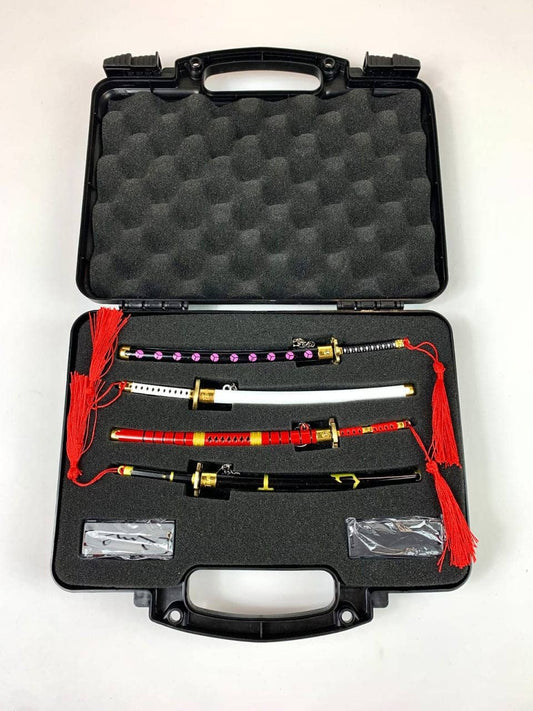


The Swords of Assassin's Creed
The Assassin’s Creed saga has not only provided us with thrilling adventures through time, but has also forged some of the most emblematic weapons in the video game universe.
Among these, the swords of the assassins and templars have held a prominent place due to their design, history, and symbolism.
Although Altaïr's sword is the most well-known, in this entry we delve into the legacy of other legendary swords that have left their mark on Assassin’s Creed players throughout its many installments.

Ezio Auditore's Sword: the rebirth of vengeance
Ezio Auditore da Firenze, protagonist of Assassin’s Creed II, Brotherhood, and Revelations, is one of the most beloved assassins.
His sword, crafted from high-quality Florentine steel, is an extension of his elegant and lethal character.
In cutscenes, an ornate hilt with Renaissance details and a sharp blade that cuts with precision are visible.
This sword represents justice, redemption, and the transition from noble youth to master assassin.

King Arthur's Sword (Sword of Eden): Templar relic
In Assassin’s Creed: Syndicate and other installments, the legendary Sword of Eden, also known as King Arthur's sword, appears. This mythical weapon is a Piece of Eden with supernatural properties, capable of unleashing energy beams and controlling minds.
Its design blends Celtic symbolism and futuristic elements, linking Arthurian legend with the hidden power of the Precursors. It is one of the most powerful swords in the Assassin’s Creed universe.

Yusuf Tazim's Ottoman Sabre
In Assassin’s Creed: Revelations, Yusuf Tazim, the charismatic leader of the Assassins in Constantinople, wields an Ottoman sabre with a curved, sharp blade.
This sword is fast, light, and elegant, perfect for urban combat.
The sabre reflects the influence of the Ottoman Empire in the saga and is a symbol of brotherhood and tradition within the Brotherhood.

Eivor's Viking Greatsword
Assassin’s Creed Valhalla introduced Eivor, a Norse warrior who can wield a two-handed Viking greatsword.
This brutal, robust sword features engraved runes and a wide blade.
It is perfect for close combat and represents the strength, fury, and honor of the Viking clans.
Some versions of the weapon acquire magical powers when upgraded to the maximum.

Arno Dorian's Sword: Revolutionary Paris
In Assassin’s Creed Unity, set during the French Revolution, Arno Dorian uses a fencing sword with a thin, fast blade.
Ideal for quick and technical duels, this weapon reflects French refinement and the agility of assassins in urban environments.
Weapon customization allows this sword to be enhanced with engraved hilts and razor-sharp blades.

Edward Kenway's Cutlass
In Assassin’s Creed IV: Black Flag, Edward Kenway, the pirate assassin, uses two short, curved Caribbean cutlasses, ideal for boarding and naval combat.
These swords reflect the pirate life, plunder, and the search for freedom. Additionally, they can be upgraded with golden blades and bone hilts, giving them a unique look.

Bayek of Siwa's Persian Sword
Bayek, the protagonist of Assassin’s Creed Origins, uses a traditional Persian sword with a curved blade and Egyptian decorations.
This type of sword is common in Ptolemaic Egypt and represents the blend of cultures that characterized that era.
Some of these swords are forged from copper, bronze, and Damascus steel, merging art and utility.
Weapons that blend culture and identity
The swords in Assassin’s Creed are not mere weapons, but profound symbols that reflect the identity of their wielders and the historical context in which they operate. Each design, from the Ottoman sabre to Bayek's Persian sword, adds authenticity and richness to the saga, strengthening the connection between players and characters.
This hidden legacy of legendary swords is a fundamental part of the charm and immersion that makes Assassin’s Creed such a memorable franchise.
I invite you to visit our store and discover the Assassin's Creed products, along with other games, movies and much more that we have to offer you at Espadas y más.