América
Astronomical Knowledge of the Mayans: Predictions, Calculations, and Meanings
Systematic Sky ObservationThe Mayan civilization, which flourished from approximately 2000 BCE to the 16th century, d...




The myth of Romulus and Remus explains the origin of Rome by combining legend, symbolism, and historical elements.From their birth to the founding of the city, this story reflects key...
The story of Romulus and Remus is the best-known foundational narrative of ancient Rome. Through this story, the Romans explained the birth of their city, its vocation for power, and the values that would mark their civilization. However, this narrative combines legend, symbolism, and historical elements, making it necessary to differentiate between the traditional myth and what historical and archaeological research has been able to confirm. The legend of Romulus and Remus According to Roman tradition, Romulus and Remus were the sons of Rhea Silvia, a Vestal Virgin, and the god Mars. Rhea Silvia belonged to the royal family of Alba Longa, descended from the Trojan hero Aeneas. Her uncle Amulius, a usurper of the throne, forced Rhea Silvia to become a Vestal Virgin to prevent legitimate offspring. Thus, when the twins were born, he ordered them to be abandoned in the Tiber river. The legend tells that the children survived thanks to a she-wolf who suckled them in the Lupercal cave, at the foot of the Palatine hill. Later, they were found by the shepherd Faustulus and raised with his wife Larentia. As adults, the brothers discovered their origin, defeated Amulius, and decided to found a new city. The dispute arose when choosing the location and leadership. After consulting the auguries, Romulus prevailed and drew the sacred boundary of the city. Remus crossed it as a sign of defiance and was killed, according to some versions by Romulus himself, and according to others, by one of his followers. Thus, Rome is said to have been founded in 753 BC, according to traditional chronology. The symbolic meaning of the myth The myth expresses central values of Roman thought: the supremacy of the state over the individual, the legitimacy of foundational violence, and obedience to sacred laws. The fratricide of Remus symbolizes that the order of the city is above even family ties. Romulus embodies the strong founder, capable of imposing authority to ensure collective survival. The consultation of auguries and the brothers' origin as sons of gods grants a mythical value that reflects the strength and importance of beliefs, traditions, myths, and religion in their daily lives, and their norms and decisions. The historical and archaeological reality From a historical point of view, there is no evidence of the actual existence of Romulus and Remus. However, archaeology has provided relevant data. Excavations on the Palatine hill have revealed remains of huts and human settlements dating to the 8th century BC, coinciding with the mythical date of Rome's founding. These findings indicate that Rome emerged as a cluster of Latin villages, probably united for defensive, economic, and religious reasons. The figure of Romulus could represent a tribal leader or a collective process of unification, later personified in a legendary hero. Romulus as a political construct Literary sources, such as Livy and Plutarch, describe Romulus as the organizer of the first Roman institutions: the Senate, the army, and social division. Although these accounts are not literally verifiable, they reflect Rome's early evolution towards a structured and militarized community. The later deification of Romulus as Quirinus reinforces his symbolic character. This process was common in antiquity and served to legitimize the power and exceptional destiny of the city.
Read more
The scutum was the standard shield of Roman legionaries, combining protection, innovative design, and tactical functionality. Its rectangular and curved shape, constructed from wood, leather, and metal, allowed for advancement...
The scutum was the standard shield of the Roman army's legionaries from the late Republic through much of the Empire. Its name comes directly from the Latin scūtum, a term used in classical sources to refer to this defensive weapon that combined protection, innovative design, and tactical functionality in combat. Origin and Evolution of the Scutum During the Roman Republic, the shields used by infantry were oval or slightly curved, providing protection to the torso and upper limbs. Over time, especially from the transition to the Empire, this shield evolved into a slightly convex rectangular shape, more effective for protecting linear combat formations. The curved shape of the scutum allowed sword blows or spear thrusts to be deflected, reducing direct impact on the soldier. This curvature also allowed adjacent shields in the shield formation to overlap, reinforcing defensive tactics such as the famous testudo or "tortoise formation." Construction and Materials of the Typical Scutum The scutum was constructed from several layers of thin wood glued together—generally three—with the grain oriented in alternate directions to increase strength and flexibility. The outer surface was covered with canvas and leather, which improved its durability against rain and blows. The edge of the shield was usually reinforced with iron or bronze metal to prevent the wood from splitting during combat. In the center, a metallic umbo (central shield boss) protruded and protected the legionary's hand, as well as being usable as a percussion weapon if necessary. Size, Weight, and Ergonomics Scuta were large: a specimen found in Dura Europos (modern-day Syria) measures approximately 105.5 cm high by 41 cm wide, enough to cover a large part of a foot soldier's body. Its semi-curved construction allowed for a balance between protection and mobility, even with an approximate weight between 5.5 and 10 kg depending on the model and era. This size was particularly advantageous for close-order infantry, as the soldier could deflect thrown or launched weapons from a distance, mitigate impacts, and protect both the combatant and their comrades in formation. Tactical Function in the Legion Beyond its purely defensive function, the scutum was part of cohesive Roman tactics. Together with the short sword gladius and the spear pilum, the shield allowed legionaries to advance as a compact block against the enemy. By overlapping the scuta of several rows, an almost impenetrable barrier was created against arrows or javelins, a technique especially useful in sieges or close-line combat. The testudo—tortoise formation—is the best-known example: soldiers aligned their shields to form a protective cover horizontally and vertically, thus reducing the effectiveness of enemy projectiles when advancing under fire. Decoration and Identification Although primarily a functional weapon, the scutum could also carry decorative motifs that identified the legion or military unit to which its bearer belonged. Emblems such as eagles, lightning bolts, or symbols associated with gods were common on the shield's front painting, serving both for unit pride and to intimidate the enemy.
Read more5 interesting facts about the Gladius The Gladius isn't just a sword; it's a symbol of Roman military might, a weapon that helped expand one of history's most powerful empires. But behind its simple design lie many surprising stories. Today in Swords and More , we tell you 5 interesting facts that (perhaps) you didn't know about the Gladius : It was not originally Roman Although we associate it with the Roman legions, the gladius originated in the Iberian Peninsula. The Romans adopted this type of sword during the Punic Wars, inspired by the weapons of the Iberian warriors. In fact, its full name was gladius hispaniensis , or "Hispanic sword." Check out this amazing Gladius! Designed to stab, not cut Unlike many medieval longswords, the gladius was designed for close combat. Legionaries used the shield ( scutum ) to close in and then attacked with quick thrusts toward the enemy's torso or between the ribs. A lethal and efficient technique. This Gladius is of incredible quality! There were several types of gladius Over time, the design of the gladius evolved. The three best-known models are: Gladius Hispaniensis (the longest and oldest) Gladius Mainz (wide blade, with a more triangular tip) Gladius Pompeii (shorter and with straight edges, ideal for urban combat) Each one was adapted to different tactical needs. The soldiers carried him on the right side Curiously, Roman legionaries wore the gladius on the right side of their belt, not on the left, as would be more natural for right-handed men. This was because the shield was carried on the left side, and drawing the weapon from the opposite side with the shield in the way was awkward. It also prevented swords from clashing between comrades in formation. Check out this Delos Gladius! It was not just a weapon, but also a symbol. The gladius represented the status of the Roman soldier. Although it was a weapon of war, it also had ceremonial value. Upon discharge, many veterans kept their gladius as a memento of their service, and sometimes it was even placed in graves as a symbol of honor and valor. You'll love this Gladius! Don't miss it! At Espadas y más, we have handcrafted replicas of the Roman gladius, ideal for collectors, historical reenactors, or military history buffs. Own a piece of history and wear it with pride!
Read moreGladius! 5 Epic Movies to Get You Ready for Gladiator 2 Legions of moviegoers, unite! Anticipation for Gladiator 2 is at an all-time high. But before we dive into the arena of the Colosseum once again, how about we reminisce about some of the cinematic gems that made us fall in love with Ancient Rome? Because yes, folks, there's a lot more to it than Russell Crowe and his famous "are you not entertained?" The Revival of Peplum Cinema and the Legacy of Gladiator Gladiator wasn't just a movie, it was a phenomenon that revitalized the peplum genre. Ridley Scott gave us a visually stunning and emotionally moving epic that reminded us of the grandeur and brutality of Ancient Rome. But did you know that there are other films that offer us a deeper and more nuanced look at this fascinating historical period? 5 Movies You Must See Before Gladiator 2 1. Julius Caesar (1953): Marlon Brando at his best, playing one of the most iconic characters in history. This film immerses us in the political intrigues that led to the assassination of Caesar and laid the foundations of the Roman Empire. 2. Spartacus (1960): Kirk Douglas plays the legendary slave who led a rebellion against Rome. Beyond the epic battles, this film speaks to us of freedom, justice and the struggle of the oppressed. Cleopatra (1963): A classic Hollywood film that takes us back to Ptolemaic Egypt. Elizabeth Taylor and Richard Burton star in this epoch-making story of love and power. 3. The Fall of the Roman Empire (1964): An epic fresco depicting the final years of the Roman Empire. Palace intrigues, colossal battles and the decline of a civilization. 4. Pompeii (2014): A more recent production that tells the tragic story of the Roman city buried by Vesuvius. Impressive special effects and a love story in the midst of disaster. Why watch these movies? History and entertainment: These movies combine historical facts with great stories, unforgettable characters and action scenes that will keep you on the edge of your seat. Delve into the Roman world: Beyond gladiators and emperors, these films show us the daily life, customs and beliefs of the Romans. Preparing for Gladiator 2 : By getting a better understanding of the historical context and characters, you'll be able to better appreciate the references and winks in the new film. Beyond the Arena: Exploring Ancient Rome on Film Ancient Rome has been an inexhaustible source of inspiration for cinema. From Hollywood blockbusters to more independent films, the fascination with this historical period is still alive. Here are some other suggestions and recommendations if you want to delve deeper into this historic world at your feet... Books: Stories of Rome: By Mary Beard. A masterpiece of history that offers a fresh and accessible view of daily life in Ancient Rome. Rome: By Robert Graves. A historical novel that combines fiction and reality, offering a fascinating insight into the lives of characters such as Julius Caesar and Cleopatra. The Last Days of Pompeii: By Edward Bulwer-Lytton. A classic of literature that narrates the eruption of Vesuvius and the destruction of Pompeii. SPQR: A History of Ancient Rome: By Mary Beard. An exhaustive tour of the history of Rome from its origins to its fall. Documentaries: Rome documentary series: From the BBC. A high-quality production that explores the life, culture and politics of Ancient Rome through historical reconstructions and interviews with experts. Imperium: Rome (Netflix): A documentary series that uses cutting-edge technology to recreate life in Ancient Rome. Life in Ancient Rome: Documentaries from National Geographic or the History Channel. These channels usually offer documentaries specializing in different aspects of Roman life, such as architecture, the military, or everyday life. Other suggestions: Historical Novels: Look to authors like Colleen McCullough (The First Men of Rome) or Steven Saylor (Rome) to immerse yourself in fictional stories set in Ancient Rome. Comics: Series such as Asterix and Obelix offer a humorous and satirical view of life in Roman Gaul. Video Games: Titles like Total War: Rome II allow you to experience life in Ancient Rome from a strategic perspective. What other films, documentaries or books about Ancient Rome do you recommend? Share your suggestions in the comments and join the conversation. May the force of Rome be with you!
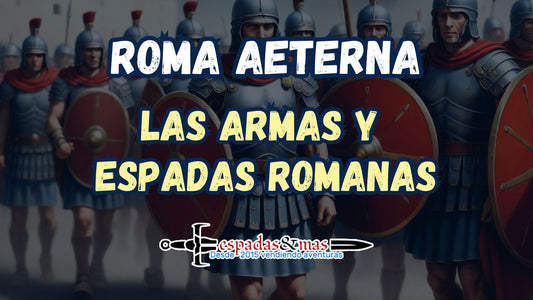
Read moreWelcome to a new Swords and More article! Today we will tell you about the glorious Rome and its weaponry. Roma Aeterna! Roman military world and weapons When we think of Roman military capability, one of the most important empires in history comes to mind. Some of the relevant elements of Roman tactics are: Discipline and structure: The Roman army was noted for its discipline and organization, as well as for its advances in weapons and tactics. Citizens between seventeen and sixty years of age were subject to military service. Those with minimum incomes of four hundred drachmas joined the infantry or heavy cavalry. Check out this amazing Roman Gladius! Composition of the army: An army was usually made up of four legions, although this number could vary. Each legion, in the 1st century BC, was made up of 5,120 men and was divided into 10 cohorts. Combat tactics: The Roman army was organized in tight formations, with a wide but shallow front line. These formations included 500 infantrymen in front, 1,200 light infantrymen on the sides, and 300 cavalrymen for support. This Gladius is of great quality! Now, if we go to weapons, the main Roman weapons are the following: The pilum was a long, heavy spear of about 2.5 metres that Roman soldiers threw like a dart towards the enemy. When several units threw their pilums at the same time, they created a shower of devastating projectiles. In addition, the pilum was also used in hand-to-hand combat, being a short spear very effective at piercing armour. The gladius hispaniensis , known as the Roman short sword, was instrumental in the expansion of the Roman Empire. With its suitable length, it allowed legionaries to attack with penetrating and devastating blows in confined spaces. Check out this spectacular Roman Centurion Gladius! The plumbata, also called the "spikes of Mars", was a new weapon adopted by the Roman armies around 300 AD. It consisted of an iron-tipped, lead-weighted dart mounted on a feathered wooden rod. The pugio, a dagger used by Roman soldiers, was an auxiliary weapon whose exact purpose is still uncertain, but it is believed to have had a meaning beyond combat, indicating the soldier's status. Look at this Roman dagger from Marto! Furthermore, the scorpion was a rotating siege engine used by the Roman army as a field artillery piece. And what do you think of Roman swords and the history of the glorious empire? (With permission from the great Spanish empire) Tell us!
Read moreWelcome to a new article on Swords and More. Today we will tell you about a topic that we are sure will be of interest to you: The Celts and their swords! About the Celts We can understand the ancient Celts as a community of diverse tribal groups that spread and populated vast regions of central and western Europe during the Bronze Age, approximately from 700 BC to 400 AD. From the Iberian Peninsula to the lands of Germany, crossing all of Europe and even reaching areas of Anatolia in the east and Ireland in the west. The Celts, although never united under a single state banner, shared certain cultural, religious and linguistic ties (despite their many differences between tribes, there are common elements to take into account) although they did not form a complex and united civilization. We can talk about different cultures of the Bronze Age that have subsequently been related to the expansion of the so-called Celtic peoples such as Hallstat and La Tène. Check out this amazing Celtic Cormac Sword! Hallstatt culture The Hallstatt culture, an archaeological civilization that flourished in Europe during the late Bronze Age and early Iron Age. Its name evokes the mystique of the Hallstatt Necropolis in Austria, where some 2,000 tombs and more than 6,000 buried treasures lie. This culture, which inherited legacies from the Urnfields, was distinguished by its skill in salt production and its increasingly intense trade with neighboring peoples. As it grew, it established connections with regions as far away as the Mediterranean and the vast steppes of Eastern Europe. Over time, iron became the central axis of its development, thus marking the beginning of the First Iron Age. La Tene culture The La Tène culture dates back to the period between 450 and 50 BC, taking its name from the place where its first remains were discovered, on the shores of Lake Neuchâtel in Switzerland. This culture emerged as the successor to the previously predominant Hallstatt culture (ca. 1200 - 450 BC), and quickly became the dominant artistic force in Central Europe. The treasures of La Tène culture have been found across a wide geographical range, from the green lands of Ireland to the vast plains of Romania, painting a picture of cultural exchange and connectivity across Western and Central Europe. Check out this Cruachan Celtic Short Sword! The Celtic Swords The Celts were skilled in metal forging, a skill that left an indelible mark on Roman military technology. From Gallic helmets to the famous Celtiberian swords, their influence was undeniable. We can distinguish several Eras: Bronze Age: Forged in bronze, these swords were rather short, with a triangular shape that made them unique, adorned with complex Celtic spiral patterns. Iron Age (First Period): Celtic swords grew in size and weight during this period. In addition to long swords, short swords, horseshoe daggers and antennae swords were also used. Iron Age (Second and Third Period): Celtic swords continued to evolve, adapting to the changing needs of the battlefield, reflecting the constant transformation of their society and technology. I love this Historical Celtic Short Sword! And what do you think of the Celts and their swords? Are you passionate about the Bronze Age? Tell us!
Read more