



Aikido is a Japanese martial art distinguished by its focus on harmony and the neutralization of aggression without resorting to violence. Its name is composed of three kanji: "Ai" (harmony), "Ki" (energy), and "Do" (path), which translates as "the path of harmony with energy."
This discipline was developed by Morihei Ueshiba , known as Ōsensei, Grandmaster, during the first decades of the 20th century. Ueshiba combined techniques from various traditional martial arts, such as Daitō-ryū Aiki-jūjutsu , kenjutsu (Japanese fencing) and sōjutsu (spear handling), integrating them around a profound philosophy of peace and reconciliation.

History and evolution of Aikido
Morihei Ueshiba was born in 1883 in Japan and showed interest in martial arts from a young age. Throughout his life, he studied various disciplines, but it was in the 1920s that he began to develop what is now known as Aikido.
His goal was to create an art that would allow one to defend oneself without causing harm to the opponent, thus reflecting his spiritual convictions influenced by Shintoism and Zen Buddhism .
Aikido was officially named as such in 1942 and, after World War II, its practice expanded internationally, with dojos being established all over the world.
Philosophy of Aikido
Unlike other martial arts that may focus on competition or direct confrontation, Aikido promotes the idea that true victory is achieved over oneself.
This philosophy is summarized in the concept of "masakatsu agatsu katsuhayabi" , which means "true victory is victory over oneself here and now."
In this practice, the Aikido practitioner seeks to harmonize with the attacker's energy, redirecting and neutralizing it without inflicting harm.

Techniques and elements of Aikido
Aikido techniques are based on unbalancing the opponent, emphasizing the importance of blending with their energy and redirecting it rather than opposing it.
Some of the fundamental techniques are:
· Ikkyo : It consists of controlling the opponent by immobilizing his arm, directing it towards the ground and keeping it under control.
· Irimi Nage : Known as the "entry throw", it involves stepping directly into the attacker and using his momentum to throw him.
· Kote Gaeshi : This technique focuses on twisting the opponent's wrist, causing him to lose balance and fall.
· Shiho Nage : Called the "four-way throw," it involves moving the opponent in a pattern that knocks them off balance and throws them to the ground.
In addition, some traditional weapons are used to better connect with the principles of martial arts, focusing on the harmony of movements. Among these, the most commonly used are:
· The bokken , a wooden katana used to learn cutting, disarming and defense techniques, which, in turn, serve to improve the fluidity and precision of movement.
· The jo , a wooden stick measuring approximately 1.28 meters, used in striking, pushing, sweeping, blocking, and defense techniques, focusing on coordination, developing balance, and improving distance perception and body control.
The wooden tanto , used primarily to learn how to handle dangerous situations and remain calm when reacting under pressure. It teaches defense against bladed weapon attacks and how to handle close-quarters confrontations, focusing on neutralizing the attacker and developing spatial awareness, quick reaction time, and the ability to adapt to unexpected movements.
All of these techniques strengthen the connection between body and mind, increasing the calm and discipline needed in critical situations, as well as increasing awareness of oneself and one's surroundings.
During training, it is essential for the Tori (defender) to recognize the timing and actions of the Uke (attacker) in order to connect with his energy and execute the technique effectively. Likewise, the Uke must be aware of the Tori's actions in order to receive the technique without suffering harm.

What differentiates Aikido from other Martial Arts
Aikido is distinguished from other martial arts in several key aspects:
· A non-competitive approach : While disciplines such as karate or judo include competitions and tournaments, Aikido lacks them, emphasizing personal growth and cooperation between practitioners, and focusing primarily on its use for self-defense.
· Using the opponent's energy : Unlike arts such as boxing or taekwondo , which are based on direct blows, Aikido uses circular movements to redirect the attacker's force, harnessing his own energy against him.
· A philosophy of harmony and peace : While many martial arts focus on defeating one's opponent, Aikido seeks the peaceful resolution of conflicts, reflecting a profound philosophy of harmony and reconciliation.
Benefits of Aikido and its fundamental principles
The practice of Aikido offers multiple benefits, both physical and spiritual.
On a physical level, it improves coordination, flexibility, balance, and posture, while strengthening muscles and stimulating circulation. But beyond the physical level, Aikido also acts as a path to inner growth: it reduces stress, promotes concentration, cultivates calm, and develops greater awareness of the present moment.
These benefits are deeply linked to the fundamental principles of Aikido, which include nonresistance, control without aggression, harmony with the opponent, and mutual respect. One learns that true strength lies not in defeating others, but in overcoming one's own impulsive reactions, finding balance within the conflict.
Essentially, Aikido is a form of self-discovery through movement. More than a self-defense technique, it is a discipline that integrates body, mind, and spirit into a single path of peace in the pursuit of harmony and self-knowledge.
Its focus on the peaceful neutralization of aggression and its rejection of competition clearly differentiate it from other martial arts.
Through its practice, values such as empathy, patience, and respect are developed, thus contributing to the search for a more peaceful and harmonious world.
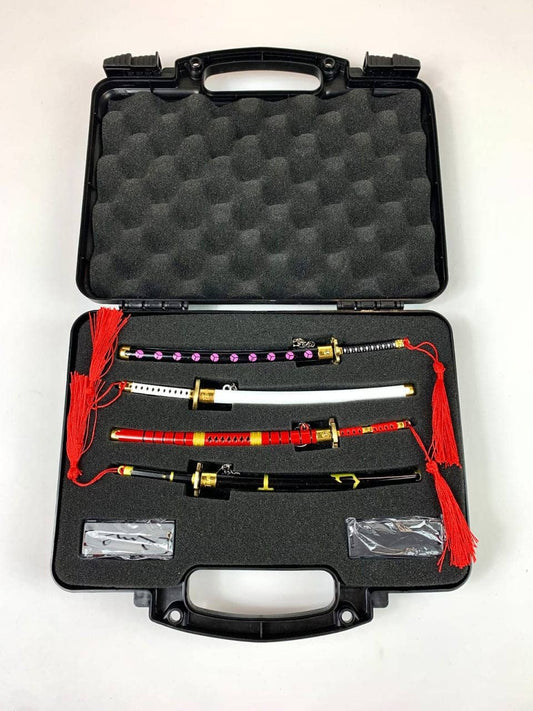
Would you like to have your own training weapons ? Don't hesitate to check out the link.

