América
Astronomical Knowledge of the Mayans: Predictions, Calculations, and Meanings
Systematic Sky ObservationThe Mayan civilization, which flourished from approximately 2000 BCE to the 16th century, d...




Few weapons in history have generated as much terminological confusion and simultaneous fascination. "Scimitar" is actually a Western umbrella term that encompasses several types of curved Islamic swords — the...
The scimitar is a single-edged, curved-blade sword originating in the Middle East, developed between the 9th and 11th centuries from the sabers of Turkish and Mongolian tribes in Central Asia. Its forward-curving blade, light weight (800–1,400 g), and length of 75 to 100 cm made it the weapon of choice for Islamic cavalry for over eight centuries. Few weapons have generated so much terminological confusion and fascination in equal measure. At Espadas y Más you can see our complete collection of scimitars right now, with decorative and functional pieces made of steel. "Scimitar" is actually a Western term that encompasses several types of curved Islamic swords—the Persian shamshir, the Ottoman kilij, the Arab saif, the Indian tulwar—which share design philosophy but have distinct technical characteristics. This guide accurately distinguishes them, reviews their history, and explains why they remain benchmark pieces for collectors in Spain and worldwide. What exactly is a scimitar? Technical definition The term "scimitar" comes from the Italian scimitarra, which in turn possibly derives from the Persian shamshir ("lion's claw") or the Turkish şimşir. In the West, it was used as a generic term for any curved sword from the Islamic world, which led to a historical inaccuracy that persists today. Technically, a scimitar is defined by these five characteristics: Curved blade: pronounced curvature towards the edge, designed to maximize cutting in motion rather than thrusting Single edge: sharpened exclusively on the convex side of the curve (the outer side) Tapered blade: narrower at the base and wider towards the tip in some models, or uniformly narrow in others Simple guard: small or S-shaped crossguard that does not hinder the rider's movement Edge-oriented balance: the center of gravity is closer to the tip than in straight European swords The key to its effectiveness is not in the force of the blow but in the slicing cut: when the curved blade impacts a target, the curvature causes the edge to "slide" forward as it advances, multiplying the length of the cut without needing to increase force. This principle made it ideal for riders who launched arcing blows from a moving mount. Origin and history: from the steppes of Central Asia to the Ottoman Empire Origin in Central Asia (7th–9th centuries) The curved blade design did not originate in Persia or the Arab world: its origin lies with the Turkic and Mongol tribes of the Central Asian steppes, who needed a weapon that could be drawn, struck, and re-sheathed from horseback at a gallop without getting stuck. Straight swords of Roman or pre-Islamic Persian tradition were too long and rigid for this use. Nomads of the steppes—Huns, Turks, Avars—developed progressively more curved swords from the 7th century, which traveled south and west through conquest routes. Persian perfection (9th–12th centuries) When the Seljuk Turks penetrated Persia during the 11th century, they brought the curved blade design with them. Persian blacksmiths—the best metallurgists of the medieval Islamic world—refined the design to create the classic shamshir: an extremely curved blade (up to 30° curvature), thin, made of Damascus or wootz steel, with an edge capable of cutting silk in the air. The Persian shamshir influenced all subsequent variants. Imperial expansion (13th–17th centuries) The Mongol, Timurid, Ottoman, and Mughal empires adopted and adapted the curved sword according to their traditions and tactical needs. The Ottoman Empire developed the kilij, with its characteristic widening in the upper third of the blade (yelman). Arab warriors used the saif. In the Indian subcontinent, the tulwar flourished. Each variant was the response of a distinct martial tradition to the same problem: mounted combat. The Crusades and the scimitar in the Western imagination (11th–13th centuries) It was during the Crusades that Europeans extensively encountered Islamic curved swords. Crusaders—accustomed to straight, one-and-a-half or double-edged swords—found themselves facing adversaries wielding completely different weapons. The scimitar entered the European imagination as a symbol of the Saracen warrior: exotic, fast, and dangerous. This perception survived in European literature, art, and heraldry for centuries. Decline and legacy (18th–19th centuries) The widespread adoption of firearms during the 17th and 18th centuries progressively reduced the importance of all bladed weapons on the battlefield, including scimitars. However, they continued to be ceremonial weapons and symbols of power in the Islamic world until the 19th century. The Ottoman sultan wore a kilij in official ceremonies; Persian nobles commissioned shamshirs with jade and jewel-encrusted hilts as status symbols. Today they are museum pieces, collector's items, and historical recreations. The 5 main types of scimitar Type Origin Main Period Curvature Distinctive Feature Shamshir Persia (Iran) 9th–19th centuries High (25–30°) Very narrow and extremely curved blade. The "pure" scimitar by definition. Only effective for cutting; practically useless for thrusting. Kilij Ottoman Empire (Turkey) 13th–19th centuries Medium-high Blade widens in the upper third (yelman), creating a heavier and more lethal striking area. Heavy combat version of the scimitar. Saif Arabian Peninsula 7th–19th centuries Variable (low to medium) More diverse design depending on region. Some are almost straight at the base and only curve at the tip. The oldest in the family. Tulwar Indian subcontinent 15th–19th centuries Medium Characteristic hilt with a disc pommel and enveloping knuckle guard. Indian adaptation of the shamshir with Mughal influences. Pulwar / Pulouar Afghanistan, Eastern Persia 17th–19th centuries Medium Similar to the tulwar but with a narrower blade and more pronounced curvature. Regional variant of the Persian-Indian corridor. Scimitar vs. other curved swords: the definitive comparative table Confusion between the scimitar and other curved swords is common. This table resolves the key differences once and for all: Sword Cultural Origin Curvature Length Edges Key Difference Scimitar (shamshir) Perso-Islamic High 75–100 cm Single (outer) Designed exclusively for slicing cuts from horseback. Useless for thrusting due to its extreme curvature. Falcata Arab / Mediterranean Low-medium (only in the final third) 55–80 cm Single Shorter than the scimitar. The curve is only in the upper third, more like a long machete. Used in the Iberian Peninsula during the Reconquista. European saber Central Europe (Hungarian-Polish) Medium 80–95 cm Single with false edge at the tip Influenced by the scimitar but adapted for both foot and mounted combat. More elaborate guard. Originated with the Polish and Hungarian hussars in the 17th century. Japanese Katana Japan Low-medium 60–80 cm Single (convex) Much less curvature. The design prioritizes cutting precision in foot combat and quick drawing (iaido), not mounted combat in an arc. Iberian Falcata Iberian Peninsula (pre-Roman) Medium (reverse — curves inward) 45–65 cm Single (inner curve) The curve is inverse to the scimitar: the edge is on the concave side, not the convex. Unique design for downward axe-like blows. Scimitar vs. straight European sword Medieval Europe None 70–120 cm Double Straight European swords prioritize thrusting (stabbing) and percussive cutting. The scimitar cannot make effective thrusts; straight swords cannot make the slicing cut of the scimitar. Want to see the difference between scimitars and Arab swords in our collection? At Espadas y Más you will find all variants of Arab and Eastern swords: shamshirs, kilijis, saifs, and alfanjes, from decorative pieces to functional models forged in steel. Shipping in 24-48h throughout Spain. Historical figures who used the scimitar Saladin (1137–1193) — The Sultan of the Third Crusade Saladin (Salah ad-Din Yusuf ibn Ayyub), founder of the Ayyubid dynasty and Sultan of Egypt and Syria, is the historical figure most associated with the scimitar in the Western imagination. His victory at the Battle of Hattin (1187), which resulted in the reconquest of Jerusalem for Islam, became the most potent symbol of the scimitar-wielding warrior against the European knight with his straight sword. Tradition says that Saladin used a Damascus steel shamshir capable of cutting a silk scarf thrown into the air. Richard I of England and Saladin never met in direct combat, but the image of their duel—the straight sword versus the curved—defined the imagery of the Crusades. Tamerlane (1336–1405) — The conqueror of three continents Timur (known in the West as Tamerlane), founder of the Timurid Empire, led one of the most devastating conquest campaigns in history: from Samarkand to India, Persia, the Caucasus, and the heart of the Ottoman Empire. His armies were masters of using the curved saber on horseback—a direct inheritance of the Mongol tradition—and the scimitar was the standard weapon of his elite cavalry, the ghulam. The defeat of the Ottoman Sultan Bayezid I at the Battle of Ankara (1402) at the hands of Tamerlane is one of the most dramatic episodes of the medieval Islamic world, with two scimitar traditions—Timurid and Ottoman—pitted against each other. Suleiman the Magnificent (1494–1566) — The Ottoman apogee Sultan Suleiman I, during whose reign the Ottoman Empire reached its greatest geographical and cultural extent, made the kilij an imperial symbol. His ceremonial kilijis—preserved today in the Topkapi Palace Museum in Istanbul—are masterpieces of Islamic goldsmithing: Damascus steel blades with gold inlays, ivory and ruby hilts, and leather scabbards with silver applications. Suleiman's kilij was not a weapon of combat but an object of power that communicated the authority of the caliphate. Nadir Shah (1688–1747) — The last great Persian conqueror Nadir Shah, founder of the Afsharid dynasty and one of the most brilliant military leaders of the 18th century, led the Persian shamshir to its last great military victories. His conquest of Delhi in 1739 and the sacking of the Mughal Empire—including the capture of the Peacock Throne, valued at tens of millions of gold pounds—was carried out by an army whose cavalry used the shamshir as its primary weapon. Nadir Shah is the last great conqueror who combined the massive use of the scimitar with modern artillery, merging the ancient and the new. Abbas the Great (1571–1629) — The Shah who modernized Persia The Safavid Shah Abbas I transformed Persia into a modern military power without abandoning the shamshir. His elite Persian guards—the qizilbash—used wootz steel shamshirs made in the best forges of Isfahan, considered the finest swords in the world at the time. "Damascus steel" or "wootz steel" (also called Khorasan steel or pulwār steel) which characterized the best Persian scimitars was for centuries the most advanced material in metallurgy in the world, with a characteristic wavy pattern impossible to replicate in Europe until the 19th century. The scimitar in popular culture and collecting The scimitar has had a constant presence in Western popular culture since the 19th century: Literature: One Thousand and One Nights presented the scimitar as the weapon of Sinbad, Ali Baba, and the desert genies. Lord Byron mentioned it in his Orientalist poems. Video games: Appears in Age of Empires (Arab units), Assassin's Creed (various titles), Dark Souls, and practically all RPGs with an Oriental or medieval setting. Cinema: Aladdin (Disney), Prince of Persia, Ray Harryhausen's Sinbad films, and dozens of adventure film productions. Heraldry: The scimitar appears in the coats of arms of several countries and regions, including Algeria (whose flag includes a star and crescent on a green background, with heraldic scimitars in its military versions). Collecting: Historical scimitars from the 16th–18th centuries in good condition fetch prices from 5,000€ to over 100,000€ at international auctions. Quality replicas are the most sought-after oriental pieces in the Spanish collecting market. At Espadas y Más, you will find our selection of collectible and functional scimitars, including models from Hanwei and Condor Tool & Knife, global leaders in quality historical replicas. You can also explore the complete universe of Arab and Eastern swords—saifs, alfanjes, kilijis, and tulwars—with 24-48h shipping throughout Spain and free shipping for orders over 60€. How to choose a scimitar for your collection If you are thinking of adding a scimitar to your collection, these are the key factors depending on its use: For decoration and display A stainless steel scimitar with a leather scabbard and engraved finishes is sufficient. Look for pieces with authentic curvature (not straight imitations), an S-shaped guard hilt, and a blade length between 75 and 85 cm. Indicative price: 60€–200€. For quality historical collection The standard is 1075 or 1080 high-carbon steel with heat treatment, a hand-stitched leather scabbard with a metal chape, and a distinctive bulbous pommel. Reference brands are Hanwei (model HN-SH2354, based on an 18th-century Persian shamshir) and Condor Tool & Knife (model CTK-61301 Sinbad). Price: 150€–400€. For historical reenactment and Eastern HEMA You need a functional carbon steel scimitar with differential tempering, authentic balance, and an edge that can be maintained. Serious options in this segment start from 250€ and can reach 800€+ for artisanal pieces based on museum originals. ⚔️ View scimitar collection at Espadas y Más → Frequently asked questions about the scimitar What is a scimitar? A scimitar is a curved-blade, single-edged sword originating in the Middle East, developed between the 9th and 11th centuries. The Western term encompasses various types of curved Islamic swords: the Persian shamshir, the Ottoman kilij, the Arab saif, and the Indian tulwar. All share a blade curved towards the outer edge, light weight, and a design optimized for mounted combat. What is the difference between a scimitar and a falchion? The scimitar (shamshir) has a high and continuous curve along the entire blade, designed for slicing cuts from horseback. The falchion has an almost straight blade for most of its length and only curves in the upper third, is shorter (55–80 cm versus 75–100 cm for the scimitar), and was more common in the Western Mediterranean, including the Iberian Peninsula during the Reconquista. Why is the scimitar curved? The scimitar's curvature is a response to the physics of mounted combat. When a galloping rider strikes with a straight sword, the weapon tends to embed itself in the target, stopping the movement. With a curved blade, the edge "slides" forward upon impact, executing a slicing cut that does not hinder the rider's speed. The curvature also allows the weapon to be drawn more quickly from the saddle. Who used the scimitar historically? The scimitar was used by the main empires and armies of the Islamic world: the Abbasid Caliphate, the Seljuk sultans, the Ottoman Empire, the Safavid Persians, and the Mughals in India. Among its most famous wielders are Saladin, Tamerlane, Suleiman the Magnificent, and Nader Shah. It was also adopted by some European armies under Ottoman influence, especially the Polish and Hungarian hussars. Is it legal to buy a scimitar in Spain? Yes, decorative and collectible scimitars are completely legal in Spain for adults. They can be owned in a private home without any additional formalities. Functional, sharp scimitars are subject to the general regulations for bladed weapons and cannot be carried in public. At Espadas y Más, all purchases of functional models require age verification.
Read moreWelcome to an article about Swords and More. We hope you are all well. Today we want to tell you about a topic that we are sure you will find interesting, specifically, we are going to... Compare the Japanese katana with the medieval sword! KATANA VS MEDIEVAL SWORD Both the katana and the medieval sword are great weapons used in warfare throughout the history of the nations of the world. Below we will compare the most important technical aspects of both weapons. Balance and Maneuverability: -Katana: Its balance is delicate, allowing for quick and precise movements. Skilled blacksmiths achieve a distribution of mass that guarantees stability in each blow. -Medieval Sword: It can vary in balance depending on the specific design, but it is usually heavier and less agile than the katana. Check out this medieval carbon steel sword Percussion Center: -Katana: It has a “sweet spot” along the blade for powerful blows with minimal vibration and recoil. -Medieval Sword: The point of impact can vary depending on the design, but is rarely optimized in the same way as in the katana. Check out this Witch King's Sword from Lord of the Rings Blade Geometry: -Katana: The curvature of the blade (sori) concentrates the force along the edge, improving cutting ability and reducing resistance. -Medieval Sword: It can have a straight or slightly curved blade, but it does not focus as much on optimizing the geometry for cutting. I love this medieval German sword! Materials: -Katana: Traditionally forged with tamahagane, a steel cast from iron sand, known for its purity and strength. -Medieval Sword: Made with various types of steel, often less refined than tamahagane. Check out this cool Kill Bill Katana with display stand and accessories! Metallurgical Techniques: -Katana: Modern swordsmiths employ a wide range of high-quality steels and alloys, optimizing strength, durability and flexibility. -Medieval Sword : It depended largely on the techniques available at the time and region, which influenced the quality and characteristics of the steel used. This One Piece Wado Ichimonji Katana is amazing! Both weapons were important in their historical and cultural context, and for collectors and practitioners of Japanese or European martial arts (HEMA), we have the best products available, but what do you think is the best option, a katana or a medieval sword? Tell us!
Read moreWelcome to a new article from Swords and More. Today we bring you a very special article, We will compare Damascus Steel with Toledo Steel! Damascus Steel VS Toledo Steel Both types of steel are of exceptional quality and highly regarded for their track record and reliability. However, despite these common points, there are a number of differences that we cannot fail to mention: Check out our Damascus Steel collection Damascus Steel: -Damascus steel is easily recognizable by its unique pattern of bands and veins, evoking the fluidity of water. -It is thought that this steel art was born somewhere between India and the Middle East, although it is considered that its origin could also be in present-day North Macedonia. I love this functional Aragorn's Strider sword! -Hardness and wear resistance are the trademarks of Damascus steel. -The magic behind this steel lies in its manufacturing technique, which involves forging and folding multiple layers of steel over and over again, thus creating a blade that is not only strong, but also beautifully ornate. Check out our collection of Toledo Swords! Toledo Steel: -Originally from the historic city of Toledo in Spain, this steel is known for its unmatched hardness. Toledo has been a bastion of sword forging and metal craftsmanship since the days of the Roman Empire. -High quality alloy is the hallmark of Toledo steel. This sword stroke by James I is spectacular -The Toledo technique was unique: a steel blade surrounded by a wrought iron band, which added extra protection that prevented the steel from bending or cracking. -Weapons made from Toledo steel were renowned for their strength and durability, and were said to have a "soul of iron." And what steel do you like the most?
Read moreWelcome to a new article from Swords and More. Yesterday we talked about Arab swords, and we hope you liked the post. Today we want to continue with the story but go to a different topic. We are going to talk about... Viking axes! TYPES OF VIKING AXES Viking axes were a symbol of the strength and skill of Norse warriors during the Viking Age. While they all share a basic shape, not all axes were created equal; each had its own purpose: Hand axe: Also known as the “one-axe” or “single-edged axe,” this was the most common axe among the Vikings . This type of axe was versatile and effective, ideal for disarming shields and neutralizing enemies in a single blow. The Norman axe is one of the most popular, with its approximately one-meter-long handle and distinctive edge on the blade. Look at this spectacular axe! Broad axe or breiðöx : Recognizable by its interesting, wide and robust design. Used mainly in the 10th and 11th centuries. It was used with both hands. Mammen axe-style battle axe: This axe had an elongated head and short cutting edge, making it handy and possibly suitable for throwing, resembling a tomahawk. Check out this cool Viking axe! Bearded axe or skeggöx: It was characterized by its short handle, which made it useful for use with one hand, and it was a war axe that is not clear whether it was exclusively used in Nordic culture, although examples have appeared on the island of Gotland. Check out this Gotland Bearded Axe! Horned axe or snaghyrnd öx: Another distinctive Viking axe design that was used mostly in the 10th and 13th centuries, possibly popular in medieval Iceland. According to the few descriptions we have from the sagas, it would have been accompanied by a pair of sharpened points, which could suggest its use as a kind of spear. Danish Axe: A type of Viking axe with a large, wide but thin blade, designed to be wielded with two hands, famous for the terror it created during Norse raids on the various European kingdoms. Does this sound familiar? Check out this Ragnar axe from Vikings In addition to their role in warfare, many of these axes were also indispensable tools in daily life, used for building ships, carts, and houses. They could also be beautifully decorated with detailed engravings and ornaments, making them incredible historical pieces. Did you like it? What do you think of Viking axes? Which one do you find most interesting? Tell us!
Read moreWelcome to a new article from Swords and More. We know that many of you are interested in the history of weapons from around the world, and today we will specifically talk about the different types of... Arabic swords! Types of Arabic swords Below we will tell you about the most important and historically notable types of Arab swords. Scimitar: This sword, known in the West as the Muslim curved sabre, is light, sharp, with a single edge and a protective metal hilt. Its long, curved blade was designed for thrusting and for stabbing deeply, making the blade cut but follow its trajectory. Its origins are in Persia, although it was also used in India during the 13th and 14th centuries. The peculiarity of its curve is that when attacking from horseback the blade does not embed itself in the opponent and cuts following the trajectory of the rider's blow. Check out this spectacular Scimitar made in Toledo! Kabila: The Kabila is a sword with a curved blade. It has the design of the hilt like the Jineta Nazarí sword and the blade like that of a scimitar sword. It is similar to a gumia but longer. The jineta sword was an innovative war weapon for the Muslim cavalry. It was very elaborate in its manufacture, so the nobles and Christian warriors of the Spanish reconquest adapted it and began to manufacture it in Toledo between the 14th and 15th centuries. This sword is amazing! Jineta : Well known as a Nasrid sword, introduced in Al-Andalus, it was a type of straight sword, double-edged with a channel up to the middle, with a bony hilt and a rounded pommel. It was one-handed, and its rounded hilts fell towards the blade leaving a minimum space between them. But without a doubt, its most important characteristic was the magnificent workmanship and quality of the materials with which the hilts were made. A quality Arab knife The scimitar: The scimitar is an important Arab weapon, single-edged and one-handed, short, curved in its last third, wider than the scimitar, sometimes grooved, and used for cutting. During the Middle Ages and until the Renaissance it was used in the Iberian Peninsula, much of the Mediterranean and especially in Italy. A stunning Arabian cutlass for your collection! And you, what do you think? Do you like these sword models?
Read moreWelcome to a new article from Swords and more. Today we will talk about the best and most famous Toledo Steel Swords! But first... What is Toledo Steel? Toledo steel, originally from the city of Toledo in Spain, is a variety of steel that was very popular during the Spanish Empire for the manufacture of weapons of war, especially swords. Look at this Sword of the Catholic Monarchs made of Toledo Steel! The manufacture of Toledo steel involved an alloy of iron and steel, resulting in a steel with uniform distribution. This alloy was more flexible than others, making it stronger and more manageable. Over the centuries, sword making in Toledo declined, until the Toledo Weapons Factory was created in 1761 with the intention of recovering the splendor of the city's weapon making. Short weapons were made only from steel, while long weapons were made with an iron core covered with two steel plates. What a great Robin Hood sword, don't miss it! Sounds interesting, right? Well, it's time to tell you which are the best Toledo Swords we have for you ;) The best swords of Toledo The best swords from Toledo are those that are handcrafted, maintaining the tradition and quality that have made Toledo steel famous. One of the best brands we can find is Marto. This brand offers you high-quality items in our store, such as this spectacular Templar sword. On the other hand, we also have within the same brand this sword that we talked about at the beginning , the one we mentioned from the Catholic Monarchs, and we are sure that it will be an incredible option for those of you looking for a Toledan option. You liked it, right? Of course you did. Both are very good options, and if you have any questions you can ask us or take a look at our collection of swords and products from Marto . But first we want to give you some advice before buying a Toledo sword. Tips for buying a Toledo Sword To buy the correct Toledo Sword you should take into account the following: Authenticity: Make sure the sword is authentic and has been made in Toledo, known for its long tradition of making high quality swords. Material: Toledo swords are famous for their steel. Check that the sword is made of this material. Craftsmanship: Toledo swords are known for their elaborate craftsmanship. If you can, look for swords that have been hand forged and tempered. History and Design : Toledo swords come in a variety of historical and cultural designs. You can choose from Roman, Oriental, Historical and Templar swords. Promotions: Some stores offer promotions that are worth taking into account, as is our case, don't miss them, they can be very useful to you. And what do you think about Toledo Steel? Tell us! ;)
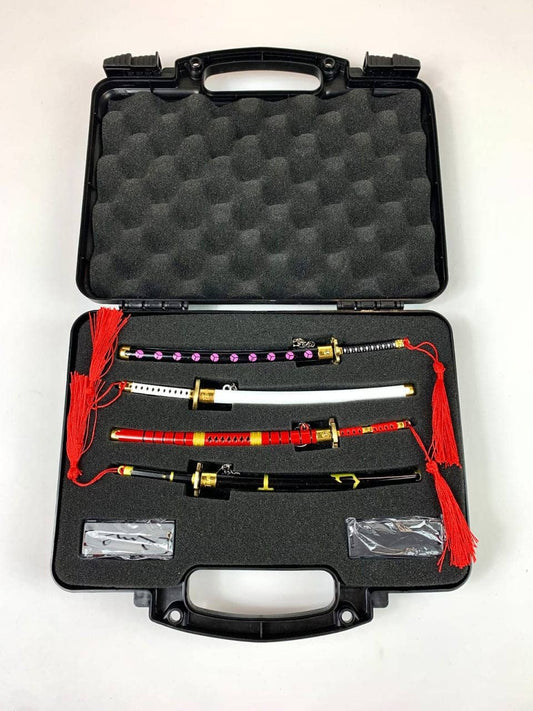
Read moreWelcome to a new article about Swords and More. Today we show you the best One Piece katanas. The most famous and high-quality ones available in our store , and we tell you about the history of each one! WADO ICHIMONJI KATANA One of the most famous swords in the series and one that Zoro values highly since it belonged to Kuina and her family. It is white with a circular guard. In Zoro's words, if Wado Ichimonji had a human appearance she would be a "kind and innocent woman." See the high-end decorative version! It is one of the 33 best edged weapons in the world, highly resistant, as it resisted the blow of Mihawk's Yoru. It was forged by Shimotsuki Kozaburo and is the only original sword that Zoro still keeps since it appeared in the anime. See the working version! KATANA ENMA Enma is a katana that was once wielded by Kozuki Oden. After Oden's death, it was given to his daughter Kozuki Hiyori who passed it on to Roronoa Zoro. It is a powerful weapon that was able to injure Kaido. The Enma katana has a clover-shaped tsuba and a dark sheath with a black tsuka decorated with a flower design. It has incredible cutting capabilities. See the decorative version with bamboo leaf When wielded by Oden it cleanly destroyed the Mountain God in one slash. It is also powerful enough to clash with one of the Saijo O Wazamono Murakumogiri, and also damage Kaido. Check out the working version! KATANA SANDAI KITETSU This katana is a spectacular Wazamono and like the other Kitetsu swords is cursed. It was forged by Kozuki Sukiyaki. This sword was found in a barrel of katanas in a shop in Loguetown by Tashigi. It is curved with a white edge and blue hamon. The tsuba is gold in the shape of a cross paté with a reddish brown hilt and a dark red scabbard. Check out the decorative version of the Sandai Kitetsu! The Sandai Kitetsu katana has a sharp cutting edge. When Zoro first used it the blade however passed through without harming Zoro but making a huge cut in the ground and the sword is considered to have a certain consciousness of its own. Check out the functional version of the Sandai Kitetsu What do you think of One Piece's katanas and their history? Tell us! At Espadas y más we are always eager to know your opinion
Read moreWelcome to a new article on Swords and More. Today, we want to be useful to all those customers who really want to buy a katana but don't know where to start. We tell you everything you need to know to make the right purchase! Which katana should I buy? The first thing you need to decide is whether you want an authentic Japanese katana (Shinken) or a decorative one (Iaito or unsharpened Shinken). Shinken are sharp swords and are designed for cutting, while Iaito and unsharpened Shinken are for practice or display. (Keep in mind that traditionally Shinken were real katanas that came from Japan, made by a craftsman etc. However, due to the increase in the market in recent years, any sharp katana has come to be called Shinken, at least in non-specific environments. This terminology is the one we will use in this post, for the sake of simplicity.) Sharp Katanas (Shinken) If you want to buy a sharp katana, designed for cutting, you have different price ranges and models. Some belong to famous television series or movies like this katana , while others are designed in a more traditional way like this model that we show you below. Choose the one that best suits what you are looking for and the use you are going to give it, whether for the mere pleasure of having it at home or in your dojo or for the practice of cutting with soft objects, tameshigiri, etc. It is important that you like it, since it will be with you for a long time. (If you want a sharpened model but prefer it unsharpened, contact us, we can do it) Dull Katanas (Iaito) Usually, blunt katanas are called iaito. Within this wide range of katanas, you can opt for a proper iaito, for the practice of Iaido , (like this spectacular model) or a more decorative katana, which you may like, but is not functional like the one we show you below. Any option is good, since they are all high-quality katanas, within the scope for which they are designed, and there are even customers who look for a katana that does not have a steel blade, but rather a bamboo one, for aesthetic reasons, comfort, or even safety, such as this model . At Espadas y más we are here to help you, do not hesitate to contact us so we can resolve your doubts, whether it is about which katana to choose or any other question related to the store!
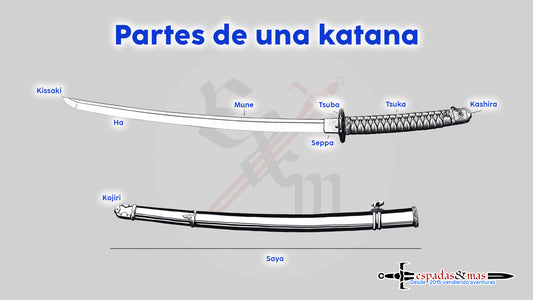
Read moreWelcome to a new article from Espadas Y Más. Today we bring you a very special post, which we are sure will be of interest to you. We are going to tell you what the parts of a katana are! Parts of a katana As you know, the katana is one of the most famous Japanese swords in history. Below we tell you the parts into which it is divided! Check out this spectacular katana for iaido! Ho (刃): This is the blade of the katana and is made primarily of steel. The blade has one sharp side and one dull side. Mune (棟): This is the back or spine of the blade. It can have different shapes, such as a diamond-shaped or round mune. Kissaki (切先): This is the sharp tip of the blade. The shape of the kissaki can vary, the most common being the chu-kissaki (half point) and the o-kissaki (large point). Ha (刃): This is the edge of the blade, which is what cuts. The ha must be extremely sharp to be effective in combat. Boshi (鋩子): This is the tip of the blade, near the kissaki. The shape and design of the boshi can vary and are distinctive features of each sword. Nakago (中心): This is the tang or unsharpened part of the blade that extends into the handle (tsuka). The nakago has inscriptions that provide information about the smith, the date of manufacture, and other characteristics of the sword. Check out this Katana Wado Ichimonji from One Piece! Tsuba (鍔): It is the sword's hand guard, designed to protect the wielder's hand from the opponent's attacks. Tsuka (柄): This is the handle of the katana. It is usually made of wood and wrapped with leather and cord to provide a comfortable and secure grip. Menuki (目貫): These are ornaments or decorations found on both sides of the handle, below the grip cord (tsuka-ito). Menuki can be of different shapes and represent traditional or symbolic themes. Did you like it but prefer the bamboo one? Same (鮫): This is sharkskin or similar material used to wrap the handle under the grip cord. It provides a non-slip surface and improves the aesthetics of the handle. Ito (糸): This is the cotton or silk cord used to wrap the handle over the shark skin. The ito not only serves as a decorative element but also provides additional grip. Kashira (頭): It is the end of the handle (tsuka) that serves as a counterweight and is firmly attached to the end of the handle. Fuchi (縁): This is the collar or ring that is placed at the base of the handle, near the hand guard (tsuba), to secure the tsuka-ito in place. Saya (鞘): It is the sheath or cover of the katana, generally made of wood and lacquered to protect the blade when not in use. Any questions? Check out our katana shop directly! Koiguchi (鯉口): This is the mouth of the saya, where the blade of the katana is inserted. The koiguchi is usually made of metal or a reinforced piece of wood. Kojiri (鐺): This is the end of the saya, opposite the koiguchi. The kojiri can be made of metal or other materials and has a decorative and protective function. We hope you enjoyed it and find it useful in learning the parts of a katana, either at a basic level or in detail!
Read more