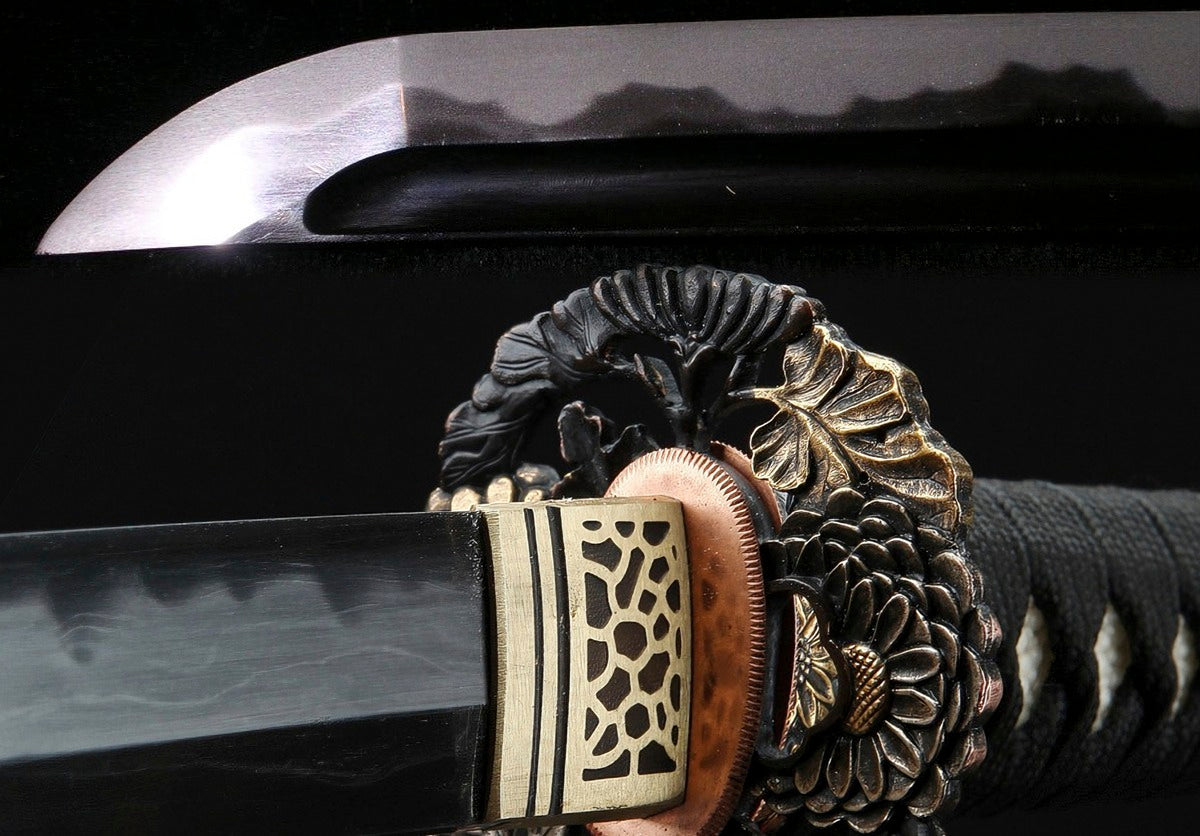






In the vast and mysterious, millennia-old tradition of katanas, revered Japanese swords, each name is much more than a simple label, encapsulating stories of heroes, legends, and masterful craftsmanship, becoming tales woven with threads of honor, tradition, and power.
Some are named after their forgers, a tribute to the mastery of the artisans who shaped each blade with pinpoint precision and unparalleled passion. Others evoke their unique characteristics, such as the curvature of a blade or a steel pattern that dazzles with its timeless beauty.
These are names that bring to life the very essence of each sword, revealing its uniqueness and the skill behind it, inspiring respect and admiration, transmitting the legacy of bygone eras through sharpened steel.
Like each name, each katana is unique; a fragment of Japan's rich culture, where tradition is intertwined with legend and skill. These swords are not just weapons, but symbols of a tradition that transcends time and space, keeping alive the flame of dedication and honor.
It is their names that help to imprint them in the memories of thousands, leaving a lasting mark. In each story told through the centuries, we find a legacy of emotion, respect, and admiration, which continues to bear silent witness to a glorious past and a present of mystery and charm.

Katanas, especially those of great historical or artistic value, often have specific names.
Here you can discover their names and what some of them mean. However, it's important to note that these "categories" are not mutually exclusive, nor do they reflect the true complexity of these concepts.
Named after Historical Figures
Some are named after people, given to them for historical or cultural reasons, and are usually associated either with the blacksmiths who forged them, in recognition of their good work, or with important figures in Japanese history who owned or used them.
Examples:
Honjo Masamune is named after its creator, Masamune Goro, a renowned blacksmith in Japanese history, and one of its owners, Shigenaga Honjo, associating the mastery of the forger, recognized as one of his finest creations, with the history of its wearer.
Tachiwaki , another famous katana renowned for its exceptional craftsmanship, named after its creator.

Named by Features
They can also be named based on some of their characteristics, from visual aesthetics to their qualities.
Example:
Kogarasu Maru , considered a masterpiece of Japanese forging, is characterized by its short blade and distinctive curvature. It is said that its name comes from Karasabi, which may be due to its similarity to a Korean sword, Kara being "Korea" and sabi , by its etymological origin, "sharp tool", or because akara-sami means "bright and shiny blade", becoming karasabi , abbreviated karasa , and karasu over time, adding the syllable ko to obtain kogarasa , "small shiny blade".
Named for Historical Events and Legends
Other katanas have names related to historical events or legends. For example, a sword used by a famous samurai or in a significant battle may bear the name of that person or event.
Examples:
Kusanagi noTsurugi . Originally known as Ama no Murakumo no Tsurugi, "Heavenly Sword of the Gathering Clouds", it was more commonly known as Kusanagi-no-Tsurugi, "Grass-Cuttering Sword" due to a legend where Prince Yamato Takeru, while on a hunting expedition, was trapped by a warlord who set fire to the grassland and killed his horse to prevent him from escaping. Takeru used the sword Ama no Murakumo no Tsurugi to cut the grass, reducing the fuel for the fire, and in doing so, discovered that the sword could control the wind, using it to direct the flames towards the warlord and his men, defeating them. In honor of this victory, Takeru renamed the sword.
Dojigiri , forged by the famous blacksmith Hoki Yasutsuna, is now in the Tokyo National Museum after passing through several clans. Minamoto Yorimitsu is said to have slain the monster Shuten Doji with it; hence its name, which means Doji cutter.
Juzumaru , forged by Aoe Tsunetsugu, is located at the Honkoji temple in Amagasaki, after belonging to the prophet monk Nichiren and the Kounji temple. It is said that Nichiren adorned the katana with a rosary to ward off evil spirits, hence its name, which means "rosary."

Named by Tradition
In Japanese culture, the act of naming a katana can be related to rituals or traditions. For example, it may be given an auspicious or meaningful name to symbolize hope for victory or protection.
Of Eras or Schools
There are different schools of forging in Japan, each with its own techniques and styles. Katanas can be named after or after the schools they belong to.
Compound Nouns
While we have mentioned some ways in which katana names can be superficially classified, many times these names can cover more than one category, or more than one motif.
Example:
Honjo Masamune , named after two different historical figures related to her.
Mikazuki Munechika , created by Sanjo Munechika, a renowned blacksmith at the imperial court during the Heian period, famous for his ability to create katanas that were as efficient in combat as they were stunningly beautiful. He was so fond of the sword that he named it after himself, along with the term mikazuki , which means "crescent moon," because the marks left in the metal during the tempering process resembled crescent moons.

Each name, each story, is a fragment of the rich Japanese culture, and while we have tried to simplify this tradition of naming them here, grouping the reasons why their respective names are selected in a broad and generic way, it is necessary to keep in mind that this choice always has a profound value and meaning, both for those who baptized them and for the sword itself, which was granted greater depth, comparable to granting it a spirit of its own in such an act.
Would you like to know the katanas in our store ?