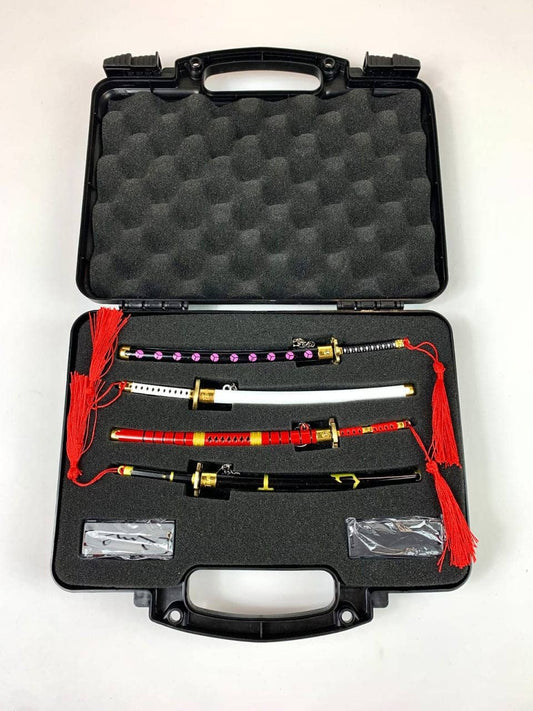


The Daishō
In the fascinating world of katanas, one of the most emblematic practices is the use of the daishō, a pair of Japanese swords usually composed of the katana and the wakizashi, which is its most commonly known form, although it has also been formed by other duos of traditional Japanese swords.
The daishō embodies the elegance, duality, and tradition of the art of swordsmanship in Japan, as well as being transcendent in samurai history.
In this article, we will take a look at the historical importance of the daishō, its symbolism, and its application in combat.

Origin of the name Daishō
The daishō originated in feudal Japan, where it was primarily used by samurai as a symbol of their high social status and martial prowess. The term "daishō" literally means "large and small" and refers to the different sizes of the two swords that comprise it.
The word daishō comes from the combination of "daitō" (long sword) and "shōtō" (short sword).
Initially, it referred to the practice of carrying a katana and a wakizashi together, without necessarily being made by the same smith or having matching fittings. However, over time, the concept of daishō evolved to imply two swords with coordinated designs and decorations.
In the early days of the samurai, the tachi was paired with a tantō. Later, the katana was combined with a shorter version of itself, known as the chiisagatana.
With the rise of the katana, the wakizashi became the preferred secondary weapon of the samurai, as, according to Kanzan Satō in his book The Japanese Sword, it was ideal for indoor combat. Samurai often left their katana at the entrance of castles or palaces and kept the wakizashi with them.

History and regulation of the Daishō
The use of the daishō became popular at the end of the Muromachi period (1336-1573), although records of its existence date back to the 16th century. In 1629, an edict was issued defining the duties of the samurai and including the daishō as part of their regulation equipment. In 1683, its use was restricted exclusively to the samurai class, making it a status symbol.
Although samurai could wear decorative swords in daily life, the Tokugawa shogunate regulated their use on formal occasions, such as audiences in castles. For official events, the daishō had to have a solid black scabbard, with the hilt wrapped in white rayskin.
During the Meiji period, in 1871, the restrictions obliging samurai to carry daishō were abolished. Finally, in 1876, most of the population was prohibited from carrying swords in public, which marked the end of the daishō as a fundamental part of the samurai identity.

Symbolic meaning of the Daishō
The daishō symbolizes the duality of the samurai, combining the strength of the katana with the precision of the wakizashi. Traditionally, the katana represented the soul of the samurai, while the wakizashi symbolized their honor and loyalty. Together, these weapons embodied the balance between power and control, essential aspects of the warrior's philosophy.
Use of the Daishō in combat
The daishō was designed to offer tactical flexibility in combat. The katana, with its long, curved blade, was used for long-range attacks, while the wakizashi, shorter and less curved, was ideal for close-quarters combat and confined spaces.
According to most traditional kenjutsu schools, only one of the daishō swords was wielded in combat. However, in the 17th century, the legendary swordsman Miyamoto Musashi developed a fighting style in which both swords were wielded simultaneously. This technique, known as Niten Ichi-ryū, allowed attacking and defending with both hands, revolutionizing the swordsmanship strategies of the time.

Ritual and etiquette of the Daishō
The use of the daishō was subject to strict rules. Samurai had to handle their swords with respect and caution, avoiding unnecessary contact between the blades. Furthermore, regularly cleaning and maintaining the daishō was a sign of dedication and discipline.
Although the practice of carrying daishō has diminished over time, its influence persists in Japanese culture. Today, these sword pairs are exhibited in museums and private collections as testimonies of their historical importance. Additionally, the idea of duality and balance between power and control remains relevant in many Japanese martial arts.
The eternal magnificence of the Daishō
The daishō represents the essence of the art of the katana and embodies the spirit of the samurai. Its symbolic meaning and its application in combat are fundamental pillars of Japanese culture. Exploring the legacy of the daishō allows us to understand the richness of this ancient tradition.
Whether you are an enthusiast of Japanese martial arts or simply admire samurai culture, the daishō remains a timeless symbol that fascinates and inspires generations.