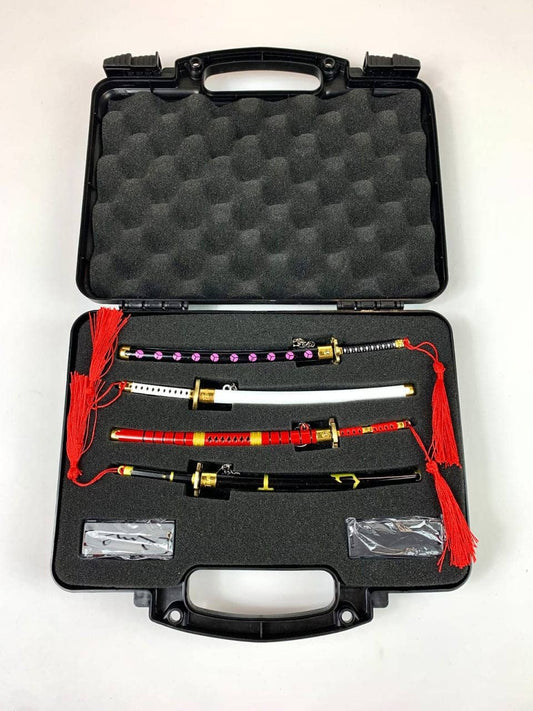


A Katana whose name transcended time
Few objects hold as much symbolism and mystery as the Katana, one of the most emblematic weapons of Japanese culture, known for its sharpness and artistic beauty.
But among them all, there is one that stands out above the rest, fascinating generations with its beauty and intricate history, and capturing the essence of the samurai spirit.
Here I invite you to delve into the history of this katana and how its name has endured through the centuries, weaving legends and shrouding its destiny in an aura of mystery.
Origin and Legend of Honjo Masamune
Its forging is said to be a work of art with more than 30,000 layers of steel, the result of a delicate process known as shita-kitae. This technique not only gives the sword strength but also endows it with a wavy hamon, which distinguishes many katanas, and is attributed to the legendary master smith Goro Masamune, one of the most celebrated smiths in Japanese history, in the 13th century, although the first records of its existence did not emerge until three centuries later.

After the Battle of Kawanakajima in 1561, General Honjo Shigenaga claimed the sword from the defeated enemy general in a duel to the death, in which his opponent split his samurai helmet in two with it. Hence its name, which merges the general's legacy with that of its forger.
Shigenaga kept the katana for years, selling it due to financial difficulties at the end of the 16th century for 13 pieces of gold to the Toyotomi clan, who ruled Japan at the time.

After their fall, it was acquired by the new shogun, coming into the possession of Tokugawa Ieyasu, a formidable warlord who, wielding it, succeeded in unifying Japan in 1603, ushering in a period of peace that would last more than 250 years.
Thus, the katana not only became a symbol of power but also a fundamental piece of Japanese history. People believed it granted supernatural powers, which made the unification of the country possible.
Honjo Masamune remained a prized dynastic relic, becoming a family treasure and symbol of the Tokugawa dynasty, passing from one shogun to another. Even after the shogunate gave way to the Meiji Restoration in 1868, the Tokugawa managed to retain it.
Declared a National Treasure in 1939, during the years of nobles and shoguns, Honjo Masamune was revered. With each generation, it was considered more than a weapon, a family legacy that resonated with the history of an entire country.
The mystery of an uncertain fate
The war in the Pacific was bloody and fierce, but in 1945 Japan faced defeat, and its surrender marked a turning point in the history of Honjo Masamune.
The American occupation decided to disarm the population. Soldiers collected all remaining Japanese katanas, causing many citizens to complain; some families even hid their most valuable katanas.
The Tokugawa clan remained intact. Over the years, they had accumulated an enormous collection of nihonto (traditional Japanese swords), with Honjo Masamune being the most important in their collection. Even so, Tokugawa Iemasa decided that it would be honorable to obey, something that was not well received by many, who saw the surrender of this katana as a betrayal of their legacy, as they considered it not an act of American protection, but a way to demoralize Japan, aware of the symbolism the katana possessed.

The last mention of its whereabouts dates back to December of the same year it was surrendered. There, the report from the Japanese Ministry suggests that it was handed over to Sergeant Coldy Biamore (or Balsamore) of the 7th US Cavalry Regiment, but he does not appear in army records. This could be a transcription error, however, it makes the sergeant's identity a mystery, and without being able to find him, there is even the possibility that it was a false name...
Furthermore, General Douglas MacArthur, in charge of the occupation, implemented reforms that affected the preservation of katanas. While some were saved and returned to Japan, many more were destroyed, taken to distant lands as trophies, or sold to collectors, increasing speculation about the fate of Honjo Masamune.
Its trace vanished into the shadows of history; however, from that moment on, mystery began to envelop it: Was it destroyed? Is it in a private collection abroad?

The story of Honjo Masamune is a strong reminder that, despite time, the greatness of a masterpiece does not disappear with it. This katana, representative of the skill of a master smith and of feudal Japan, evokes a mixture of admiration and melancholy. Its legend lives on in the hearts of those who know its name and history, reminding us of what has been lost and maintaining hope for what can still be recovered.
The most fascinating thing is that this is not the story of a magical weapon from a mythical and distant time and place. It was a real katana, in the relatively recent past. One of the world's greatest lost treasures.
Although its whereabouts remain an enigma, the history surrounding it continues to inspire generations of treasure hunters, historians, and culture lovers around the world. What would happen if the legendary sword appeared one day in a small attic in some village?
The echo of its voice still resonates, a testament to the indomitable spirit of Japan and its rich cultural heritage that needs to be preserved and celebrated.
Ultimately, it is more than an extraordinary katana; it is a symbol that tells the story of a people and their will to keep their traditions alive.
Its legend persists, showing that, in the world of swords, sometimes it is the weapon itself that becomes the true pillar of history, much more than its custodians or those who wielded it.
And you, what do you think was the fate of Honjo Masamune?
Do you believe it will reappear someday?
If you like katanas, you can take a look at the shop, here.