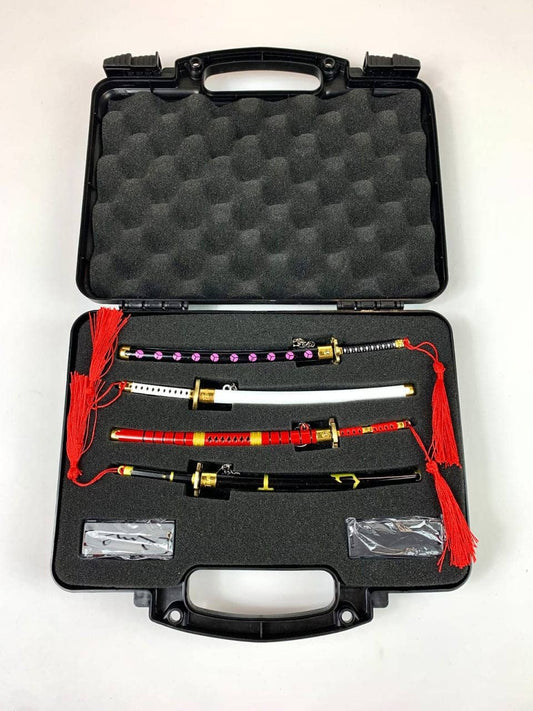


The Value of the Katana
The katana has been much more than a mere weapon: it is a symbol of honor and skill; a tradition that dates back to the samurai era in Japan.
Each sword is unique, and its veneration lies not only in its beauty but also in its functionality and the deep respect it commands. For those of you who have the privilege of owning one, it is known that its aesthetics and meaning go beyond the material; however, this possession carries great responsibility.
Proper care is an art in itself, so we invite you to discover how to keep your katana in perfect condition, ensuring both its longevity and your safety.

Katana Cleaning
To preserve the integrity of a katana, a regular cleaning routine is necessary. If it is used, it is essential to clean it immediately afterward to ensure that no traces of moisture or dirt remain that could damage the blade. Otherwise, it is recommended to do so approximately every 3 months.
It is ideal to use a katana cleaning kit to remove both old oil and any residue from the blade. You can do a superficial cleaning (of the blade only) or a deep cleaning, by disassembling the katana.
In addition, it is necessary to re-oil the blade after use and, if not used, at least once a month.
To disassemble the katana, unscrew the top part of the hammer included in the cleaning kit and use it to push the wooden (or bamboo) pegs, resting one end on them and hitting the other with the aforementioned hammer. (This tool can be replaced by a small, flat piece to prevent it from getting stuck in the peg and only pushing it, and another instrument to hit it).
Once the two pegs are removed, the hilt can be pulled off by pulling it backward while gently pushing the guard in the opposite direction, being careful not to touch or brush the blade. Then, the consecutive parts fitted after the hilt can be removed.
To clean it, if there is oil on the blade, a cloth should first be used to remove it. Then, with an Uchiko ball, a kind of small bag held with "a stick," which contains a special powder for subtle polishing and residue removal, small and gentle taps are given, holding it by the stick, along the blade, so that the powder is spread over it.
Once it has been spread over the entire blade, a sheet of rice paper (although it can be replaced by some other paper) is passed over the blade, folded on the unsharpened part, with uniform movements, always from the hilt towards the tip.
Afterward, it can be oiled. The cleaning kit usually includes a special vegetable oil, but other oils can also work, preferably those that are not extremely liquid.
A little of this is placed on a microfiber cloth and then spread over the blade, from the base to the tip, with careful movements, and can be spread from the unsharpened area towards the edge; leaving a homogeneous and not too thick layer.
To reassemble it, simply place the parts in the reverse order in which they were removed. The tang (the part that continues from the blade and fits into the handle) must be perfectly fitted to be able to insert the pegs.
Disassembling it allows you to reach the entire blade, and with the parts separated, you can check that they do not have powders or other residues; however, while it is necessary to clean it after each use and periodically for maintenance, as well as when oiling it, it is not necessary to disassemble it every time, and the relevant blade care can be done without it...
Moisture can cause oxidation, while impurities can damage the steel, which is why proper maintenance is so important. In addition, it is clearly necessary to ensure that you do not touch the edge with your hands at any time, as the natural oils from the skin can affect the sword's surface, just as a careless movement can cause deep wounds. It is advisable to always use gloves and a cotton or silk cloth.
On the other hand, the scabbard, which is usually made of wood or leather, should be cleaned with a dry cloth, avoiding chemical products that could damage the finish.

Cleaning Kit
They usually include:
Choji oil or vegetable oil.
An uchiko ball
A brass hammer
Cleaning cloths (microfiber and rice paper)
Some include spare pegs (bamboo or wooden dowels)
Location and Storage
The place where you store a katana is crucial for its preservation. Ideally, choose a spot away from direct sunlight and without abrupt temperature changes. Also avoid excessive humidity, and try to ensure the environment is not too dry, in addition to keeping it where it is not at risk of falling.
It is common to use a vertical stand to display it, or to place it on a soft surface, such as cotton cloth, to prevent scratching. If you decide to store it in its scabbard, first make sure the blade is completely dry.
It is always advisable to leave the edge facing upwards, so that if there is any excess oil on it, it drains away from the edge.
Caring for a katana is not just a duty; it is a commitment to its legacy and worth. A way to honor the history and craftsmanship behind each blade.
By following these care instructions and precautions, you not only protect your investment but also become the guardian of a cultural heritage that deserves to be preserved.
Would you like to see our functional katanas? You can do so here.
You can also find a video about sword conservation here.