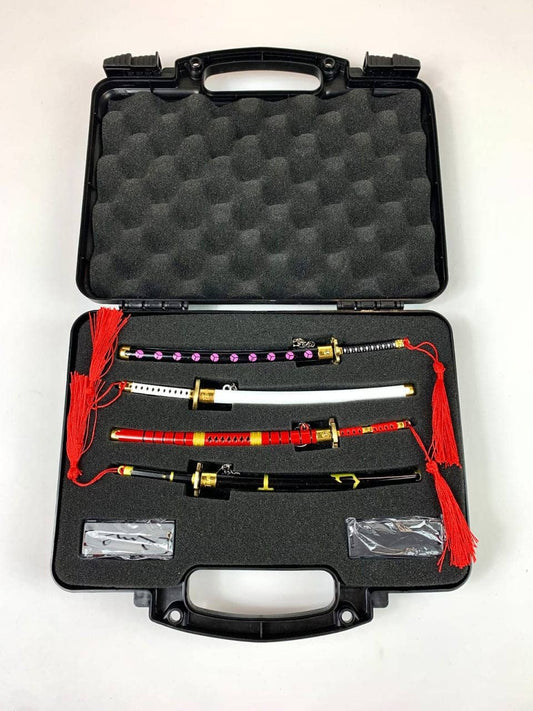


The Different Types of Swords
Swords have been fundamental weapons throughout human history, adapting to the tactical, cultural, and technological needs of each era and region.
Below, we will explore their classification according to different criteria, their distinctive characteristics, and representative historical examples.
How are swords classified?
Swords can be classified according to various criteria, such as handling, blade shape, and historical-cultural period.
Each classification allows us to better understand their evolution and use in different contexts.
Below, we will look at some of the possible classifications.

Classification by handling
One-handed swords
Designed to be used with a single hand, allowing the warrior to hold a shield or perform other actions simultaneously.
They are light and balanced, ideal for fast and agile combat.
Hand-and-a-half swords
Also known as bastard swords, these swords have an elongated hilt that allows them to be used with one or two hands.
They offer versatility in combat, combining the agility of a one-handed sword with the power of a two-handed one.
Two-handed swords
Swords of great size and weight, designed to be wielded with both hands.
They are ideal for powerful attacks and for engagements against heavily armed opponents.
Classifications by shape and design

Classification by blade curvature
Straight swords
Typical of European and Mediterranean tradition, these weapons have a straight blade, usually double-edged, making them versatile for cutting and thrusting.
Curved swords
Characteristic of Asia and the Middle East, they feature an arched blade that favors wide, fast, and fluid cuts, especially from horseback.

Classification by edge
Single-edged swords
Lighter and faster to handle, they are optimized for effective cuts without losing precision.
Double-edged swords
Designed for cutting in both directions and thrusting with greater ease, they were predominant in Europe.

Classification by point
Swords with sharp, narrow points
Ideal for thrusting, piercing armor, and precision combat, typical of Renaissance fencing.
Swords with rounded or broad points
More suitable for cutting than piercing, they were used in dynamic and cavalry combat.

Classification by length and proportion
Short swords (50–70 cm)
Compact and easy to carry, they were used in close combat and in tight formations.
Medium swords (70–100 cm)
Balanced for cutting and thrusting, they were very versatile weapons on the battlefield.
Long swords (100–140 cm or more)
Often required the use of both hands, offering great reach and cutting power.

Classification by guard and hilt design
Swords with simple guards
Incorporated a basic crossguard that protected the hand, typical of medieval Europe.
Swords with elaborate or basket guards
Featured more complex hand protections that surrounded the hand, designed for advanced fencing.
Swords without guards
With minimal hilts, they were more primitive or utilitarian, prioritizing the blade over hand defense.

Historical and cultural examples of swords
Roman gladius
A short, straight sword used by Roman legionaries.
Its design allowed for precise thrusts in close-quarters combat, being fundamental to Roman military tactics.
Japanese katana
A curved, single-edged sword, a symbol of samurai culture.
Its blade, forged with traditional techniques, is renowned for its elegance and effectiveness in combat.
Renaissance rapier
A one-handed sword with an elaborate hilt, popular in Europe during the Renaissance.
Its design allowed for both cuts and thrusts, being used in duels and for personal defense.
Scottish claymore
A large two-handed sword used by Scottish warriors.
Its wide blade and long hilt allowed for powerful attacks, making it emblematic in the Scottish Wars of Independence.
Iberian montante
A large sword used on the Iberian Peninsula during the Middle Ages.
Its length and weight made it suitable for combat against heavily armed opponents.
Viking sword
A double-edged weapon used by Norse peoples between the 8th and 11th centuries.
Balanced and sturdy, it was designed for powerful cuts and was a symbol of prestige among Viking warriors.
Persian shamshir
A curved and elegant sword, native to Persia and widespread in the Middle East.
Its thin, sharp blade made it ideal for quick cuts, and its design influenced later Islamic swords.
Indian talwar
A curved sword from India, with a distinctive circular guard.
It was used by cavalry and warriors of the Indian subcontinent, noted for its effectiveness in mounted attacks.
Chinese jian
A straight, double-edged sword, considered the "noble weapon" of China.
Used for over 2,500 years, it was associated with both combat and spiritual and philosophical practice.
Chinese dāo
A curved, single-edged sword, very popular in the Chinese military.
Known as the Chinese "saber," it was valued for its versatility and ease of use, becoming an iconic weapon in martial arts.

A sword adapted to every need
The diversity of swords throughout history reflects societies' adaptation to their combat and defense needs.
From the tight formations of Roman legions to duels of honor in Renaissance Europe, each sword tells a story of its time and culture.
Understanding these weapons allows us to appreciate not only their design and functionality but also the historical context in which they were forged.
At Espadas y más, you can find a wide variety of Swords and Katanas and much more. Don't miss out!