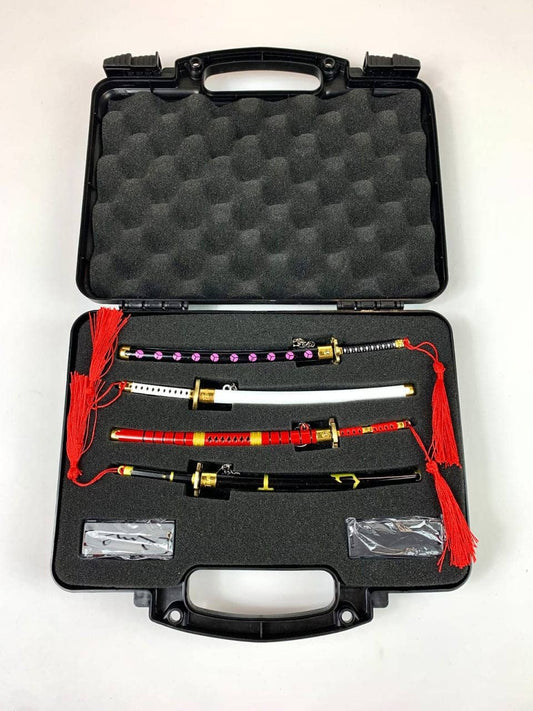


The Ninjatō
Few historical figures have captivated as much as the ninjas of feudal Japan. Shrouded in shadows and secrets, the shinobi became the symbol of espionage, infiltration, and missions that required more than brute force.
While samurai fought on battlefields and represented their lords' honor, ninjas moved silently, scaled walls, gathered information, and disappeared before anyone noticed their presence.
Over the centuries, their image became surrounded by legends. Stories of agents capable of infiltrating enemy strongholds, traversing forests at night, and using tools designed to overcome seemingly impossible obstacles fueled the mystery that still surrounds the shinobi today.
Among all the weapons associated with these clandestine warriors, none are as recognizable as the ninjatō, the sword that popular culture presents as the ninja's characteristic weapon.

The weapon for shadow missions
When one imagines a ninja advancing in the darkness of night, gliding through a forest, or silently crossing an enemy fortress, it's easy to picture the ninjatō as part of their equipment.
Unlike the large weapons of war intended for battlefields, this sword is associated with mobility, stealth, and the ability to operate in confined spaces.
Modern accounts and depictions portray the ninja as an infiltration specialist, capable of adapting to any situation. In that context, the ninjatō fits perfectly with the image of a warrior who had to rely more on intelligence, observation, and speed than on brute force.
More than just a weapon, it became the inseparable companion for missions carried out away from the eyes of enemies and sentinels.
A design conceived for speed and adaptability
The ninjatō is a straight-bladed sword, with simple lines and a practical appearance. Its design conveys an immediate sense of functionality, without excessive adornments or elements that distract from its main purpose.
The most striking characteristic is precisely that straight silhouette, which visually differentiates it from the traditional katana.
Within the ninja imagery, this shape is associated with speed of use and ease of handling in changing environments.
The sword had to be a versatile tool, capable of accompanying its wielder in constant movement, climbing over obstacles, and unexpected situations.
This combination of simplicity and effectiveness is one of the reasons why the ninjatō remains so attractive to collectors, Japanese culture enthusiasts, and lovers of historical weapons.

Why does the ninjatō continue to fascinate the world?
Few weapons have maintained such a constant presence in popular culture. Movies, novels, video games, comics, and series have contributed to making the ninjatō a universally recognizable image.
Even those who know little about Japanese history usually identify this sword as part of the classic ninja equipment.
Its popularity is largely due to everything it represents.
The ninjatō evokes mystery, adventure, and the idea of overcoming obstacles through skill and cunning. It does not symbolize great armies or multitudinous battles; it symbolizes the individual who acts in silence, trusting in their preparation and their ability to adapt to any challenge.
The eternal symbol of ninja warriors
Over time, the ninjatō has ceased to be merely a sword associated with the shinobi and has become a true cultural symbol.
Its silhouette appears in countless illustrations, collections, and representations dedicated to the ninja world, keeping alive a fascination that spans generations.
It is a symbol of agility, skill, and silent stealth, just like those who carried it.