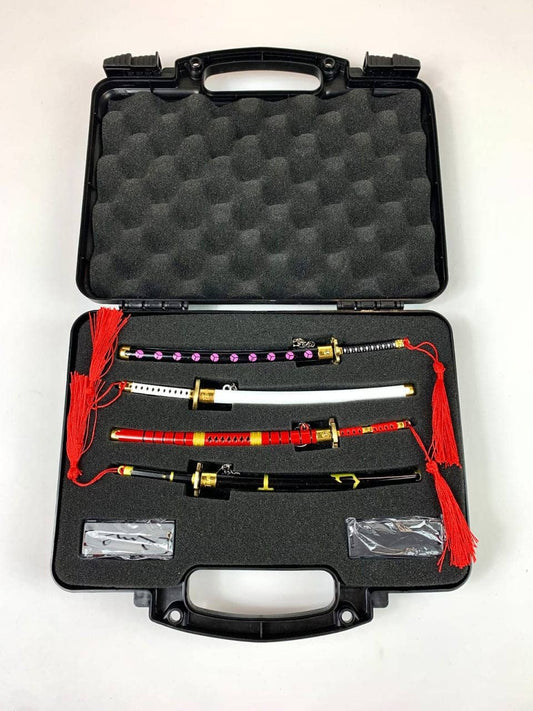


Mini Katanas
Mini katanas have gained popularity among collectors and Japanese culture enthusiasts alike, thanks to their detailed design and symbolic significance.
These miniature replicas of traditional katanas not only capture the essence of the original weapon but also serve as decorative or collectible items.
Despite their reduced size, many are crafted from quality materials and reflect the same artisanal care as full-sized swords.

What is a Mini Katana?
Concept, Origin, and Historical Development
A mini katana is a scaled-down reproduction of the Japanese katana. These retain the morphology, characteristic curvature, proportions of the hilt and guard, as well as the blade's polish, but all adapted to dimensions generally ranging between 15 cm and 40 cm.
Their current function is primarily ornamental and didactic: they allow appreciation of the metallurgical engineering and aesthetics of the original weapon without the license, space, or maintenance requirements of a full-sized sword.
The phenomenon emerged at the beginning of the 20th century as a tourist souvenir in Kyoto and Nara, crafted by artisans who used carbon steel and simple tempering techniques to meet the demand from Western visitors.
With the expansion of specialized collecting in the post-war period, these models evolved into high-level pieces, forged with laminations, lacquered saya (scabbards), and chiseled brass fittings, faithful to the style of historical schools like Bizen or Soshu.
Over the last few decades, the growth of fairs dedicated to Japanese pop culture, along with the spread of anime series and video games focused on swords, has solidified the mini katana as a global cult object.
Contemporary designers incorporate stainless steels, cryogenic treatments, and laser engravings to add aesthetic value and ensure corrosion resistance, while museums and dojos use them as illustrative tools in seminars on Japanese military history.
Thus, the mini katana has transformed from a simple souvenir into a reference piece that synthesizes traditional craftsmanship, metallurgical engineering, and modern design trends.

How to choose a mini katana?
Selecting a quality mini katana involves more than an aesthetic decision. It is a process that requires attention to technical and functional aspects that ensure both its historical fidelity and its durability.
These pieces, despite their small size, must reflect the artisanal precision and symbolic values that characterize the original katana.
The first fundamental aspect is the steel composition. The best ones are forged with materials such as tempered carbon steel, high-grade stainless steel (like 440C), or even composite steels (san-mai), which provide hardness and corrosion resistance. The quality of the metal influences not only durability but also the sharpness of the finish, the polish of the blade, and the fidelity of the lines.
Secondly, the degree of authenticity and craftsmanship must be evaluated. Professional reproductions often include many details similar to the original; they must maintain correct proportions and respect regional styles, for example, Edo koshirae or Shinto; they even offer certificates of origin or limited series.

Technical maintenance and conservation
The mini katana, like its full-sized counterpart, requires rigorous maintenance to preserve its condition over time. Steel, although treated, remains vulnerable to moisture and contact with natural skin acids.
It is advisable to carry out periodic cleaning with microfiber cloths that will not scratch the blade's polish. Afterwards, a thin layer of camellia oil or choji oil, traditionally used on Japanese swords, should be applied to prevent oxidation.
No abrasive products should be used, and it is essential to avoid direct handling without gloves if the original finish is to be preserved.
Regarding conservation, it should be stored in dry, ventilated places away from direct sunlight.
It is preferable to use horizontal stands to distribute the weight without damaging the saya (scabbard) and to keep the piece protected from dust and moisture with fabric covers or acrylic display cases.
The value of owning a mini katana
Each mini katana is, in itself, a tangible representation of values such as discipline, respect for tradition, and technical refinement.
For collectors, designers, or lovers of Japanese art, owning a quality mini katana represents an investment in knowledge, history, and beauty.
Furthermore, their portability and versatility make them ideal objects for thematic exhibitions, educational practices, or contemporary artistic inspiration.
Don't forget to check out our Mini Katana collection.