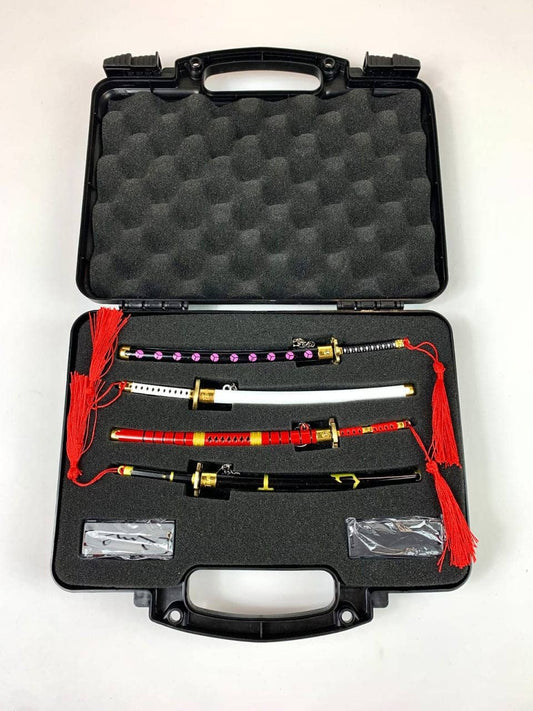


Muramasa was a 16th-century Japanese swordsmith whose katanas earned a reputation for being "cursed": according to legend, they incited their bearers to violence and demanded blood. Today, his swords are museum pieces valued at tens of thousands of euros, and his myth lives on in pop culture: he is the direct inspiration for the Kitetsu swords wielded by Roronoa Zoro in One Piece.

If you're interested in legendary katanas, both historical and those featured in anime, in our collection of high-end premium katanas you'll find pieces forged with the same artisanal criteria that made Muramasa famous. We tell you his true story, the origin of the curse, and how it reached Eiichiro Oda's manga.
Who was Muramasa and why is he considered a cursed smith?
Sengo Muramasa was a master swordsmith active in Ise Province during the Muromachi period (16th century). His technique was exceptional: his katanas stood out for an extraordinarily aggressive edge and a forging quality that rivaled the best artisans of his time. But it was precisely this reputation for "cutting too well" that fueled the legend that his swords had a will of their own and a thirst for blood, to the point of driving their owners to madness or betrayal.
The technical characteristics of a Muramasa sword
Muramasa-ba (the temper pattern)

The hamon—the temper line visible on the blade—of Muramasa swords is especially recognizable: it depicts shapes reminiscent of dancing flames or choppy waves. It's not just aesthetics: it indicates the difference in hardness between the edge and the spine of the blade, the key to its cutting ability.
Muramasa-nakago (the tang)

The tang, hidden within the hilt, retains engraved marks that today allow experts to date and authenticate original pieces. It is, along with the hamon, the technical signature that distinguishes a genuine Muramasa from a later attribution.
The origin of the curse: the Tokugawa and the death of Matsudaira Kiyoyasu
The dark legend of Muramasa didn't come out of nowhere: it was fueled by an accumulation of real incidents linked to the Tokugawa clan. In 1535, Matsudaira Kiyoyasu—grandfather of Ieyasu Tokugawa, the first shogun of the dynasty—was assassinated by his own retainer with a sword forged by Muramasa. Decades later, more deaths and accidents within the clan involved blades from the same smith. By the time Ieyasu Tokugawa consolidated the shogunate, the belief that Muramasa swords were "Tokugawa bloodthirsty" was so widespread that it is said he even forbade their possession in his court.
From Muramasa to Kitetsu: the curse that reached One Piece
The legend of Muramasa crossed centuries to become one of the clearest references in contemporary Japanese manga. In One Piece, the fictional Kitetsu school of smiths forges a line of cursed katanas that demand blood and curse those who wield them without deserving it. The Sandai Kitetsu, one of Roronoa Zoro's three swords, is a direct reference, acknowledged by fans themselves, to the real mythology of Muramasa: the seller's distrust, the weapon's bloodlust, and Zoro's challenge to prove he could master it are an almost literal nod to the original Japanese legend.
You can see this historical connection replicated in our Zoro's Sandai Kitetsu Katana (Damascus steel, functional), or explore the rest of the complete collection of One Piece katanas.
Muramasa vs. Masamune: the myth of rivalry
Muramasa is often pitted against Masamune, the other great name in Japanese forging, in stories that narrate a trial between both katanas: Masamune's would refuse to cut a leaf falling down the river, while Muramasa's would cut anything in its path. The problem is chronological: Masamune worked almost two centuries before Muramasa, so the duel is later folklore, not history. Still, the legend perfectly encapsulates the Japanese duality between the "compassionate" sword and the "bloodthirsty" sword. We delve deeper into this comparison—and its legendary katanas, the Yawarakai-Te and the Juuchi Fuyu—in our article Masamune vs Muramasa: the legend that forges their aura.
Legendary Muramasa swords and their bearers

Muramasa no Kaze: Yamato Takeru's wind sword
Light and designed for fast, evasive combat, it is said to have accompanied Yamato Takeru, a heroic figure in Japanese mythology, in his campaigns against enemies far superior in number.
Muramasa no Hōō: Minamoto no Yoshitsune's phoenix
Decorated with phoenix motifs—a symbol of rebirth—it is attributed to Minamoto no Yoshitsune, one of the most revered warriors of feudal Japan.
How much is a Muramasa sword worth today and where to get a replica?
Original Muramasa pieces are extremely rare: many were lost in wars and political purges, and owning one was considered almost a crime during the Tokugawa shogunate. Those that survive and come up for auction fetch tens of thousands of euros. For the rest of us, the alternative is handcrafted replicas true to the spirit of their forging: in our collection of Damascus steel katanas you will find pieces with a pronounced hamon and collector-level finishes, with shipping in 24-48h to Spain.
Frequently asked questions
Why are Muramasa swords said to be cursed?
Because Japanese legend holds that their extraordinary sharpness made them "bloodthirsty," driving their owners to violence. The belief was reinforced by several real incidents, such as the death of Matsudaira Kiyoyasu in 1535 at the hands of a Muramasa blade, which led the Tokugawa clan to distrust these swords.
What is the relationship between Muramasa and Kitetsu in One Piece?
The Kitetsu katanas from One Piece, including Roronoa Zoro's Sandai Kitetsu, are directly inspired by the real legend of Muramasa: swords of extraordinary quality but with a cursed reputation, which demand blood and distrust before accepting their wielder.
Were Muramasa and Masamune real rivals?
No, this is later folklore: Masamune worked almost 200 years before Muramasa, so they never met. The legend of the duel between their swords arose later, as a way to contrast two philosophies of Japanese forging.
How much does an original Muramasa sword cost?
Authentic pieces are extremely rare and can fetch tens of thousands of euros at auction. Handcrafted replicas of Damascus steel or premium katanas are the accessible alternative for collectors.
What distinguishes a Muramasa sword at first glance?
Two technical features: the Muramasa-ba, a very distinctive hamon in the shape of flames or waves, and the Muramasa-nakago, a tang with characteristic engravings that experts use to authenticate original pieces.