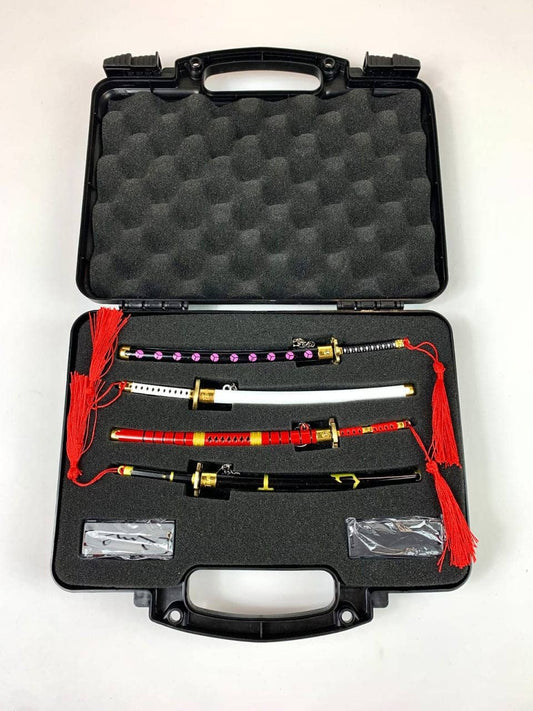


Sting, Dagger and Sword of Middle-earth
Within the vast universe of The Lord of the Rings, where legendary swords like Andúril and Narsil symbolize royalty and war, there exists a small blade that shines for its courage, not its size: Sting, the Elven sword that accompanied Frodo Baggins on his journey to Mount Doom.
It was not only a useful weapon but also a symbol of courage in the hands of one who was never a warrior but became a hero.
Here you can discover its history, origin, magic, and what makes it one of the most beloved weapons in Tolkien's mythological universe.

Origin of Sting: a treasure from Gondolin
Sting was not forged in the recent times of the Third Age. Its origin dates back to the city of Gondolin, one of the most famous and tragic Elven kingdoms of the First Age.
It was there that many magical weapons were forged, imbued with power, beauty, and strength.
The curious thing is that Sting, being a short sword, was probably originally intended as an Elven dagger. However, in the hands of a hobbit like Bilbo—and later Frodo—its size, proportionally, resembled that of a sword. This made it a unique piece from its discovery.
Bilbo and the discovery in the Misty Mountains
It was found by Bilbo Baggins in The Hobbit, during his adventure with the dwarves in the Misty Mountains, inside a troll cave.
Orcrist, Thorin's sword, and Glamdring, Gandalf's sword, were also found alongside it.
All three were Elven weapons, forgotten for centuries and recovered by chance.
Bilbo chose Sting without knowing he was starting a legacy. It was his first weapon, and although he initially wielded it with insecurity, he soon grew fond of it. He even gave it a name, as the great warriors of old did.

Physical characteristics of Sting
Sting is not large or intimidating, but its beauty is evident.
The blade is thin and curved, with a sharp and flexible edge, made of a silvery Elven metal that does not rust. Its hilt has Elven engravings, and some accounts suggest it has a bluish or ivory tone.
The most special thing about this weapon is its magical ability to detect orcs: when enemies of this race approach, the blade glows with a blue radiance.
This detail not only serves as a warning but also as a narrative device to create tension, as we see at multiple moments in both The Hobbit and The Lord of the Rings.
Frodo's inheritance
At the beginning of The Fellowship of the Ring, Bilbo gives his sword to Frodo, along with his mithril chainmail.
Although Frodo was not a trained fighter, he soon learned to use Sting decisively.
In the Shire, Bree, Moria, or Cirith Ungol, Sting was a constant and silent companion.
Frodo used it to defend himself from the Nazgûl, from Shelob—the terrifying giant spider—, and from the orcs of Mordor.
Although it was not a powerful weapon in terms of damage, its lightness and reaction to danger made it invaluable.

A symbol of humble courage
Sting became more than just a sword. In Frodo's hands, it symbolized the courage of the small against the immense. The bravery of the humble who, without seeking glory, becomes the protagonist of the most important events.
Tolkien constantly emphasizes that power does not always reside in the great, but in those who resist with dignity. Sting is that idea made of steel: a small blade, yes, but with firm purpose.
The end of the journey and the fate of Sting
After the fall of Sauron and the destruction of the One Ring, Frodo returns to the Shire and, some time later, departs for Valinor, the realm beyond the sea.
In some versions, Sting was given to Sam; others claim it was kept as a relic.
Whatever its final fate, the sword remained forever associated with Frodo's name and the sacrifice he made for Middle-earth.