América
Astronomical Knowledge of the Mayans: Predictions, Calculations, and Meanings
Systematic Sky ObservationThe Mayan civilization, which flourished from approximately 2000 BCE to the 16th century, d...




Before becoming one of Marvel's most iconic characters, Hulk was a revolutionary idea that blended science, fear, and human conflict. But behind the green giant lies a story full of...
The Origin of the Green Giant In the 1960s, in the midst of the Cold War, the world lived with a mixture of fascination and fear of science. Nuclear energy promised incredible advances, but also awakened the fear of total destruction. In that context, two comic creators, Stan Lee and Jack Kirby, working for Marvel Comics, decided to create something different: a superhero who was not perfect, but deeply human, marked by fear, rage, and inner conflict. Thus, the Incredible Hulk was born in 1962. Bruce Banner and the Experiment Gone Wrong The story begins with Dr. Bruce Banner, a brilliant but reserved scientist, specializing in nuclear energy and, specifically, dangerous gamma radiation. The U.S. military funds his research with the hope of turning that energy into a military and technological advance. During a test in a controlled desert, Banner detects that a young man has entered the test zone. Without thinking, he runs to save him, but fails to escape the explosion in time. At that moment, he is exposed to an extreme amount of gamma radiation. At first, nothing evident happens. However, over time, Bruce begins to notice strange changes. His pulse alters, his character becomes more unstable... until he discovers the impossible: when he feels intense fear or uncontrollable rage, his body transforms. His muscles grow monstrously, his skin changes tone (in early versions, it was even gray), and his mind is invaded by a primitive fury. Hulk is born: a creature of almost limitless strength, but without emotional control. Though he wasn't the only one... In the different versions of the alternative universes created by Marvel, such as Ultimate or "What If...?", the origin of Hulk changes slightly, either due to experiments with the super-soldier serum, variations of gamma radiation, or other circumstances. Over the years, different versions of the character appeared, such as the "Professor" or "Smart Hulk," who combines Banner's intelligence with his strength, contrasting in many cases with the wild and childish Hulk of the early comics. The Hunted Monster and the Idea Behind the Character From his first appearances in The Incredible Hulk #1, the character was not presented as a classic hero. He was more of a destructive force, misunderstood and dangerous. The army, led by General "Thunderbolt" Ross, constantly pursues him, convinced that he poses a threat to humanity. But the true core of the story is not outside, but within Bruce Banner. Each transformation is a metaphor for the loss of control, of how human emotions can break logic and turn us into something we don't recognize. The character is also inspired by classic literary influences such as Frankenstein and The Strange Case of Dr. Jekyll and Mr. Hyde, which already explored the idea of human duality: two identities within the same being. Regarding this inspiration from these literary classics, like Frankenstein, Mary Shelley's creature, Hulk is born as a consequence of a scientific experiment that escapes its creator's control. Both characters are misunderstood beings, seen as monsters by those around them; within them, there is a struggle to find their place in the world. This connection allowed Stan Lee to explore not only the fear of a science capable of creating something unknown but also the question of whether a being considered monstrous can retain humanity. On the other hand, the influence of Dr. Jekyll and Mr. Hyde is one of the keys to understanding the creation of Hulk. Bruce Banner and Hulk represent two opposing parts of the same person: reason, intelligence, and self-control versus impulses, anger, and unleashed strength. Hulk was not simply a monster, but the representation of the internal struggle between the rational mind and emotions that can escape control. Evolution and Meaning of the Incredible Hulk Over time, Hulk evolved within the Marvel Comics universe. From being an almost mindless monster, he went through different stages: more intelligent, wilder, or even emotionally complex. This allowed for the exploration of new, deeper stories, where the conflict was not only physical but psychological. Additionally, the change from the original gray color to green was due to printing problems in early comics, which caused the gray to appear with different shades on each page, while green was much easier to reproduce consistently. This technical detail ended up becoming one of his most recognizable hallmarks. Today, the Incredible Hulk remains a cultural symbol. He is not just a character of enormous strength, but a representation of the internal struggle we all experience: the balance between reason and impulse, between control and chaos. His origin, more than a simple superhero story, is a reflection on what happens when science, emotions, and fear collide in a single being.
Read more
The Naruto universe is made up of ninja villages, clans, and organizations with different values, abilities, and ways of understanding the world. In this article, you will discover which ninja...
Discover your ninja destiny The ninja universe of Naruto presents us with a world full of villages with unique characteristics and specific values. In addition, we also find rebel organizations such as the Akatsuki and Orochimaru's team, which bring together ninjas with unusual ideals and abilities. According to your zodiac sign, your personal characteristics would make you stand out and become a valuable member of a group. Here we explore where you would belong, and why you would fit in there. Get ready to immerse yourself in this ninja world and discover your ideal place! Cloud Hidden Village (Kumogakure) ♈ ARIES Your energy, bravery, and competitive spirit would make you perfectly fit in the Cloud Village, known for its strong, direct ninjas with a great sense of pride. Like them, you are always willing to fight for what you believe in and never back down from a challenge. If you chose a rebellious path, the Akatsuki could also be an option. Your impulsive character and combative style, which reflect your passion and determination, would make you a special member. ♐ SAGITTARIUS Your adventurous and optimistic spirit would make you a perfect Kumogakure ninja. This village, known for its determination and energy, aligns with your independent and outgoing character. You are always looking for new challenges and in the Cloud, you would find the ideal environment to explore and grow. If you felt limited, you could choose to join Orochimaru's team, where your curiosity for the unknown would lead you to experiment and discover your own limits. Rock Hidden Village (Iwagakure) ♉ TAURUS Your determination and loyalty would make you an exemplary member of Iwagakure. You are someone who doesn't give up easily and always works hard to achieve your goals, characteristics that would make you stand out in a place where physical strength, endurance, stability, and perseverance are essential qualities. However, your stubbornness could lead you to seek more freedom in Orochimaru's team, where you would have the opportunity to develop your skills without restrictions. ♑ CAPRICORN Your ambition and discipline, your practical nature, and your ability to work tirelessly towards your goals would make you stand out as a strong and respected leader in Iwagakure. The ninjas of this village value perseverance and determination, qualities that you master. If you chose a rebellious path, loyalty to your ideals could lead you to join the Akatsuki team or even become an independent renegade ninja in search of power and personal evolution. Leaf Hidden Village (Konohagakure) ♋ CANCER Your loyalty and sense of home would make you belong to the Leaf Village. Konoha's values, such as protecting friends and family, reflect your emotional and protective nature. As a ninja of this village, you would work hard to care for others. If you ever felt betrayed, you might consider joining Orochimaru's team. Your intense emotions could be exploited by him, who would see you as a ninja with unlimited potential. ♍ VIRGO Your perfectionism and sense of duty make you belong to Konoha. In this village, your dedication to hard work and your ability to solve problems would be highly valued. You would be a reliable and analytical ninja, ideal for strategic missions. Your love for perfection could also lead you to Orochimaru's team, where you could develop your skills to the fullest. ♒ AQUARIUS Your innovative mind and free spirit make you an ideal candidate for Konoha. You are someone who values community and teamwork, but also looks for unique ways to solve problems. As a Leaf ninja, you would bring fresh ideas and creativity to your missions, making you a valuable asset to your village. Your desire to change things could lead you to the Akatsuki, where your unconventional approach would make you an unpredictable and effective member. Sand Hidden Village (Sunagakure) ♌ LEO Your charisma and ambition would make you perfectly fit in Sunagakure. This village, home to strong and proud ninjas, reflects your desire to lead and be admired. You would stand out as a brave warrior, just like Gaara, whose leadership and strength inspire those around him. Your dominant nature could also lead you to the Akatsuki, where your power and desire for recognition would fit well. ♓ PISCES Your empathy and emotional connection make you ideal for Sunagakure. Although this village may seem arid, your ability to connect with others would bring a new perspective. As a Sand ninja, you would bring compassion and sensitivity, balancing the strength and pride characteristic of its inhabitants. If you chose a darker path, your sensitivity could be manipulated by Orochimaru, who would offer you the possibility of protecting others in exchange for joining his team. Mist Hidden Village (Kirigakure) ♎ LIBRA Your sense of justice and your ability to mediate conflicts would make you stand out in the Mist Village. Kirigakure has undergone a significant transformation, leaving behind its dark past as the "Bloody Mist Village." Your balanced nature would be ideal to help maintain peace in this village that is still seeking its identity. Your ability to see all angles of a situation could also lead you to the Akatsuki, where you would act as a voice of reason among the more chaotic personalities. Akatsuki ♊ GEMINI Your duality and adaptability make you perfect for the Akatsuki. Your ability to switch between strategies and personalities depending on the situation would make you an unpredictable and effective ninja in this rebel organization. You are creative, charismatic, and skilled in manipulation, qualities that the Akatsuki value greatly. As an Akatsuki member, you would likely come from Otogakure, the Sound Hidden Village, known for its ninjas who use unconventional techniques, their interest in forbidden knowledge, and their ability to adapt to different combat methods. ♏ SCORPIO Your intensity and mystery would lead you directly to the Akatsuki. With your passionate and strategic character, you would be a lethal and enigmatic member of the group. You are someone who is not afraid to explore the forbidden and face darkness, which fits perfectly with the nature of this organization. In addition, your loyalty to your own principles would make you stand out among the members. Among these, you would probably come from Amegakure, the Rain Hidden Village, a place marked by conflicts, wars, and ninjas who developed a tougher view of the world.
Read more
For decades, The Exorcist has terrified millions of viewers, but behind the film lies a real case surrounded by mystery, surprising testimonies, and many unanswered questions. The 1949 story that...
The true story that inspired one of the most influential horror filmsIn 1973, the film The Exorcist, directed by William Friedkin, was released and quickly became one of the most influential works in horror cinema.What many people don't know, or only know as a rumor or an aside, is that its story wasn't entirely born from imagination, but was inspired by a true case that occurred in 1949 in the United States, anonymously known as the case of "Roland Doe" to protect the minor's identity. Beyond its connection to that episode, the film marked a before and after in the horror genre.Its atmosphere, special effects, and the way it dealt with themes such as faith, fear, and the unknown had an enormous impact on viewers.Over the years, The Exorcist became a reference in horror cinema and one of the most talked about and influential films of its time.The real case of the 1949 exorcismIt all began in Maryland, when a 14-year-old boy began to display behaviors that his family couldn't explain.According to testimonies collected at the time, the minor suffered episodes of sudden aggression, abrupt personality changes, and phenomena that his family considered anomalous.Situations such as strange movements of objects, unexplained noises, and unusual physical strength during some episodes were described. The family, of Protestant origin, first sought medical help.The boy was admitted to different hospitals, but doctors could not find a clear cause.At that time, child psychiatry did not yet have such advanced tools as today, so many complex cases remained without an accurate diagnosis. Due to the lack of answers, the family turned to religious help.Finally, Catholic priests intervened and began performing prayers and exorcism rituals.Among the names associated with this process is Father William Bowdern, along with other Jesuits.According to their reports, during these sessions, behaviors were observed that they interpreted as signs of possession, such as violent reactions, strange language, and alleged marks on the skin.The impact of the case and its transformation into mythThe case was partially disseminated at the time, including a mention in The Washington Post on August 20, 1949.However, it wasn't until decades later that it gained true notoriety thanks to the writer William Peter Blatty, who used these events as inspiration for his novel The Exorcist, published in 1971. From there, the story transformed into a global cultural phenomenon, especially after the 1973 film adaptation.The film amplified many elements of the original case, creating much more extreme and visual scenes than those described in the real testimonies. Today, many researchers believe that there is no conclusive evidence of demonic possession.Alternative explanations have been proposed, such as severe psychological disorders or undiagnosed neurological episodes.However, the case remains a subject of debate because the available information is incomplete and is based, in large part, on witness accounts. Between documented history and cinematic legendUltimately, the true case behind The Exorcist is a mixture of documented facts, religious interpretations, and the passage of time, which transformed what could have been a complex clinical story into one of the most famous legends of modern cinema.
Read more
Discover the longest and most popular TV series; productions that have stood the test of time and become international phenomena. From medical and police dramas to science fiction and grand...
The longest-running series in history When we talk about the longest-running series in television history, what matters isn't just their duration, but their ability to stay alive for decades and become global phenomena. These are productions that have spanned generations, evolving over time without losing their essence and adapting to new audiences in different countries. Doctor Who: The British series that defies time Doctor Who is one of the longest-running science fiction series in history. Born on the BBC in 1963, the story revolves around the Doctor, a mysterious time traveler who roams the universe aboard the TARDIS, a spaceship that outwardly looks like a simple British police box. Its great peculiarity is the regeneration of the protagonist, a narrative device that has allowed for changes in actors without breaking the continuity of the story, keeping it alive for generations. Its mix of adventure, science fiction, and social commentary has made it a global icon. Grey's Anatomy: The human drama within the hospital Grey's Anatomy has established itself as one of the most enduring medical dramas in modern television. Set in Grey Sloan Memorial Hospital, it follows the lives of surgeons who face extreme decisions both inside and outside the operating room. Beyond the medical cases, the series stands out for the emotional evolution of its characters, personal relationships, and how it has managed to reinvent itself over the years without losing international viewership. Law & Order: Special Victims Unit, relentless investigation Law & Order: Special Victims Unit is a police procedural series focused on investigating sex crimes and particularly sensitive cases in New York. Its independent episode structure has allowed it to remain relevant for decades. The focus on investigation, legal drama, and the social impact of the cases has made it one of the most exported and recognized police series worldwide. And it also contributes to a much broader saga, as part of the interconnected Law & Order series. Supernatural: Brothers against the impossible Supernatural follows the Winchester brothers on their journey across the United States, facing demons, ghosts, and supernatural creatures. What begins as a series of isolated cases evolves into a much deeper story about destiny, sacrifice, and the fight against apocalyptic forces. Its longevity is due to its ability to blend horror, action, and emotional drama, creating one of the most loyal fan bases in modern television. And although its main story officially ended, it also has a sequel and even an anime adaptation of its first season. NCIS: Naval Criminal Investigative Service: Military investigation with a global seal NCIS: Naval Criminal Investigative Service focuses on a team of special agents who investigate crimes related to the United States Navy. Each case combines action, forensic analysis, and team dynamics that have made the series one of the most stable on American television. Its international success, especially in Europe and Spain, has kept it as one of the most recognizable police series in the world. In addition, the series spawned the NCIS franchise, which features other interconnected productions that expand this universe. The Walking Dead: The apocalypse that changed television The Walking Dead marked a before and after in the zombie genre on television. The story follows a group of survivors in a devastated world, where the threat of the walking dead is as dangerous as humanity itself. Its global success generated a complete franchise and a huge community of followers worldwide, including Spain. House, M.D.: The most unpredictable doctor House breaks from the typical medical drama by focusing on Dr. Gregory House, a medical genius with a difficult personality and unconventional methods. Each episode presents complex medical cases that he solves through deduction, almost like a detective. The series combines medicine, mystery, and a strong psychological component that made it very popular worldwide. Princess Agents: The Chinese drama of survival and power Princess Agents, known in Spain as "Princesa Valiente," is a Chinese historical drama that exceeds 58 episodes (58 in its uncut DVD format and 67 in its television version), thus meeting the longevity criterion of the ranking within Chinese dramas. Although there are others that are longer, they have been less widely distributed globally, as this one, in particular, broke audience records at the time. Additionally, a continuation of the story titled Rebirth is about to be released. The story follows a young slave who struggles to survive in a court marked by war, political intrigues, and betrayal. Its mix of action, military strategy, and the evolution of the main and secondary characters made it one of the most widely distributed Chinese dramas internationally, with a presence on platforms and an audience in Spain. Elementary: The modern detective of New York Elementary is an American series that reinterprets the figure of Sherlock Holmes in a contemporary setting, transplanting his cases to New York City. The story follows a brilliant but unstable Holmes and Joan Watson, who becomes his partner in solving complex crimes. Throughout its seasons, both work together investigating police cases while evolving as a team, combining investigation, deduction, and personal development. Its self-contained case format and light continuity made it a long-running series, known internationally. The Blacklist: The most wanted criminal who collaborates with the FBI The Blacklist is an American criminal thriller series centered on Raymond "Red" Reddington, a former high-level criminal who voluntarily surrenders to the FBI on one condition: he will only work with Agent Elizabeth Keen. From this agreement, a plot unfolds in which the team investigates a list of extremely dangerous criminals, while increasingly complex conspiracies directly affecting the protagonists are uncovered. Throughout its seasons, the series combines self-contained cases with a global narrative of espionage and secrets, which has made it a long-running production, well-known internationally, and broadcast in numerous countries, including Spain. Clarifications This ranking combines several factors: duration, popularity, and the ability to become global television phenomena. Consideration is also given to duration in relation to the type of series and the context of the country or market where it was produced and broadcast, as not all productions follow the same criteria for length; some countries even set limits on duration or number of episodes.
Read more
The best anime of all time include Dragon Ball Z, Attack on Titan, Fullmetal Alchemist: Brotherhood, Death Note, One Piece, Demon Slayer, Naruto, Bleach, Hunter x Hunter, and Neon Genesis...
The best anime of all time include Dragon Ball Z, Attack on Titan, Fullmetal Alchemist: Brotherhood, Death Note, One Piece, Demon Slayer, Naruto, Bleach, Hunter x Hunter, and Neon Genesis Evangelion. In 2026, the most anticipated titles are Dandadan, Wind Breaker, Mushoku Tensei III, and Solo Leveling Season 2. This guide organizes the best recommendations by genre, experience level, and streaming platform. Anime has evolved from a niche genre to the fastest-growing entertainment format globally in the last decade. Netflix, Crunchyroll, and Prime Video compete for the rights to the most anticipated titles, and anime seasons spark global debate every three months. This guide is designed to answer the question everyone asks at some point: Where do I start? What do I watch next? What's new this year? The 10 Best Anime of All Time — Always a Safe Bet This list is not ordered by personal ranking — it reflects the consensus of major rating platforms (MyAnimeList, AniList, Anime-Planet) and the votes of tens of thousands of fans. If you've never watched anime or are looking for something to recommend to someone, start here: Anime Main Genre Episodes Why Watch It Platform (US) Fullmetal Alchemist: Brotherhood Action / Fantasy 64 The best anime story ever told. Perfect characters, impeccable worldbuilding, no filler. Netflix / Crunchyroll Attack on Titan Action / Drama 87 + movies The series that proved anime could be as complex as any global television show. Crunchyroll / Hulu Death Note Psychological Thriller 37 The most tense intellectual duel in anime. Perfect for introducing anime to skeptics. Netflix / Crunchyroll Hunter x Hunter (2011) Adventure / Action 148 The best power system in shōnen anime. Each arc surpasses the last. Crunchyroll / Netflix Neon Genesis Evangelion Sci-Fi / Mecha 26 + movies The work that redefined modern anime. Essential for understanding the history of the medium. Netflix Demon Slayer (Kimetsu no Yaiba) Action / Fantasy 55+ (ongoing) The most spectacular animation in anime history. The perfect entry point for new fans. Crunchyroll / Netflix One Piece Adventure / Action 1100+ The best-selling manga franchise of all time. The Wano arc is one of the best animated stories ever. Crunchyroll Naruto / Naruto Shippuden Action / Adventure 720 The series that introduced anime to a whole generation. The Pain arc is anthological. Crunchyroll Bleach: TYBW Supernatural Action 61+ (ongoing) The animation of the final arc (Studio Pierrot 2022–2025) is among the most spectacular in modern anime. Hulu / Crunchyroll Violet Evergarden Drama / Romance 13 + movie The most beautiful visual production in modern anime. Kyoto Animation at its best. Netflix Best Anime by Genre Shōnen — Epic Action and Adventure The most popular anime genre, aimed at young people but with a universal audience. The best representatives of modern shōnen combine spectacular battles with deep character development: Demon Slayer — the best current shōnen entry point Jujutsu Kaisen — the most solid shōnen of the new post-2020 generation My Hero Academia — the best Japanese superhero anime Black Clover — slow at first, but one of the best arcs in the genre Chainsaw Man — the most disturbing and innovative shōnen of recent years A fan of shōnen and swords? Our anime swords and katanas collection includes replicas from the genre's most popular series. Isekai — Parallel Worlds and Reincarnations The fastest-growing anime genre in the last decade. A protagonist dies or is transported to another world and must adapt using their prior knowledge: Re:Zero — the most intelligent and psychologically complex isekai Mushoku Tensei — the best-produced isekai with the most elaborate worldbuilding Solo Leveling — the Korean manhwa that redefined the genre. Anime adaptation in 2024 That Time I Got Reincarnated as a Slime — the most popular isekai of recent years Overlord — isekai from the antagonist's perspective. Unique in its category Historical and Samurai Anime — The Connection to Real History The subgenre with the most direct connection to real Japanese culture and the world of swords: Rurouni Kenshin — the most influential samurai anime of the 90s. Remake in 2023 Vagabond (manga) — the most faithful and artistically elevated adaptation of Miyamoto Musashi's story in the medium Vinland Saga — cinematic quality Viking anime. Real Vikings, not fantastical ones Kingdom — the best military strategy anime, set in China during the Warring States period Samurai Champloo — Japanese hip-hop aesthetic applied to the Edo period. A unique classic If historical anime fascinates you, at Espadas y Más you'll find functional katanas for iaido and kenjutsu practice — the martial arts that inspired these characters. 90s Anime — The Classics That Started It All The anime that built the medium as we know it today. If you were born in the 90s or want to understand where it all comes from: Dragon Ball Z — without Dragon Ball Z, modern battle anime wouldn't exist Neon Genesis Evangelion — the most important thought experiment in 20th-century anime Cowboy Bebop — jazz, sci-fi, and existentialism. The most influential anime in the West Sailor Moon — defined the magical girl genre and remains a reference 30 years later Ranma ½ — comedy and martial arts that invented many modern anime tropes Yu Yu Hakusho — the supernatural martial arts tournament that defined a genre Rurouni Kenshin — the repentant samurai who brought the history of the Bakumatsu to mass anime audiences 2026 Anime Releases — The Year's Highlights Anime releases are the category with the highest CTR across the entire site — fans actively seek out new content. This section is updated every season: Anime Season Status Platform Why Follow It Dandadan Part 2 Ongoing Netflix The freshest and most visually innovative anime of 2025-2026. UFOs, yokai, and teenage romance. Wind Breaker Season 2 Confirmed 2026 Crunchyroll The best street fighting anime since GTO. Cloverworks animation. Mushoku Tensei III Season 3 In Production Crunchyroll The third season of the best-produced isekai in the medium. Solo Leveling Season 2 Season 2 Confirmed 2026 Crunchyroll The manhwa that reshaped isekai has more to tell in Arise from the Shadow. Bleach: TYBW Part 4 Final Arc Confirmed Hulu / Crunchyroll The most anticipated anime conclusion of the Bleach generation. One Piece (post-Egghead) Ongoing Ongoing Crunchyroll The new arc enters the most important moments of the manga. To stay up-to-date with all anime releases, visit the Espadas y Más anime blog — we publish new season analyses, character updates, and series guides every week. Where to Start Based on Your Profile? If you are... Start with Then watch A total beginner Death Note (37 ep., self-contained, accessible) Attack on Titan → Demon Slayer An action fan Demon Slayer (spectacular animation from ep. 1) Jujutsu Kaisen → Hunter x Hunter → FMA Brotherhood A history and samurai fan Vinland Saga (Viking historical realism) Rurouni Kenshin → Kingdom → Samurai Champloo A fantasy world fan FMA Brotherhood (the best worldbuilding in anime) Re:Zero → Mushoku Tensei → That Time I Got Reincarnated A veteran looking for something new Chainsaw Man (breaks all shōnen conventions) Dandadan → Frieren → Dungeon Meshi Does your favorite anime feature iconic swords, katanas, or weapons? At Espadas y Más you'll find replicas from the most popular series: anime katanas, fantasy swords, collectible figures, and merchandise from over 50 series. Shipping within 24-48h throughout Spain, free for orders over 60€.
Read more
From epic adventures and open worlds to strategic battles and extreme survival, some video games have left their mark on entire generations of players. On the occasion of International Video...
A Top 10 for International Video Game DayThe so-called "International Video Game Day" does not have a single officially recognized date globally. On the internet, however, two symbolic dates have become popular, which the community uses to celebrate gaming culture: July 8th and August 29th.Although neither is official, their use has varied depending on the context.July 8th tends to appear more in general and international content related to video games, while August 29th has a greater presence in Spain and in the Spanish-speaking gaming community, promoted by specialized media and social networks as a reference date to celebrate the world of gaming. Both dates serve as a symbolic way to discuss the growth of video games, their technological evolution, and their impact as one of the most important entertainment industries in the world.Today, we will use this date as an excuse to review some of the most beloved, played, and discussed titles by the global gaming community, in this Top 10, which represents the diversity, influence, and legacy of the most important video games for millions of players.Below, a review of some of the most popular and highly-rated video games by players worldwide, explained as if they were movie stories. Top 10 most popular and beloved video games by the gaming community1. MinecraftA character appears in an unknown world made entirely of blocks.With no fixed story, they must survive, explore dark caves, face creatures that come out at night, and learn to build shelters, houses, or entire cities.Over time, they can create practically anything they imagine in a limitless open world. 2. Grand Theft Auto VThree men with very different lives find themselves caught up in the criminal underworld of a big city.Robberies, chases, betrayals, and confrontations with gangs and police mark a story where every decision can change their destiny in a world full of chaos and freedom. 3. FortniteHundreds of players land on a mysterious island where only one can survive.They must search for weapons, build makeshift shelters, and face each other as the map shrinks, forcing them to fight in increasingly smaller spaces. 4. The Legend of Zelda: Breath of the WildA hero awakens after years, without memory, in a kingdom destroyed by a dark force.He explores mountains, forests, and ancient temples while discovering his past and seeking a way to save the princess and free the kingdom. 5. Call of Duty: Modern WarfareA professional soldier participates in secret military missions in different countries.He infiltrates war zones, fights armed enemies, and experiences dangerous operations where survival depends on precision and teamwork. 6. League of LegendsTwo teams of heroes with special abilities battle on a strategic battlefield.Each character has unique powers, and they must coordinate to destroy the enemy's base while protecting their own. 7. Red Dead Redemption 2An outlaw is part of a criminal gang in the twilight of the Old West.As the world shifts towards modernity, he faces robberies, chases, internal betrayals, and decisions that affect his destiny and that of his companions. 8. Counter-Strike: Global OffensiveTwo teams face off in closed scenarios: one tries to plant explosives, and the other must prevent it.Each round is a fast-paced combat where strategy, speed, and precision are essential to win. 9. Super Mario Bros.A hero named Mario travels through worlds full of platforms, enemies, and obstacles to rescue Princess Peach, kidnapped by an enemy who dominates castles and entire kingdoms. 10. Elden RingA warrior arrives in a dark world full of ruins, dangerous creatures, and ancient secrets.Without clear guidance, he must survive, explore, and uncover the truth of a cursed kingdom while facing very powerful enemies.
Read more
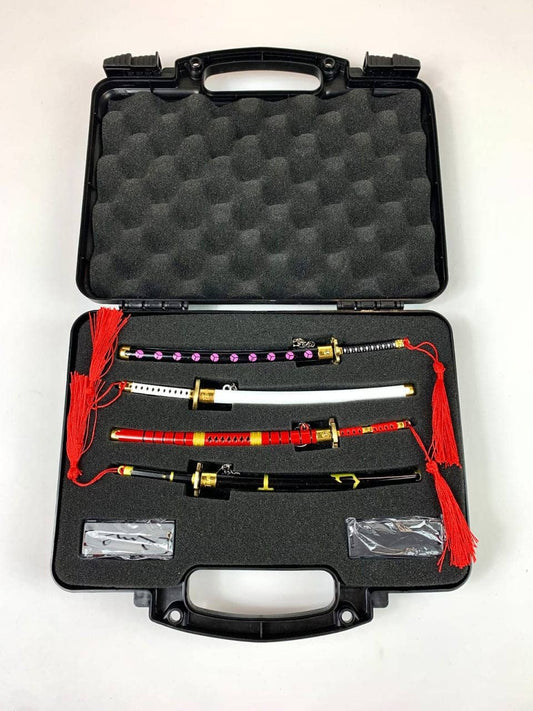
At Swords and More you will find individual replicas of Enma, Wado Ichimonji and Sandai Kitetsu, the 3-katana Pack (Wado + Sandai + Yubashiri with display stand starting from €119.99),...
Reading time: 9 min · Updated: July 2026 Roronoa Zoro's three current swords are Enma (O Wazamono grade, formerly Kozuki Oden's sword, absorbs its wielder's Haki), Wado Ichimonji (Saijo O Wazamono grade — the highest possible in the One Piece universe — a symbol of his promise to Kuina), and Sandai Kitetsu (Wazamono grade, a cursed sword from the Kitetsu line). These three form Zoro's current Santoryu since the Wano arc. Few elements in the One Piece universe generate as much discussion among fans as Roronoa Zoro's swords. It's not just about the power they represent — it's about what they signify. Each katana Zoro wields has a story behind it, a symbolism intertwined with his own journey to become the world's greatest swordsman. In this guide, you'll find everything you need to know about his three current swords: their history, their grade in the One Piece sword classification system, their specific power, and why each is irreplaceable for the character. If you already know the backstory and want to go directly to the replicas, you can skip to the section on available replicas in Spain. Zoro's swords at a glance — complete comparative table The sword classification system in One Piece has five grades, from highest to lowest: Saijo O Wazamono (12 Supreme Grade Swords), O Wazamono (21 Great Grade Swords), Ryo Wazamono (50 Skillful Grade Swords), Wazamono (fine grade swords), and unclassified. This table places Zoro's most important swords in that context: Sword Grade Forger Previous owner Special power Status Enma O Wazamono Shimotsuki Kozaburo Kozuki Oden Absorbs and releases the wielder's Haki ✅ In use Wado Ichimonji Saijo O Wazamono ⭐ Shimotsuki Kozaburo Kuina (childhood friend) No supernatural power — its strength is spiritual ✅ In use Sandai Kitetsu Wazamono Unknown (Kitetsu line) Loguetown merchant Active curse — wild temperament ✅ In use Shusui O Wazamono Unknown Ryuma (legendary swordsman) Black blade — supernatural durability ❌ Returned to Wano Yubashiri Ryo Wazamono Unknown Ippon-Matsu (Loguetown) Exceptional lightness ❌ Destroyed (Enies Lobby) Canon Note: This article is based on the status of the manga and anime up to the Egghead arc (2024–2025). If the series has advanced since then, some swords may have evolved. We update this article periodically. Enma — the most powerful sword Zoro has wielded Origin and history O Wazamono Enma is, along with Ame no Habakiri, one of the two swords Kozuki Oden carried in his legendary Nitoryu. It was forged by Shimotsuki Kozaburo — the same master blacksmith who decades earlier would create the Wado Ichimonji and who illegally emigrated from Wano to East Blue, where he had a grandson named Koushirou and a student named Kuina. The connection between Enma and Wado Ichimonji is not coincidental: both came from the same hands, the same fire, with the same forging philosophy. Kozuki Oden, daimyo of Kuri and the only man who could wound Kaido, wielded Enma throughout his life as a swordsman. After his death at the hands of Kaido and Orochi, the sword passed to his daughter Kozuki Hiyori, who kept it for twenty years. In the Wano arc, Hiyori offered it to Zoro in exchange for returning Shusui — the national treasure Zoro had received from Ryuma — to its original owner's grave. Zoro accepted without hesitation. The power of Enma — why it's so difficult to control Enma has a unique characteristic among all known swords in One Piece: it actively absorbs its wielder's Armament Haki (Busoshoku Haki) and releases it in each strike in an amplified form. This makes it a devastating weapon in the hands of someone with sufficient control — and a death trap for those who don't. When Zoro first unsheathed it, Enma involuntarily drained a massive amount of his Haki, temporarily aging his arm and visibly reducing his life energy. This is exactly what it did to all its previous owners, which is why Enma is said to "reduce its wielders to mummies" if they cannot control it. It took Zoro some time to tame it, and this learning process is one of the most important character development arcs in Wano. The sword is not powerful because it is big or because it is cursed. It is powerful because it demands everything you have — and if you can give it, it gives you double back. Enma's appearance is unmistakable: dark purple hilt, characteristically shaped golden tsuba, long blade with a pronounced curve. It is the sword most visually associated with the "new Zoro" post-Wano. View Zoro's 5 Katana Pack with Enma + Display Stand → Wado Ichimonji — the soul of Roronoa Zoro The highest-ranking sword of the maximum grade Saijo O Wazamono The Wado Ichimonji is the highest-grade sword Zoro possesses: Saijo O Wazamono, the supreme category, shared with only 11 other swords in the entire One Piece universe. This objectively makes it the highest quality sword in his current arsenal — even if it's not the most destructive in terms of supernatural power. It was forged by Shimotsuki Kozaburo and belonged to Isshin's dojo in Shimotsuki Village, East Blue. Roronoa Zoro trained there as a child, where he met Kuina, the daughter of Master Koushirou — the only rival Zoro couldn't defeat in his formative years. The two made a pact: someday, one of them would become the world's greatest swordsman. The next day, Kuina died in a domestic accident. The promise that defines everything Zoro asked Master Koushirou for Kuina's sword. With the Wado Ichimonji in hand, he renewed the promise: he would become the world's greatest swordsman for both of them. From that moment, the Wado Ichimonji ceased to be merely a weapon — it became the physical embodiment of Zoro's dream and the soul of his most respected rival. This symbolic weight explains why Zoro never gives up the Wado Ichimonji even when he has lost or changed the rest of his swords. While Sandai is a combat tool and Enma is his greatest technical challenge, Wado is what makes everything make sense. In the fight against Mihawk in the East Blue — the first and most crushing of his defeats — it was the only one of his three swords that survived the attack of the world's greatest swordsman. Physical characteristics The Wado Ichimonji has an appearance that deliberately contrasts with his other swords: an impeccable white blade, a circular silver guard with a clean design, and a wrapped white hilt. It is the most elegant sword in Zoro's arsenal — a katana that seems calm, almost silent, until someone who knows its burden wields it. Relevant technical detail: Both the Wado Ichimonji and Enma were forged by Shimotsuki Kozaburo. This means that the two most important swords in Zoro's history came from the same blacksmith — a detail Oda included decades after its revelation and the character's original introduction. View Zoro's 3 Katana Pack (includes Wado) from €119.99 → Sandai Kitetsu — the cursed sword Zoro tamed The Kitetsu line — three swords forged with demon blood Wazamono Kitetsu swords are not just one: they are a dynasty of three weapons, each of a different grade, all forged with the same dark technique that gives them their curse: Shodai Kitetsu — Saijo O Wazamono. The most powerful. Location unknown. Nidai Kitetsu — O Wazamono. In the possession of Silvers Rayleigh, Roger's first mate. Sandai Kitetsu — Wazamono. The one Zoro wields. The Kitetsu are known in the world of One Piece for bringing misfortune and violent death to all their wielders. It's not a legend or an exaggeration: it's a documented pattern. The Loguetown merchant who owned it refused to sell it to Zoro precisely because of this — he didn't want to be responsible for the young swordsman's death. The Loguetown scene — how Zoro won it by defying the curse What Zoro did next is one of the most revealing scenes of his character in the entire series. He took the Sandai Kitetsu, threw it into the air, spinning it, and extended his arm beneath its descending trajectory — letting the sword fall onto his wrist without moving. If the curse was real, it would cut him. If he was worthy of wielding it, it would leave him untouched. The sword landed, encircling his arm without causing him the slightest harm. The astonished merchant not only sold it to him — he also gave him the Yubashiri, a Ryo Wazamono-grade sword, in recognition of his bravery. This moment perfectly defines Zoro: he doesn't defy the curse because he's reckless, but because he has absolute faith in his own luck and his own will. If he's going to die, it will be in combat, not by a sword that doesn't want to fight. Appearance and combat behavior The Sandai Kitetsu is recognizable by its red blade — a design detail that differentiates it from any other katana in the series. The hilt has a characteristic wrapping and a distinctly shaped tsuba. In combat, it is described as a sword with a "wild temperament" — it doesn't passively obey its wielder, but seems to have its own impulses that Zoro controls with his willpower. For collectors, the Sandai is the most visually striking piece in Zoro's arsenal precisely because of that red blade — a sword that immediately draws the eye in any display case. View high-end Sandai Kitetsu replica → The swords Zoro lost — why they matter for understanding his current ones Zoro's current arsenal cannot be understood without knowing what is missing. Two swords define his history of losses: Yubashiri — the lightness Shu destroyed Zoro carried the Yubashiri (Ryo Wazamono, medium grade) from Loguetown to Enies Lobby, where Marine Shu — a user of the Sabi Sabi no Mi, which rusts metal on contact — destroyed it in combat, turning it to dust in seconds. It is the only one of his swords he did not lose by his own choice. He brought it to Thriller Bark as fragments and buried it there. It is the only moment in the series where Zoro shows something akin to mourning for a sword. Shusui — the treasure he returned The Shusui (O Wazamono, black blade) was the reward for defeating Ryuma's zombie in Thriller Bark. It was a national treasure of Wano — the sword of the country's most legendary swordsman — that had been outside its borders for decades. Zoro carried it for much of the second half of the series until, in Wano, Kozuki Hiyori asked him to return it. Zoro accepted Enma in exchange without negotiating. Shusui now rests in Ryuma's grave, where it belongs. For a complete history of these swords and all others Zoro has wielded, read our dedicated article: The stories behind Roronoa Zoro's swords → Why does Zoro use three swords? Santoryu in context Santoryu — literally "three-sword style" — is not Zoro's only style, but it defines his identity. He developed it as a child in Isshin's dojo, adapting the use of the third sword in his mouth as a response to his own limitation: hands can only hold two. What began as an eccentric technique evolved into a complete combat philosophy with four documented styles: Santoryu (three swords), Nitoryu (two), Ittoryu (one), and Kyutoryu (nine — the maximum spiritual manifestation of his power). For an in-depth analysis of each style and the role of Haki in Zoro's evolution, read: Zoro's swordsmanship abilities in One Piece → Where to buy replicas of Zoro's swords in Spain At Espadas y Más, we have the most complete collection of Roronoa Zoro sword replicas available in Spain. From complete packs for the fan who wants all three at once, to individual high-end replicas for the demanding collector: Product Swords included Material Price Zoro's 5 Katana Pack + Wall Display Stand Enma, Wado, Sandai, Shusui, Yubashiri Blunt steel View price Zoro's 3 Katana Pack + Display Stand Wado Ichimonji, Sandai Kitetsu, Yubashiri Blunt steel €119.99 (was €173) Sandai Kitetsu — high-end Individual Sandai Kitetsu Steel, premium finishes View price Functional Zoro Katana 102cm Functional Zoro katana replica Carbon steel, hand-forged blade View price All products have 24-48h shipping throughout Spain and free shipping from €60. 14-day return policy. ⚔️ View the entire Roronoa Zoro collection — katanas, figures, and merchandise → Frequently asked questions about Roronoa Zoro's swords What are Roronoa Zoro's current swords? Zoro's three current swords are Enma (O Wazamono, formerly Kozuki Oden's sword), Wado Ichimonji (Saijo O Wazamono, the highest grade, a symbol of his promise to Kuina), and Sandai Kitetsu (Wazamono, a cursed sword from the Kitetsu line). These three form his Santoryu since the Wano arc, where Zoro exchanged Shusui for Enma. Which is Zoro's most powerful sword? In terms of supernatural power, Enma is the most powerful: it absorbs and releases Zoro's Haki in an amplified form, and it was the sword of the legendary Kozuki Oden. In terms of classification grade, the Wado Ichimonji is the highest (Saijo O Wazamono, the highest grade in the One Piece universe). In terms of emotional value, Wado is irreplaceable — it's the only one Zoro would never trade for anything. Why is Sandai Kitetsu cursed? The Sandai Kitetsu belongs to the Kitetsu line, a series of three swords forged with techniques that confer a "curse" — they bring violent death to all their wielders. Zoro publicly defied this curse in Loguetown by throwing the sword into the air and extending his arm beneath its falling trajectory. The sword circled his arm without cutting him, demonstrating that he was worthy of wielding it. Zoro controls it with his willpower, although the sword retains a "wild temperament" in combat. How many swords has Zoro had throughout the series? Zoro has wielded over ten swords throughout One Piece. The most significant ones are Wado Ichimonji (from the beginning), Sandai Kitetsu and Yubashiri (from Loguetown), Shusui (from Thriller Bark, returned in Wano), and Enma (from Wano, his current most powerful sword). He has also incidentally wielded enemy swords in combat. Who forged Zoro's swords? Two of his three current swords were forged by the same master blacksmith: Shimotsuki Kozaburo created both the Wado Ichimonji and Enma. This is one of the world-building details that Oda prepared decades in advance — the blacksmith who forged the sword of Zoro's soul is the same one who forged his most powerful one. The forger of the Sandai Kitetsu is unknown, as is the case with the entire Kitetsu line. Where to buy replicas of Zoro's swords in Spain? At Espadas y Más you will find individual replicas of Enma, Wado Ichimonji and Sandai Kitetsu, the 3-katana pack (Wado + Sandai + Yubashiri with display stand from €119.99), the 5-katana pack with wall display, and a functional 102cm hand-forged carbon steel katana. Shipping in 24-48h throughout Spain and free for orders over €60.
Read more
This guide is updated for 2026 with all movies and series from the DC universe, including James Gunn's new DCU.
Chronological Order to Watch Justice League Movies: Complete Guide to the DC Universe (2026) If you want to fully understand the story of the Justice League, you need to know the correct chronological order to watch DC movies. This updated guide for 2026 includes all DCEU (DC Extended Universe) movies, TV series, and James Gunn's new DCU so you don't miss a thing. In what order should DC movies be watched to understand the Justice League? The answer depends on whether you prefer the release order or the chronological story order. For a first-time viewing, we recommend the release order. If you've already seen some movies, the chronological order allows you to enjoy the narrative in temporal sequence. Complete Chronological Order of the DCEU (DC Extended Universe) This is the chronological order based on the years in which the events take place: Year Movie Director Notes 1917 Wonder Woman Patty Jenkins World War I 1984 Wonder Woman 1984 Patty Jenkins Cold War 1985 Aquaman (prologue) James Wan Meets Thomas Curry 2013 Man of Steel Zack Snyder Beginning of the DCEU 2013 Batman v Superman (prologue) Zack Snyder Death of Bruce's parents 2015 Batman v Superman: Dawn of Justice Zack Snyder 18 months after Man of Steel 2016 Suicide Squad David Ayer Less than 1 year after Batman v Superman 2016 Justice League Zack Snyder/Joss Whedon Team formation 2016 Aquaman James Wan After Justice League 2019 Shazam! Andy Muschietti 1 year after Justice League ? Birds of Prey Cathy Yan Uncertain date, possibly between Suicide Squad and Justice League Important: Zack Snyder's Version We recommend ignoring the 2017 version and going directly to the Snyder Cut (2021). The differences are many: the Snyder Cut is 4 hours long, includes key scenes with Darkseid, and better explains the narrative. Release Order (Recommended for First-Time Viewers) If it's your first time watching DC movies, follow this order: Man of Steel (2013) Batman v Superman: Dawn of Justice (2016) Suicide Squad (2016) Wonder Woman (2017) Justice League (2017) → better Snyder Cut 2021 Aquaman (2018) Shazam! (2019) Birds of Prey (2020) Wonder Woman 1984 (2020) The Suicide Squad (2021) Black Adam (2022) Shazam!: Fury of the Gods (2023) The Flash (2023) Blue Beetle (2023) Aquaman and the Lost Kingdom (2023) DCEU/DCU TV Series in Order DCEU Series (Extended Universe): Peacemaker Season 1 (2022) - After The Suicide Squad James Gunn's New DCU (Chapter One: Gods and Monsters): James Gunn revealed the official chronological order of the new DCU: Order TITLE Type Release Date 1 Creature Commandos Animated series December 2024 2 Superman Film July 11, 2025 3 Peacemaker Season 2 Series Second half of 2025 4 Supergirl: Woman of Tomorrow Film June 26, 2026 5 Lanterns Series 2026 6 Clayface Film 2026 Independent Films (Non-canonical to the DCEU) Some DC films are not part of the extended universe: Film Year Notes Joker 2019 Parallel universe, not DCEU The Batman 2022 Robert Pattinson's independent universe The Batman Part II October 3, 2025 Independent sequel What movies should you watch before Justice League? To fully understand Justice League, you need to watch these first: Man of Steel (2013) - Introduces Superman Batman v Superman (2016) - Introduces Batman and Wonder Woman Suicide Squad (2016) - Introduces Harley Quinn and context Wonder Woman (2017) - Get to know Wonder Woman better Upcoming DC Universe Films Warner has several projects in the pipeline: Man of Tomorrow (2027) - Superman sequel The Authority (undated) The Brave and the Bold (undated) - Batman and Robin Swamp Thing (undated) Wonder Woman 3 (undated) Differences between DCEU and DCU Feature DCEU (Extended Universe) DCU (James Gunn's New Universe) Start 2013 (Man of Steel) 2024 (Creature Commandos) Main Director Zack Snyder James Gunn Superman Henry Cavill David Corenswet Batman Ben Affleck Robert Pattinson (Part II) + new in Brave and Bold Status Finished (2023) In development (2024-2027+) Which order should I follow? First time: Release order Already watched some: Chronological order For Justice League: Man of Steel → Batman v Superman → Suicide Squad → Wonder Woman → Justice League (Snyder Cut) New DCU: Follow James Gunn's order from Creature Commandos This guide is updated for 2026 with all DC universe movies and series, including James Gunn's new DCU.
Read more
June has become one of the most prominent months in the cinematic calendar over the years, with the release of some of the most influential films in cinema history. Over several...
Classics Released in June Throughout History June has established itself as one of the most powerful months for the release of cinematic blockbusters. Over several decades, this period has seen films arrive in theaters that redefined genres, propelled new narrative technologies, and left a lasting cultural footprint. What better way to commemorate the anniversaries of these releases than by rewatching them, or perhaps, seeing them for the first time? Below, we review some of the most representative releases that occurred in June, focusing on their plot, reception, and historical relevance, so you can choose your favorites and decide which one you would like to watch this month that has just begun. Jaws (1975) Jaws, directed by Steven Spielberg, tells the story of the terror caused by a massive great white shark in a coastal community dependent on tourism, where the police chief, an oceanographer, and a professional hunter unite to stop the threat. Its blend of suspense, iconic music, and visual tension revolutionized commercial cinema. It was a massive box office and critical success, considered the birth of the modern blockbuster and a benchmark for summer cinema. Raiders of the Lost Ark (1981) This adventure directed by Steven Spielberg and created by George Lucas features archaeologist Indiana Jones on a quest for the Ark of the Covenant before it falls into Nazi hands. The film combined action, humor, and spectacle with an innovative pace for its time. Its reception was extraordinary, solidifying Harrison Ford as an adventure film icon and establishing a franchise that redefined the genre. E.T. the Extra-Terrestrial (1982) Directed by Steven Spielberg, the film tells the story of Elliott, a boy who finds and helps a lost extraterrestrial on Earth return home. Its blend of adventure, emotion, and fantasy captivated viewers of all ages. The film was a global phenomenon critically and at the box office, becoming the highest-grossing film in history for years. Furthermore, it solidified Spielberg as one of Hollywood's greatest directors and remains one of the most beloved and influential works in family cinema. Gremlins (1984) Gremlins, directed by Joe Dante, tells the story of an adorable creature that, when certain rules are broken, creates chaos populated by mischievous monsters. It blends light horror with dark comedy and social criticism. The public enthusiastically responded to its irreverent tone and visual creativity. The film became a cult classic of the 80s and pushed the boundaries of family entertainment. Ghostbusters (1984) This supernatural comedy follows a group of scientists who start a business capturing paranormal entities in New York. Its combination of humor, pioneering special effects, and charismatic characters quickly connected with audiences. It was a cultural phenomenon, generating sequels, animated series, and a lasting brand. Its success confirmed that fantasy comedy could dominate the summer box office. Predator (1987) Predator blends military action and science fiction by showing a commando unit facing an alien hunter in the jungle. Starring Arnold Schwarzenegger, it stood out for its tense atmosphere and iconic creature. Although its initial critical reception was mixed, the public embraced it as an intense spectacle. Over time, it became a benchmark for 80s action cinema. Jurassic Park (1993) Based on the novel by Michael Crichton, the film features a theme park populated by cloned dinosaurs that escape human control. Its revolutionary digital effects transformed the film industry. It was an immediate global success, praised for its visual realism and sense of adventure. It marked a before and after in the integration of CGI into commercial cinema. Con Air (1997) This action thriller follows a former soldier traveling on a plane full of criminals when a riot breaks out. With a fast pace and spectacular scenes, the film opted for direct entertainment. It was well-received by audiences who loved 90s action cinema and solidified its status as an example of the decade's explosive spectacle. And how many of these did you know? Have you seen them all yet?
Read more