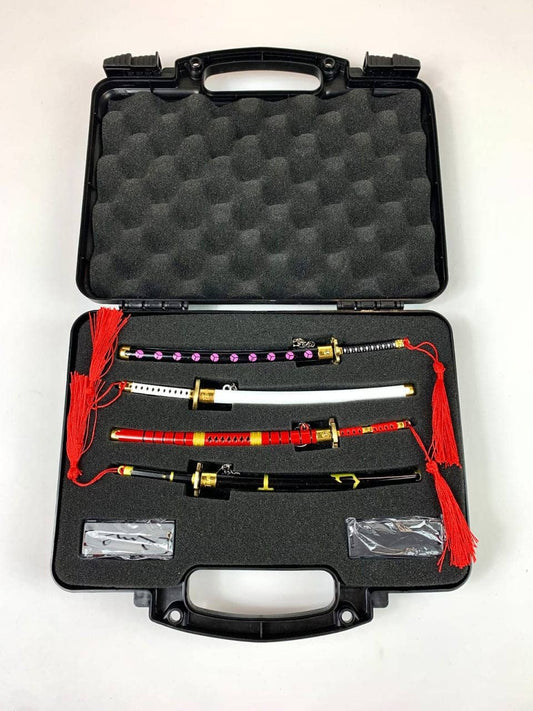


Japanese Officer Swords
Japanese swords have fascinated generations, not only for their beauty and craftsmanship but also for the rich history and symbolism they carry.
If you have ever felt the call of these steel-forged masterpieces, I invite you to delve into the world of Japanese officer swords.
These are not mere weapons; they are emblems of honor, tradition, and valor that have transcended time.
In this article, we will explore the history, types, and significance of these swords, as well as their availability for those who wish to add them to their collection.
Brief Historical Context
Japan's military history is marked by clan conflicts and feudal wars until the Meiji Restoration in 1868, which brought about the modernization of the country.
This change not only opened doors to trade and Western influence but also gave rise to a modern army that sought to emulate the military powers of the era.
In this context, Japanese officer swords began to take shape, fusing tradition with modernity.

Types of Japanese Officer Swords
Japanese military swords, known as guntō or gendaitō, were produced between 1875 and 1945.
During this period, the most common style was the shinguntō, which was characterized by its modern mounting and the mass production of its blades.
Although many of these swords were manufactured using industrial methods, some retain the tradition of artisan forging, being classified as gendaitō or kindaitō.
In physical terms, these swords typically measured between 90 and 100 centimeters in overall length, with blades between 65 and 70 centimeters.
The weight usually ranged between 900 grams and 1.2 kilograms, depending on the blade type and mounting.
The curvature was moderate, inspired by the classic katana, and they were designed for functional balance rather than prolonged hand-to-hand combat.
The shinguntō, meaning "new military sword," was used by the Imperial Japanese Army from 1935 to 1945, symbolizing not only rank but also the samurai heritage that endures in Japanese culture.
During World War II, officers were required to carry a sword, and although many were of non-traditional manufacture (known as shōwatō), these also have historical value and are prized in the collecting sphere.
Shinguntō featured standardized mountings, with ray skin (samegawa) wrapped handles and cord bindings, simple metal guards, and lacquered or painted metal scabbards.
Unlike traditional swords, many blades lacked visible differential hardening (hamon), reflecting their symbolic and regulatory function more than intensive use in combat.

Uses, Meanings, and Rules of Officer Swords
Officer swords were not just mere weapons; they were symbols of status and pride.
Each sword told a story, connecting its bearer with the rich samurai tradition.
Although many officers carried low-quality swords on the battlefield, traditional swords were often passed down through generations, creating an emotional link to the past.
The use of these swords in combat was significant, though not always the norm.
In battles such as those in Burma and New Guinea, soldiers used their swords in decisive moments, turning them into symbols of bravery and sacrifice.
However, most of the specimens that have survived to this day remain intact, making them valuable pieces for collectors.

Availability and Collectibility of the Japanese Officer's Sword
Authentic Japanese officer swords, especially those pre-1945 and traditionally forged, are increasingly rare and valued, particularly those from before World War I.
Their collectibility depends on their state of preservation, blade type, and historical documentation.
However, regardless of this, they are highly valued by those who appreciate Eastern history and by collectors of historical items, especially those focusing on the history of Japan.
Final Reflections
The Japanese officer's sword was a symbol of continuity between samurai tradition and the modern army.
Beyond its military use, it represents hierarchy, identity, and historical memory in Japan's modernization process.