América
Astronomical Knowledge of the Mayans: Predictions, Calculations, and Meanings
Systematic Sky ObservationThe Mayan civilization, which flourished from approximately 2000 BCE to the 16th century, d...




Edmund Pevensie's sword in The Chronicles of Narnia isn't just a combat tool. It's a symbolic piece that accompanies the character's evolution from betrayal to heroism. Its sober design, practical...
A Sword Between Magic and Medieval Fantasy The saga of The Chronicles of Narnia, written by C.S. Lewis, hides within its pages a universe full of fantastic creatures, epic battles, and legendary weapons. One of these weapons is Edmund Pevensie's sword, an object that not only stands out for its visually powerful design but also for its profound symbolism. In this article, we will tell you everything about this iconic weapon, from its history within the world of Narnia to its use in the films and its spiritual and narrative meaning. A Weapon Forged for Redemption Edmund's sword not only represents strength but also the transformation of a character.At the beginning of The Lion, the Witch and the Wardrobe, Edmund Pevensie is a selfish and manipulative young man, seduced by the White Witch. However, his journey in Narnia transforms him into a brave warrior. His sword becomes an extension of his inner change, symbolizing his redemption, courage, and new loyalty. Physical Characteristics of the Sword Edmund Pevensie's sword is a piece of great visual presence. Its long, straight blade appears forged from tempered steel, with a double central line that gives it structure and solidity.The pommel is ornamented with Narnian symbols, highlighting its connection to the magical world.The design was intended to combine elegance with lethality. The hilt, covered in dark leather, allows for a firm grip even during prolonged combat. The cinematic version of the sword, used by Skandar Keynes (the actor who plays Edmund), was designed by Weta Workshop's prop department, known for their work on The Lord of the Rings.The sword was made in several versions: a steel one for static scenes, and rubber or aluminum versions for action scenes. The Evolution of the Bearer Edmund Pevensie wields his sword at key moments in the saga, accompanying its bearer in his character development, reflecting his path to maturity.In Prince Caspian, he is seen fighting alongside his siblings to restore balance in Narnia, in contrast to his beginnings, when he used to act on his own and keep his distance from the others. His skill with the sword not only demonstrates his physical prowess but also his commitment to the just cause.During the battle against the Telmarines, Edmund's sword shines with its precision.It is not a decorative sword, but a weapon designed for action. Thanks to it, Edmund proves to be one of the bravest and most reliable characters in the saga; a significant change from the young man who, feeling overshadowed by his siblings, still didn't know which path to take, appearing insecure, fearful, and lonely. Symbolism and Spirituality Unlike Peter's sword, which represents leadership and nobility, Edmund's sword has a spiritual background. It is the weapon of the penitent, of one who falls but rises again. It represents the human capacity to err and find redemption through sacrifice, courage, and loyalty.Many fans interpret the sword as a reflection of the forgiveness Aslan grants Edmund. It is not just a tool of war, but an emblem of his moral rebirth. A Coveted Piece for Collectors Due to its popularity, Edmund's sword has been replicated by numerous forging houses and manufacturers of cinematic replicas. Collector's versions are usually made of stainless steel, with engravings inspired by Narnian symbols.Many collectors consider this sword an essential piece for any fan of The Chronicles of Narnia. Its elegant design and narrative relevance make it ideal for both display and cosplay. Presence in the Merchandise Market and Pop Culture Edmund's sword has been marketed in the form of action figures, toy replicas, and video games such as The Chronicles of Narnia: Prince Caspian. In each adaptation, its understated design has been maintained, reflecting Edmund's more reserved and strategic personality compared to his siblings. Legacy of a Silent Warrior Edmund Pevensie is not the most outgoing of the siblings, but his evolution makes him one of the most admirable characters. His sword doesn't have a name like Rhindon, Peter's sword, but it carries an equally powerful symbolic weight. It represents the silent warrior, the redeemed brother, the ally who doesn't need to lead to make a difference and, above all, the one who knew how to accept his mistakes, confront his weaknesses, and bravely stand as the most faithful companion, who learned from his failures and faced his fears... If you like swords, don't forget to check out the products in our store.
Read more
Conan's father's sword in Conan the Barbarian (1982 film) is much more than a weapon. It represents Conan's legacy, warrior culture, and identity. Forged from tempered steel and decorated with...
A weighty weapon in Conan the Barbarian In the universe of Conan the Barbarian, few weapons carry as much symbolic weight as Conan's father's sword.Introduced at the beginning of the 1982 film, directed by John Milius and starring Arnold Schwarzenegger, this sword embodies not only Conan's blood legacy but also the essence of his people, his lineage, and his life's mission. More than a combat tool, it is an ancestral emblem of power, heritage, and justice. The teaching of steel: legacy and formation The relationship between Conan and his father is defined from the very first scene, when his father speaks to him about the sword and the "riddle of steel." This scene highlights the importance of the weapon as an object of training and legacy.The sword represents a direct link to paternal wisdom and the tribal culture that will be annihilated by Thulsa Doom, leaving the sword as one of the few tangible memories of that lost past. (Image of the Conan's Father's Sword, Bronze Color) Carefully thought-out appearance and details From its shape to its ornamentation, every detail contributes to giving this sword an image that is not only recognizable, but also powerfully symbolic. Physical and functional characteristics Conan's father's sword stands out for its robust and functional design. It is a large weapon, ideal for two-handed use, with a straight, double-edged blade, designed for effective cutting and thrusting.We can assume it is forged from tempered steel, with a high carbon content, which would give it strength, toughness, and durability in combat.Its polished surface reflects not only light but also the spirit of an era forged in battle. Runic and ancestral symbolism One of the sword's most distinctive features is its runic engravings.These symbols, clearly inspired by Nordic or Celtic designs, allude to concepts such as protection, magical power, and spiritual connection. The ancient runes are not mere adornments, but a symbolic statement: this sword not only wounds, it also protects and guides. And it effectively contributes to conveying the idea of a sacred relic that condenses the history and spirit of an entire warrior people in its blade. The deer head: strength, nobility, and nature Another notable element is the hilt, decorated with a deer head, a symbol of strength, nobility, and connection to nature.This figure reinforces the idea that the sword is not merely an instrument of death, but a channel to higher values. Through this adornment, the nobility of its original wielder and the dignity of their struggle are conveyed. (Image of the Conan's Father's Sword, Silver) A symbol of struggle, justice, and redemption As history unfolds, Conan's father's sword becomes much more than a relic. It is a spiritual guide, a constant reminder of the past and of duty. Its emotional weight is as strong as its physical power. It represents the fight for justice, vengeance for the lost people, and the redemption of his lineage.Conan's father's sword is much more than a cinematic weapon. Within the world of its own story, it is the soul of a culture, the essence of a legacy, and the emblem of an eternal struggle for justice.Its imposing design, runic engravings, and the deer head on the hilt make it an object laden with meaning.Throughout Conan the Barbarian, this sword accompanies the protagonist as a constant echo of his past and a guide on his path to redemption and glory. In the brutal world of Hyboria, this sword symbolizes good, courage, and justice.
Read more
The Conan the Barbarian saga is legendary not only for its epic story and its imposing protagonist, but also for the weapons that accompany him. In this article, we take...
The Story of Conan the Barbarian During the Hyborian Age, a dark time dominated by the power of the sword and sorcery, Thulsa Doom and his cruel army of warriors entered a Cimmerian village, killing the inhabitants, except for the children who were taken prisoner. Conan was one of them and he saw with his own eyes how they killed his father and beheaded his mother . Something Engraved in his memory along with his nascent thirst for revenge was the banner carried by the invaders, two facing serpents over a moon and a rising sun. She endured many trials and tribulations until she gained her freedom, thus beginning her path to justice and revenge against Doom, the culprit of destroying her home . A path in which she would face many enemies, but also find allies. Atlantean, Conan's first sword How did this come into your hands? At the beginning of that path he falls into a cave where he acquires the Atlantean sword by taking it from a skeleton. The acquisition of the Atlantean sword represents a narrative turning point. It is a symbolic piece forged according to Atlantean mythology . It is the silent impulse that guides him toward his destiny and is considered one of the most iconic weapons in fantasy cinema, representing the fight against evil, as well as his strength and ability to face adversity. Throughout the film, the sword becomes a symbol of his journey and evolution as a character, from his thirst for revenge to a hero who will bring justice and peace to the world . Its design has transcended its function within the film, becoming a recognizable icon within the imaginary of fantasy cinema of the 80s . (Image of an Atlantean Sword, decorative replica ) Description and curiosities A curiosity worth mentioning is that this Atlantean sword , for the 1982 film "Conan the Barbarian", directed by John Milius and starring Arnold Schwarzenegger, was designed by Ron Cobb , recognized for his work in visual effects and scenery in other science fiction and fantasy films, who in making it sought to capture the aesthetics of the Conan era and reflect the mythical and legendary background of the character, combining elements of ancient art with a fantastic style. The handle features intricate goldwork, with zoomorphic motifs and skulls reminiscent of a mythological Atlantean imaginary. The design follows the visual setting criteria typical of epic productions set in fictional cultures of great lost civilizations , aligned with the narrative of history. The engraved runes They are also an important element in the film's mythology, representing a type of writing associated with ancient cultures and, in the context of "Conan the Barbarian," adding mystery and antiquity to the weapon. Although visually impressive, the runic inscriptions on the blade do not correspond to any decipherable historical alphabet, but rather act as visual elements that refer to protohistoric writing and cinematic symbolic mysticism. Conan's allies On his journey, Conan encounters several allies, one of the main and closest being Subotai, a thief and excellent archer played by Gerry Lopez . A cunning and skilled character, he is known for his skill with the bow and his ability to move stealthily. Throughout the film, he provides support and loyalty to Conan in his quest for revenge against the main villain. Their relationship is a blend of camaraderie and mutual respect. We can also mention Akiro , played by Mako Iwamatsu . A wise man and sorcerer who also joins Conan's cause. Akiro brings a deep knowledge of the supernatural and the world of magic, which is crucial in several parts of the story. Although he is not a warrior in the traditional sense, his wisdom and mystical abilities are valuable to the group. In addition, this character brings a touch of humor and humanity, balancing the seriousness of the plot. Both characters are essential to the development of the story , helping to show different aspects of Conan's struggle , not only against his enemies, but also in his search for identity. The dynamic between Conan, Subotai and Akiro enriches the narrative and adds depth to the film. (Illustration of Valeria's Sword, from Conan the Barbarian ) Valeria, Conan's unconditional support Finally , we can highlight the person who becomes her unconditional ally , Valeria, played by Sandahl Bergman . A strong and charismatic character. Throughout the film she displays a balanced mix of strength and vulnerability. While she is a formidable fighter, a skilled and brave warrior, capable of facing challenges and dangers with great skill, and with a bold and determined personality, she also has a softer, more emotional side, especially in her relationship with Conan. This character is constructed with an archetypal duality: competent warrior and affective figure , which allows for the exploration of gender and emotional dynamics in narrative contexts dominated by action. She represents a strong woman in a world filled with violence and betrayal, and her connection to Conan adds depth to the story, showing that despite the brutality of the environment, there is also room for love and loyalty. Her character and determination make her a fundamental pillar in the story, or offering her unconditional support , not only sharing her adventures and battles, but also providing emotional support and helping the protagonist confront his fears and his past. The Sword of Valeria The weapon Valeria carries is designed to reflect her narrative character: stylized, with a curved blade and functional ornamentation . It functions both as a combat tool and as a symbolic extension of the character, reflecting the style of swords of the period . The hilt is elegant and features ornate details that give it an attractive and powerful appearance. It is a symbol of bravery, loyalty, and the fight for good and freedom at any cost ; central elements in the story.
Read more
Kill Bill is not only a masterpiece of modern action cinema, but also a visual and narrative homage to samurai culture and the art of the Japanese katana . Directed...
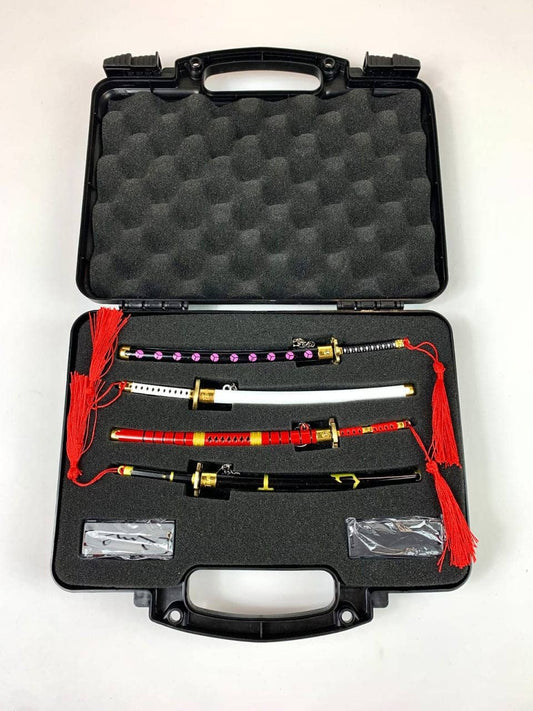
Kill Bill The origin of the film Kill Bill dates back to the days of shooting Pulp Fiction. It was during breaks between scenes that Uma Thurman and the brilliant director Quentin Tarantino began to outline a fascinating story: that of a ruthless assassin who, after trying to leave the world of crime for a normal life, is betrayed and attacked by her boss's group. Thus began one of modern cinema's most memorable tales. The story of Kill Bill: Tragedy and revenge It all begins during a wedding ceremony in the middle of the desert. A commando breaks into the small chapel and brutally murders the groom and guests. The Bride—played by Uma Thurman—, pregnant, is left for dead, though she miraculously survives the attack and falls into a coma. Four years later, she awakens and, thirsty for revenge, begins her lethal crusade against those who took her life and that of her child.Having worked for the deadly Deadly Viper Assassination Squad, she now has only one goal: to avenge the death of her loved ones. Thus, she sets out to eliminate all members of the criminal organization one by one, culminating her journey with the final confrontation against Bill, her former lover and leader of the gang. (Image of The Bride's Hattori Hanzo Katana, replica) Who is Hattori Hanzo in Kill Bill? One of The Bride's first decisions after waking up is to go to Okinawa. There she meets Hattori Hanzo, a legendary Japanese swordsmith and master, considered the best katana maker in the world. For over 25 years, Hanzo had not created a single weapon, feeling remorse for forging instruments designed for killing.However, when The Bride reveals to him that her goal is to eliminate Bill—a former student of Hanzo, whose behavior had dishonored his legacy—, the master decides to break his vow to forge one for her. For an entire month, Hanzo works on a new katana, which he describes as "the best blade he has ever made." (Swords like these, historically, would require a traditional forging technique of 3 to 6 weeks, using tamahagane steel and techniques such as folding and differential hardening with clay, consistent with the time mentioned). The katana used by Uma Thurman was designed following real aesthetic and ergonomic parameters of the Japanese Edo period, though incorporating stylistic liberties characteristic of cinema. The production designer consulted martial arts and traditional forging experts to achieve a visually stunning yet functional result on screen.Thus, the final design featured a curved blade approximately 70cm long, appearing to be made of San-mai type tempered steel, a technique used for a balanced edge and flexibility, and a visible hamon, giving the appearance of having used a differential tempering technique to reinforce its edge while maintaining flexibility. With a sober appearance that, along with the care of these details to resemble traditional katanas, was ideal.Thus, this weapon of pure steel, sharp blade, and elegant design, a symbol of power, became the emblem of the film. Hattori Hanzo's legacy Quentin Tarantino revealed in the DVD extras for Kill Bill that the character's name is a direct homage to the legendary Hattori Hanzō, a real ninja and samurai from the 16th century. Although not explicitly mentioned on screen, the film's swordsmith is said to be a descendant of that historical warrior.This detail adds an additional layer of depth to Tarantino's cinematic universe. (Image of a Hattori Hanzo Katana, replica) The Relevance of Swords in Kill Bill Iconic Scene: The Japanese Sword Gallery The sequence in which Thurman ascends to the upper floor of Hanzo's bar to contemplate his sword collection is one of the most revered. With a solemn and almost sacred air, it shows The Bride, full of respect, hesitating even to touch one of the legendary blades. This scene expresses the profound meaning of katanas in culture and the mysticism surrounding Hanzo's swords in the plot, considered deadly works of art.It also shows that, unlike many Japanese swords of the Muromachi period, these seem to be inspired by the Shinogi-Zukuri style, with a well-defined cutting line and a lighter weight to maximize attack speed. Emblematic Swords from Kill Bill One of the most iconic elements of Kill Bill is, without a doubt, its swords. These weapons are not only impressive for their design but represent the essence of each character. We have:· The Bride's Katana: The most emblematic and characteristic of the series. A sword forged by Hattori Hanzo, representing the purity of purpose, determination, valor, and rebirth. Its curved design, precision, and aesthetics make it an extension of its wielder, and in every duel, they manage to denote that its curvature and edge allow for a combat style based on precise and rapid cuts.· O-Ren Ishii's Katana: This katana captures the essence of its owner, the ruthless Yakuza boss. Curved and richly decorated, it reflects both O-Ren's discipline and ferocity. Lacking a Tsuba, and also named as a Hanzo sword.· Budd's Katana: Another Hanzo katana. Kept in secret without being used, its presence symbolizes the weight of the past and the latent violence in a warrior who renounced his path.· Bill's Katana: Also forged by Hattori, unlike others, it featured a straighter and polished blade, symbolizing his elegance and dominance. It is the perfect reflection of his character: lethal, calculating, and at the same time, sophisticated. (Image of the Kill Bill Katana Pack, replicas) The Aesthetics of Violence and the Warrior's Code The violence in Kill Bill is carefully choreographed, with a visual style that pays homage to samurai cinema and kung-fu films. But what truly stands out is the respect each character shows for their sword, almost as if they were sacred relics, something that undoubtedly honors the profound significance these weapons have held throughout history for their wielders and for the cultures from which they originate.
Read more
Muramasa swords have transcended the boundaries of Japanese history to become authentic symbols of mysticism, power, and artisanal excellence. Forged by one of the most enigmatic blacksmiths of feudal Japan,...
The Swords of Muramasa Since time immemorial, swords have been symbols of power, honor, and skill in Japanese culture, with katanas being particularly prominent among them. Among the many legends of blacksmiths, especially Japanese swordsmiths, none resonates as much as that of Muramasa, a name that evokes both admiration and fear. Muramasa swords are not just weapons; they are pieces of art, history, and mysticism that have endured throughout the centuries. I invite you to explore the legacy of these swords, their unique characteristics, the stories surrounding them, and their value in today's world. Distinctive Characteristics of Muramasa Swords · Muramasa-ba (Blade Pattern) The uniqueness of Muramasa swords begins with the Muramasa-ba, the hamon or temper pattern that adorns their blades, very characteristic of katanas. These distinctive lines, which can resemble dancing flames or rolling waves, are not merely decorative. They act as an indicator of the different levels of hardness along the blade, resulting in greater cutting ability and durability. The Muramasa-ba has become a recognizable symbol of Muramasa's mastery. · Muramasa-nakago (Tang) The nakago, or tang, is another essential feature of these swords. Although hidden within the hilt, its meticulous craftsmanship reveals much about its history. It often features engraved markings and a finish that combines functionality with aesthetics. Experts can sometimes date the sword based on the shape of the nakago and its markings, providing a deeper connection to its time of manufacture. Cursed Reputation The infamy of Muramasa swords stems from their supposed cursed nature. Throughout the ages, legends have held that these swords tend to incite their wielders to acts of violence and aggression, or demand to be stained with blood, whether of an enemy or the wielder himself. This influenced many samurai to prefer not to own them. This dark myth has contributed to their mystical aura, attracting admirers and fans, both believers and skeptics. Muramasa Swords in Today's Market Genuine Muramasa pieces are now rare and highly valued. The legacy of this smith has been passed down through generations, but many of his works have disappeared during wars and political crises. Possession of a Muramasa sword was once considered an almost criminal act, which has only increased its rarity and, consequently, its value.Currently, an authentic sword can fetch prices in the tens of thousands of euros at auction.The history carried by a Muramasa sword not only speaks of its quality; it is a journey through time, unparalleled craftsmanship, and a legacy that continues to defy history. Muramasa: An Enduring Legacy Despite Muramasa's figure being shrouded in mystery, the impact of his swords on Japanese history is undeniable. From samurai warriors to contemporary collectors, his works capture the imagination of those seeking to understand the essence of Japanese culture. The legendary aura surrounding Muramasa not only highlights the quality of his work but also the importance of the symbolism that swords hold in Japanese narrative.Historians like Oscar Ratti and Adele Westbrook have argued that the dark reputation of these steels may have influenced why they are not yet classified as 'National Treasures of Japan'. Perhaps, with the evolution of cultural perception and greater recognition of historical and technical relevance, the recognition of Muramasa's work will change in future generations. Legendary Muramasa Swords and Their Bearers Muramasa swords are renowned for their mysticism and their connection to legendary warriors. Known as "swords that transcend time," their fame has endured through generations, capturing the imagination of many. These are just a couple of them: · Muramasa no Kaze: The Wind Sword of Yamato Takeru Belonged to Yamato Takeru With a lighter blade than common ones, this sword is designed for fast and evasive combat. Its edges are as sharp as the wind, allowing for precise and lethal cuts.Yamato Takeru, a heroic figure in Japanese mythology, is known for his bravery and ingenuity in battle. It is said that he was able to subdue powerful enemies thanks to the spirituality emanating from the Muramasa no Kaze sword. This blade was not only a tool of war but a companion that guided him in his quest and protected him in adversity. · Muramasa no Hōō: The Phoenix Wielded by Yoshitsune Belonged to Minamoto no YoshitsuneThis sword is famous for its blade decorated with phoenix symbols, representing rebirth and renewed strength. Its hilt is robust, providing a firm and powerful grip.Minamoto no Yoshitsune was one of Japan's most legendary warriors, whose strategies and bravery have been admired for centuries. It is said that by wielding Muramasa no Hōō, Yoshitsune not only became a formidable leader but was also endowed with unparalleled fearlessness, capable of confronting entire armies at the command of his loyal warriors. Muramasa's legacy is a testament to how art and history can intertwine to create pieces that not only stand out in their time but also inspire and fascinate through the ages. Muramasa swords, with their unique characteristics and the mysticism surrounding them, are more than simple weapons; they are an enduring cultural legacy. For those who feel a connection to history, craftsmanship, or ancient myths, the story of Muramasa continues to offer a rich and engaging narrative that will endure for future generations. The deep admiration they commanded in their time remains intact, reminding us that some legends never die. If you like katanas, ancient swords, both Japanese and from around the world, and collecting, do not hesitate to visit our Online Store.
Read more
A journey through the history and evolution of the katana, from its origins influenced by Chinese swords to its consolidation as a symbol of samurai culture.
A question that intensifies with globalization Swords have been symbols of power, honor, and skill throughout history, but few have captured popular imagination like the katana. This elegant curved blade, with its distinctive design and almost mystical aura, has come to represent the mastery of Japanese smithing and samurai nobility. However, as we explore its past, we ask: are katanas truly exclusive to Japan, or have they been influenced by traditions from other countries, particularly China? In this article, we will discover its fascinating history, from its conception by masters like Masamune to its relevance in the world today. Historical origins and their Chinese influence The history of the katana begins approximately thirteen hundred years ago, during the 8th century. The swords that preceded it, such as the jian and the tang-dao, were Chinese swords that arrived in Japan long before the modern katana took shape. Although these ancient swords differed considerably in design—the jian is a straight, double-edged sword, while the dao is a curved, generally single-edged blade—talented Japanese blacksmiths learned and adapted. Through a gradual process of innovation and improvement, a weapon emerged that was both functional and artistic. During the Heian period (794-1185), Japanese swords began to evolve. Although the katana as such did not yet exist, long swords known as tachi began to become popular among the aristocracy and samurai; they had a curved shape similar to that of the katana but were designed to be worn suspended with the cutting edge facing down. As combat evolved, the need for a sword that allowed for quick drawing and a fluid transition between attack and defense became apparent.It was during the threat of Mongol invaders in the 13th century that the need for a sword that could penetrate their thick leather armor arose, giving birth to the katana, which irreversibly changed the way of fighting in Japan. Chinese influences on the evolution of the katana The influence of Chinese traditions on sword forging is undeniable. Early Japanese blacksmiths adopted Chinese forging and metallurgy techniques, and although they adapted them to their own cultural context, it is possible to trace a link across the centuries that illustrates how these influences shaped what would eventually become the katana. In addition to Chinese swords, there are also other types of Japanese swords that help contextualize the evolution of the katana. The wakizashi, a shorter sword often carried alongside the katana, also evolved from tactical needs, specifically its usefulness in more confined spaces. Together, these swords formed the daisho, a symbol of a samurai's status. The Golden Age of the Katana As we move forward in time, we reach the Muromachi period in the 14th century, where the art of sword forging reached its zenith. It became a cultural and spiritual symbol. Unfortunately, the creation of quality katanas could not always be maintained. During the turbulent Sengoku period, when Japan was plunged into internal wars, the demand for swords increased dramatically. This led to more industrialized production, where quantity surpassed quality. Later, with the unification of Japan and the establishment of the Edo period (1603-1868), there was a fundamental change in the perception of the katana. In this time of relative peace, the sword became an object of art rather than a weapon of combat.Forging techniques were refined and master blacksmiths such as Masamune and Muramasa became famous for the quality and beauty of their swords. These swords were considered "alive" and were believed to possess a spirit that could offer protection or cause calamity.This era marked the peak of the katana, a weapon that was not only a lethal instrument but also a work of art. And while the masters of Osaka created beautiful and decorated swords, katanas began to be used less on the battlefield and more as symbols of prestige. The katana in the modern era: Japanese tradition and cultural legacy The rise and fall of the katana continued into the 19th century with the Meiji Restoration, which brought with it a wave of Westernization that swept away many ancient traditions. Samurai swords, which were objects of respect and power, became relics. Despite the abolition of katanas in public and the emergence of firearms, there is a resurgence of interest in these swords. Today, enthusiasts and collectors seek to acquire authentic katanas, demonstrating that the fascination with these objects has not diminished over time. Their popularity has expanded beyond Japan and is recognized and imitated worldwide.The ability of contemporary smiths to keep katana forging traditions alive reflects a deep connection to Japanese history. While the katana may have roots intertwined with Chinese influences and other traditions, its specific evolution and intrinsic symbolism are essentially Japanese, and it has come to represent not only the skill and spirit of samurai warriors but also a rich history of innovation, adaptation, and a cultural legacy that endures to this day. So, are katanas truly Japanese? Although its origins are intertwined with influences from other traditions, particularly ancient China, its evolution and perfection, to become the characteristic sword it is today, occurred in Japan. The essence of the art of katana forging, its cultural significance, and its aesthetics are undeniably Japanese. As we explore its history, the legacy of bravery and honor it represents is indisputably Japanese. It is a symbol that continues to inspire generations and, undoubtedly, still has much to tell. If you like katanas, or even want to see other types of swords, including Chinese ones, do not hesitate to visit our online store.
Read more
If you're interested in Japanese history and samurai culture, you'll surely find this introduction to Daishō helpful, as it teaches you about its meaning, history, and relevance to samurai.
The Daishō In the fascinating world of katanas, one of the most emblematic practices is the use of the daishō, a pair of Japanese swords usually composed of the katana and the wakizashi, which is its most commonly known form, although it has also been formed by other duos of traditional Japanese swords. The daishō embodies the elegance, duality, and tradition of the art of swordsmanship in Japan, as well as being transcendent in samurai history.In this article, we will take a look at the historical importance of the daishō, its symbolism, and its application in combat. Origin of the name Daishō The daishō originated in feudal Japan, where it was primarily used by samurai as a symbol of their high social status and martial prowess. The term "daishō" literally means "large and small" and refers to the different sizes of the two swords that comprise it.The word daishō comes from the combination of "daitō" (long sword) and "shōtō" (short sword). Initially, it referred to the practice of carrying a katana and a wakizashi together, without necessarily being made by the same smith or having matching fittings. However, over time, the concept of daishō evolved to imply two swords with coordinated designs and decorations. In the early days of the samurai, the tachi was paired with a tantō. Later, the katana was combined with a shorter version of itself, known as the chiisagatana. With the rise of the katana, the wakizashi became the preferred secondary weapon of the samurai, as, according to Kanzan Satō in his book The Japanese Sword, it was ideal for indoor combat. Samurai often left their katana at the entrance of castles or palaces and kept the wakizashi with them. History and regulation of the Daishō The use of the daishō became popular at the end of the Muromachi period (1336-1573), although records of its existence date back to the 16th century. In 1629, an edict was issued defining the duties of the samurai and including the daishō as part of their regulation equipment. In 1683, its use was restricted exclusively to the samurai class, making it a status symbol. Although samurai could wear decorative swords in daily life, the Tokugawa shogunate regulated their use on formal occasions, such as audiences in castles. For official events, the daishō had to have a solid black scabbard, with the hilt wrapped in white rayskin. During the Meiji period, in 1871, the restrictions obliging samurai to carry daishō were abolished. Finally, in 1876, most of the population was prohibited from carrying swords in public, which marked the end of the daishō as a fundamental part of the samurai identity. Symbolic meaning of the Daishō The daishō symbolizes the duality of the samurai, combining the strength of the katana with the precision of the wakizashi. Traditionally, the katana represented the soul of the samurai, while the wakizashi symbolized their honor and loyalty. Together, these weapons embodied the balance between power and control, essential aspects of the warrior's philosophy. Use of the Daishō in combat The daishō was designed to offer tactical flexibility in combat. The katana, with its long, curved blade, was used for long-range attacks, while the wakizashi, shorter and less curved, was ideal for close-quarters combat and confined spaces. According to most traditional kenjutsu schools, only one of the daishō swords was wielded in combat. However, in the 17th century, the legendary swordsman Miyamoto Musashi developed a fighting style in which both swords were wielded simultaneously. This technique, known as Niten Ichi-ryū, allowed attacking and defending with both hands, revolutionizing the swordsmanship strategies of the time. Ritual and etiquette of the Daishō The use of the daishō was subject to strict rules. Samurai had to handle their swords with respect and caution, avoiding unnecessary contact between the blades. Furthermore, regularly cleaning and maintaining the daishō was a sign of dedication and discipline. Although the practice of carrying daishō has diminished over time, its influence persists in Japanese culture. Today, these sword pairs are exhibited in museums and private collections as testimonies of their historical importance. Additionally, the idea of duality and balance between power and control remains relevant in many Japanese martial arts. The eternal magnificence of the Daishō The daishō represents the essence of the art of the katana and embodies the spirit of the samurai. Its symbolic meaning and its application in combat are fundamental pillars of Japanese culture. Exploring the legacy of the daishō allows us to understand the richness of this ancient tradition.Whether you are an enthusiast of Japanese martial arts or simply admire samurai culture, the daishō remains a timeless symbol that fascinates and inspires generations.
Read more
With more than two centuries among these forgers, their fame, a perfect example of the duality of Yin and Yang, has been such that legends even place them together, although...
Masamune and Muramasa, Two Opposing Masters of Katana Forging The legendary katanas of Gorō Nyūdō Masamune and Muramasa have transcended time, becoming an essential part of Japanese folklore. They are a reflection of the duality between good and evil, a recurring concept in samurai culture. These samurai swords stand out not only for their beauty and craftsmanship, but also for the stories of mysticism and power that surround them. The Wisdom of Masamune: The Saint of Katanas Masamune, known as the "saint of katanas", was a master swordsmith of the Kamakura period (1185-1333). His forging technique was unparalleled, achieving a perfect balance between hardness and flexibility. His swords were not only deadly weapons but also symbols of honor, justice, and masterful craftsmanship. Masamune's katanas stood out for their sharpness, strength, and elegant design. It is said that he infused his creations with a spiritual aspect, making them much more than mere weapons. Katana forging in Japan is an ancient art, and Masamune elevated this practice to a legendary level. The Shadow of Muramasa: Cursed Swords Muramasa, unlike Masamune, is remembered for forging katanas with extraordinary sharpness, but shrouded in a sinister aura. Born approximately two centuries after Masamune, his swords were considered "bloodthirsty" and were believed to induce madness and violence in their bearers. Many Japanese legends attribute a kind of "curse" to Muramasa's swords, which has made them an object of fascination for lovers of samurai history and legendary sword forging. Although, of course, there is no concrete proof of this supposed curse, the stories have endured in popular culture. The Encounter of Masamune and Muramasa: A Timeless Myth It is often said that Masamune and Muramasa were rivals, even though historical reality tells us they existed almost 200 years apart. However, their swords coexisted in the same time and space, which has given rise to fascinating myths about confrontations between the two smiths, especially due to the differences that make them almost opposites: Masamune, a symbol of calm and moderation, contrasted with Muramasa's impetuous and violent image. One of the most well-known tales is the Challenge of the Swords, in which both smiths test their creations in a stream. Muramasa's katana, Juuchi Fuyu ("merciless winter"), indiscriminately cut everything it touched, whereas Masamune's, Yawarakai-Te ("tender hand"), avoided harming what was unnecessary. A monk who witnessed the test declared that Masamune's katana was the true masterpiece, for it distinguished between good and evil. The Waterfall Test and Katana Forging, Another Version of Masamune vs. Muramasa Another similar legend, or perhaps another version of the same, tells that Masamune and Muramasa forged swords for the shogunate and, to test their quality, threw them into a waterfall. Muramasa's sword cut every drop of water it touched, while Masamune's passed through the water without resistance. This tale reinforces the perception that Masamune created sacred swords, while Muramasa was the forger of cursed weapons. The Legacy of Masamune and Muramasa in Popular Culture The duality between Masamune and Muramasa goes beyond legends; it represents the eternal struggle between balance and chaos. Their legendary samurai swords have inspired countless stories, anime, manga, and video games, keeping alive the fascination with Japanese katana forging. Through these stories, interest in Japanese history and its traditions continues to grow. Each katana tells a story, and each ancient forge hides secrets that still await discovery. In a world where the line between myth and reality is blurred, the legends of Masamune and Muramasa continue to captivate those who seek the art and mystery of samurai swords. Perhaps they are not legendary swords, but if you take a look at our katanas here, you surely won't regret it.
Read more
If you've ever wondered why katanas are so prestigious, I invite you to continue reading to discover some of the reasons why these swords are the marvels they are, enduring...
The Legacy of Katanas There is something about the katana that captures the imagination and inspires admiration in all who behold it. More than a sword, it is a symbol of art, craftsmanship, culture, and spirituality. Although its time as a weapon on battlefields ended centuries ago, it remains a revered, desired, and deeply respected object worldwide.Its legacy is marked by its impeccable functionality, artistic beauty, and intimate connection to samurai tradition and the values of honor, discipline, and loyalty. To hold a katana in your hands is not just to hold a masterpiece of engineering, but to connect with centuries of history and the soul of Japan.I invite you to read on to explore more of what makes these Japanese swords so remarkable. Unique and Balanced Design The design of the katana is a testament to the perfection achieved by Japanese swordsmiths. Its curved blade, created through the process of "differential hardening," is not only aesthetic but also functional: this method combines a hard edge with a softer spine, achieving a perfect balance between strength and flexibility.The curvature of the blade is achieved by rapidly cooling it in water or oil after heating, a change that not only gives it its characteristic shape but also its ability to make clean and precise cuts.The forging technique known as sanmai, which combines three layers of carbon steel, further reinforces the katana's durability. The central layer, made of softer steel, provides impact resistance, while the harder outer layers ensure an incomparable edge.This level of detail and technical perfection makes it one of the most effective swords ever made. Work of Art and Cultural Symbol In feudal times, katanas were custom-forged for each samurai, becoming an extension of their spirit. They were not mere combat tools; each katana was unique, with decorations on the hilt, sheath, and/or blade that reflected the warrior's personality and achievements. These details not only beautified them but also endowed them with personal and cultural significance.The katana is also deeply linked to bushido, the samurai code of honor. It was believed that the samurai's soul resided in his sword, and this spiritual bond meant that the katana was treated with almost religious respect. It was a symbol of honor, loyalty, and self-control, values that samurai lived by fervently.Even today, the katana remains a representation of Japanese art. Collectors and lovers of Japanese culture consider it a masterpiece that encapsulates centuries of history and tradition. Legends that Fuel its Prestige The mystical aura of the katana is enriched by the legends that surround it. One of the best-known stories is that of Susanoo, the storm god, who slew the giant serpent Yamato-no-Orochi and found in its tail the legendary sword Kusanagi no Tsurugi (Grass-Cutting Sword). This sword became one of Japan's three sacred treasures, representing imperial power and legitimacy.Another legend speaks of swords with magical names and abilities such as "Heavenly Pointed Long Blade" or "Great Reaping Blade," which appear in ancient texts like the Kojiki. These stories reinforce the idea that katanas are not just weapons, but also objects of great spiritual power. Versatility and Perfection in Combat The katana was the samurai's inseparable companion on the battlefield. Its design allowed for fluid handling, whether with one or two hands, and its long handle enabled precise and powerful cutting techniques. Thanks to its lightness and balance, it became an extremely versatile weapon, suitable for both quick skirmishes and prolonged engagements.It was also a symbol of status and was often passed down from generation to generation as a family treasure. This heritage and exclusivity further added to its prestige. Unique Characteristics that Transcend Time Each katana is a testament to the skill and care of master swordsmiths. From its curved blade and ray or sharkskin-wrapped hilt to its perfectly designed wooden sheath, every detail has a functional and aesthetic purpose. Engravings on the blade, such as inscriptions or decorative patterns, not only beautify the sword but also narrate stories of the warriors who wielded them.Furthermore, traditional manufacturing techniques, such as the use of bamboo pins to secure the blade to the handle, ensure they are both durable and repairable. These characteristics differentiate them from common swords and reinforce their reputation as perfect weapons.That is why, even though each smith had their own methods, their work and overall design have remained faithful over time. Enduring Popularity in the 21st Century Today, the katana remains an object of desire for collectors, martial artists, and enthusiasts of Japanese culture. Whether as a training tool in martial arts like kendo and iaido, or as a display piece, it maintains its prestige as a cultural icon.The global fascination with katanas has also been fueled by their presence in movies, TV series, and video games. In popular culture, they are associated with strong and honorable characters, perpetuating their symbolism as a weapon of power and grace. An Eternal Legacy The katana is much more than a sword; it is an emblem of history, art, and spirituality. Its unique design, its connection to culture, and the legends surrounding it have made it a timeless object that continues to captivate generations.To own one is not just to possess a weapon, but also a fragment of rich Japanese tradition. Its prestige, fueled by its beauty and functionality, makes it an eternal symbol of excellence.If you ever dream of holding a piece of history that represents honor, discipline, and mastery, the katana will surely awaken your admiration and respect. Have you seen our variety of katanas? You can do so here.
Read more