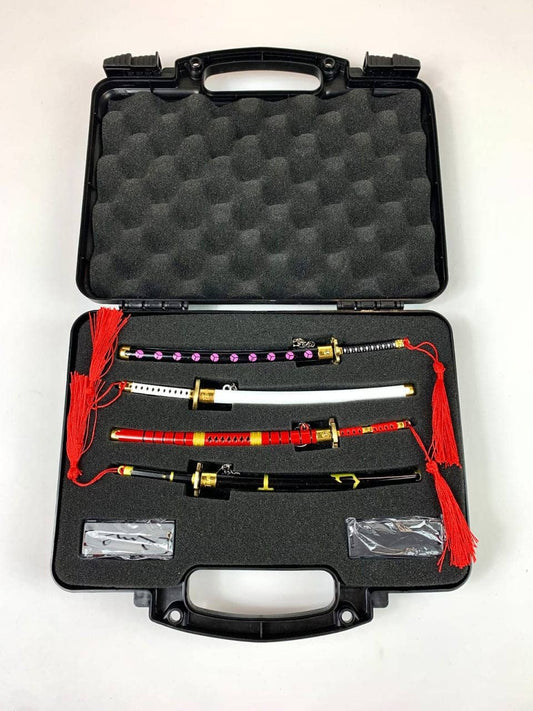


The Katana Blacksmiths
In the vast and fascinating universe of swords, none holds a place as revered as the katana. This sword, an undisputed symbol of samurai culture, is not just a weapon, but a work of art forged with ancestral mastery.
Since its creation, a halo of mystery and admiration has been woven around its makers, who have left their mark on history through the unparalleled elegance and quality of their creations, even to the point where it is often said that their forging was aided by the gods...
In this journey through time, we will explore not only the most celebrated, such as Masamune and Muramasa, who deserve separate articles, but also other master smiths who have contributed to the richness of this Japanese tradition.
Gorō Nyūdō Masamune: Timeless Mastery
Let's begin our journey with Masamune, the great master blacksmith of the 13th century, whose legacy endures to this day. This innovator is known for having perfected the art of forging, creating the famous tamahagane, or "jewel steel"/"precious steel". Although the details of his life are shrouded in mist, the legends about his swords, such as the Honjo Masamune, considered one of the best ever created, shine brightly, even though the lack of signature on his works has caused many to be lost in time.
Sengō Muramasa: The Dark Side of the Forge
In contrast to the luminous figure of Masamune, we find Muramasa, the blacksmith who turned steel into a symbol of fatality. His swords, believed by many to be cursed, gained notoriety in legends due to their insatiable thirst for blood.
It is said that, upon submerging their swords in a river, Muramasa's sword would cut any living being it encountered, while Masamune's refused to do so, letting the leaves flow unharmed. This duality of honor and evil in the art of forging adds a fascinating touch of mystery to the history of Japanese swords.
However, they were not the only Legendary Masters

Fujiwara Kunitsugu
This Heian period smith is renowned for his skill in creating swords that resembled works of art. He based his technique on the Masamune tradition, achieving a near-perfect balance between beauty and functionality.
Hikoshirō Sadamune (Sōshū Sadamune)
A student of Masamune, he is recognized for his ability to produce high-performance katanas; his creations were sought after by numerous warriors who valued their exceptional sharpness and precision.
Amakuni Yasutsuna
A 10th-century master, Yasutsuna is perceived as one of the great innovators, with the first long, single-edged curved sword (tachi) associated with him. His legacy was kept alive in the way samurai families venerated him throughout the centuries.
Kanesada
Active during the Edo period, the Kanesada forging school stood out for its strong and durable swords, capable of holding up in battle without losing their shape.
Kiyomaro (Yamaura Kuranosuke)
Considered one of the best smiths of the Kamakura period, Kiyomaro forged swords that were prized not only for their functionality but also for their aesthetic design.
Nagasone Kotetsu
Initially known as Nagasone Okisato, he was born in Sawayama and dedicated himself to sword forging during the Edo period, becoming a master whose works are prized for their exceptional sharpness.
His swords were famous for their resistance and their ability to pierce helmets, however, it is said that they were counterfeited so frequently that he himself could not distinguish them.
Shizu Kaneuji and the Kanenobu clan
Recognized at the end of the Edo era, he was a student of Masamune. Both he and his clan have created various types of samurai weapons, including katanas, wakizashis, and spears that have lasted for more than six centuries.
They were recognized for their innovative approach, which preserved tradition while incorporating modern elements.
Sanjō Kokaji Munechika
A swordsmith who shone in the imperial court, Munechika is famous for his ability to create katanas that were not only efficient in combat, but also stunningly beautiful, giving rise to several legends surrounding him and his katanas, such as having received help from a fox deity to forge one of them.
Fukuoka Ichimonji School Swordsmiths
Their name resonates in history. Considered among the progenitors of the art of forging, the members of the Ichimonji school are famous for their well-proportioned and balanced swords, which are still studied today.

Tradition in the Present
Despite the centuries that have passed, sword forging in Japan remains a revered art. Contemporary masters like Yoshindo Yoshihara, Gassan Sadatoshi, Ono Yoshimitsu, Akitsugu Amata, or Masamine Sumitani, are a symbol of the Japanese forging heritage. Following the traditions of their ancestors and using ancestral techniques, they keep the flame of this sacred art alive.
Katanas, more than simple weapons, are vessels of stories, legends, and feelings. Each one is forged with the spirit of those who fought for justice and glory.
The admiration for these forging masters goes beyond their skill; it invites us to reflect on the value of the traditions and stories that give life to our legacy.
In a constantly changing world, the art of katana forging continues to capture the imagination of many, keeping the essence of the samurai alive and remaining constant through time.
Who knows how many other enduring stories are yet to be discovered, hidden in the forged steel of these great masters? And how many more will emerge in the future, when those who today keep this art alive are just an echo in history and the 21st century a distant past?
If you like katanas, don't miss the opportunity to see this great variety.