


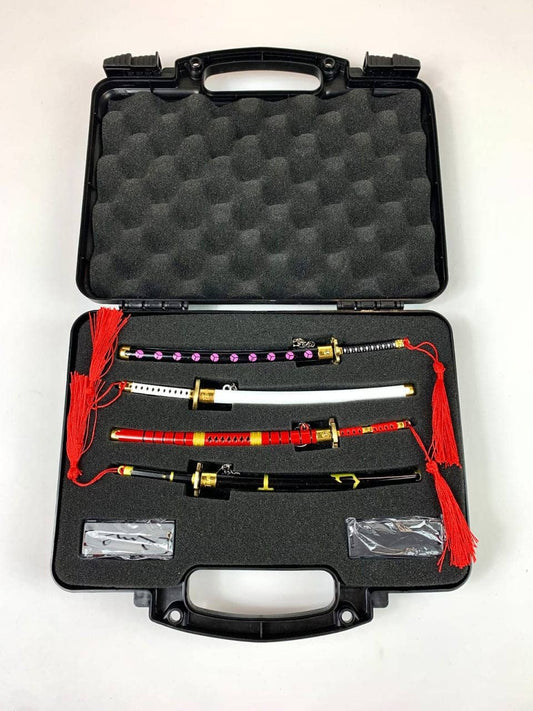


El Cid Campeador
The swords Tizona and Colada, attributed to El Cid Campeador, are part of Spain's tradition and historical memory.
More than mere weapons, they represent the valor, honor, and legacy of one of the most emblematic figures of the Middle Ages.
Through history and legend, these swords have reached us as symbols of identity and cultural heritage.
Who was El Cid Campeador and why are his swords so famous?
El Cid Campeador, Rodrigo Díaz de Vivar (c. 1043-1099), was a prominent Castilian knight and military strategist of the 11th century.
His figure was linked to the service of both Christian kingdoms and Muslim rulers, embodying the complex dynamics of the medieval Iberian Peninsula.
His most famous weapons, the swords Tizona and Colada, gained legendary fame due to their profound symbolic significance in Hispanic tradition.
His memory transcended historical chronicles to become a literary myth thanks to the Cantar de mio Cid, an anonymous epic poem that, by blending real events with fictional elements, consecrated these swords as inseparable emblems of El Cid's legacy and medieval Spanish culture.

Tizona: El Cid Campeador's most famous sword
Tizona, El Cid Campeador's most famous sword, symbolizes the power and authority of Rodrigo Díaz de Vivar during the Spanish Reconquista.
Although there is no definitive historical evidence that El Cid used it in combat, Tizona has been traditionally linked to his figure as an emblem of knightly honor, bravery, and military strategy.
Today, it remains a benchmark of martial tradition and one of Spain's most emblematic historical swords.
The sword measures 93 centimeters long, 4.5 wide, and weighs 4.5 kg.
Its history is shrouded in enigma: it is said to have been in the possession of the Catholic Monarchs and, later, was acquired by the Marquis of Falces, who sold it to businessmen from Burgos for 1.6 million euros in 2008, and it was subsequently ceded to the Junta de Castilla y León.
It is currently on display at the Museum of Burgos.
In literature, the Cantar de mio Cid presents it as a spoil of war taken from King Búcar of Morocco in Valencia, consolidating its legend and its status as an inseparable symbol of El Cid's legacy.
It is important to note that, by blending historical facts with fiction, this work does not constitute evidence of its actual use in battles.

Colada: origin, battles, and legend
Colada is one of the most famous swords associated with El Cid Campeador and forms part of his literary and cultural legend.
Although its existence is mainly documented in El Cantar de mio Cid and later chronicles, there is no contemporary historical evidence to confirm that El Cid used this sword in actual battles during the Reconquista.
The fame of this sword was solidified in medieval literature.
In literature, El Cantar de mio Cid mentions Colada as one of the two steel blades used by Díaz de Vivar in his campaigns, taken as part of a spoil of war: according to the work, it was given to him by its owner, Count Berenguer Ramón II of Barcelona, during his ransom in Valencia.
Subsequently, the poem relates that Colada was donated, along with Tizona, to the Infantes de Carrión—literary characters without historical basis—and, after the affront of Corpes, an episode of humiliation narrated in the Cantar, it returned to El Cid Campeador, who gave it to one of his men, Martín Antolínez, for use in future campaigns.
Today, replicas and pieces attributed to Colada exist in museums and private collections, reinforcing its cultural and historical value, albeit always in the context of its literary legend.
Colada remains an inseparable emblem of El Cid's myth, evoking the heroic and strategic figure of the Castilian knight, and maintaining a prominent place in Spain's historical and cultural memory.

The legacy of Tizona and Colada in history and popular culture
The swords Tizona and Colada transcend their martial function to become cultural and literary symbols of the Spanish Middle Ages.
Their fame, consolidated in the Cantar de mio Cid and subsequent accounts, has inspired chronicles, exhibitions, reproductions, and artistic representations that evoke the bravery, honor, and military strategy of El Cid.
Today, both swords are benchmarks of Spain's historical memory and popular culture, connecting medieval epic with Spain's cultural identity.
You can find these replicas and many more in our Swords and more store.


