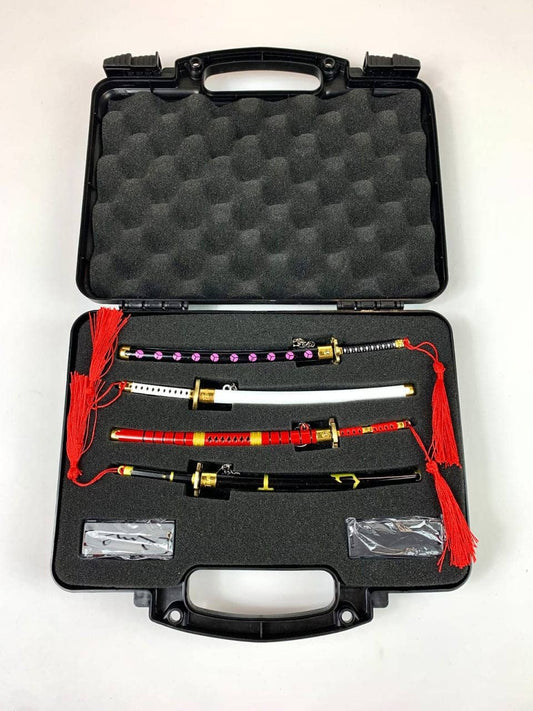


The Chokutō
Before the elegant curve of the katana dominated the Japanese battlefield, there was a straight, unadorned, and lethal sword: the Chokutō.
This ancient weapon played a leading role in Japan's earliest eras, between the 4th and 9th centuries, when elite warriors wielded this type of blade in ceremonies, battles, and rituals.
With its straight, sharp form, the Chokutō reflects continental influence and represents a key piece in the evolution of Japanese swords.
Through this article, you will learn about its origin, use, symbolism, and legacy in the martial and spiritual tradition of the Land of the Rising Sun.

Origin and historical context of the Chokutō
The Chokutō emerged during the Kofun Period (250–538 AD), when Japan adopted Chinese and Korean customs and technologies.
In fact, many early Chokutō were imported from other regions of the Asian continent, especially China and Korea, or imitated Chinese sword designs like the jian.
Its use extended until the 9th century before being gradually replaced by curved swords like the tachi and later the katana.
Even so, it did not entirely disappear: it remained in ceremonial and religious contexts.
Technical characteristics of the Chokutō
Its main distinguishing feature is its straight, single-edged blade.
These are some of its most notable characteristics:
- Straight blade, sharpened on one side.
- Average length of 60 to 70 cm.
- Edge designed for cutting rather than thrusting.
- Simple hilt, without an elaborate tsuba (handguard).
- Traditional single-piece forging in early examples.
In its time, it was primarily used by elite soldiers or high-ranking figures, especially in ceremonies.

Spiritual and ritual symbolism
In addition to its function as a weapon, it had a strong symbolic component.
Many were placed in royal tombs or used in Shinto rituals.
Some were even associated with imperial divinity, such as the legendary Kusanagi Sword, one of Japan's Three Imperial Regalia, which is believed to be Chokutō-shaped.
The straight shape of the blade represented the uprightness of spirit and the connection to the heavens, symbolizing justice and divine will.
The forging and evolution of the Chokutō
The first ones were forged with continental-style steel techniques.
Over time, Japanese artisans began to develop their own methods, such as tamahagane, which would later be refined to make katanas.
Its evolution towards curved blades was due to tactical needs. Curved swords were more effective from horseback, facilitated cutting in motion, and offered greater resistance to impacts.
This change marked the birth of the katana as the great successor.

The Chokutō in modern culture and collecting
Today, authentic ones are extremely rare and are preserved in museums or private collections.
They also appear in anime, video games, and movies, where they symbolize antiquity, nobility, or divine connection.
Modern artisan swordsmiths recreate these swords as decorative pieces or for ceremonial purposes, and their study is essential to understanding the evolution of Japanese weapons.
The Chokutō represents the beginning of swordsmanship in Japan.
Although it was surpassed by more efficient weapons, its symbolic value and sober aesthetic make it a gem of the past.
Its straight blade not only cut through the air in battle but also pierced the veil between the earthly and the divine.
Preserving and studying it is to understand the foundations of bushido, honor, and the spiritual legacy of ancient Japanese warriors.