América
Astronomical Knowledge of the Mayans: Predictions, Calculations, and Meanings
Systematic Sky ObservationThe Mayan civilization, which flourished from approximately 2000 BCE to the 16th century, d...




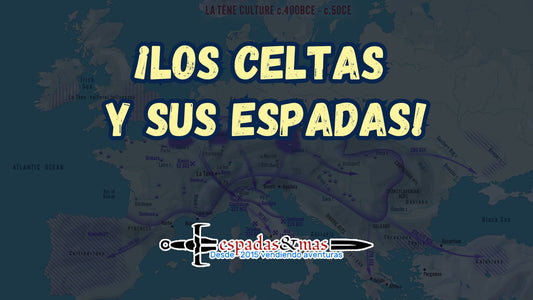
Welcome to a new article on Swords and More. Today we will tell you about a topic that we are sure will be of interest to you: The Celts and their swords! About the Celts We can understand the ancient Celts as a community of diverse tribal groups that spread and populated vast regions of central and western Europe during the Bronze Age, approximately from 700 BC to 400 AD. From the Iberian Peninsula to the lands of Germany, crossing all of Europe and even reaching areas of Anatolia in the east and Ireland in the west. The Celts, although never united under a single state banner, shared certain cultural, religious and linguistic ties (despite their many differences between tribes, there are common elements to take into account) although they did not form a complex and united civilization. We can talk about different cultures of the Bronze Age that have subsequently been related to the expansion of the so-called Celtic peoples such as Hallstat and La Tène. Check out this amazing Celtic Cormac Sword! Hallstatt culture The Hallstatt culture, an archaeological civilization that flourished in Europe during the late Bronze Age and early Iron Age. Its name evokes the mystique of the Hallstatt Necropolis in Austria, where some 2,000 tombs and more than 6,000 buried treasures lie. This culture, which inherited legacies from the Urnfields, was distinguished by its skill in salt production and its increasingly intense trade with neighboring peoples. As it grew, it established connections with regions as far away as the Mediterranean and the vast steppes of Eastern Europe. Over time, iron became the central axis of its development, thus marking the beginning of the First Iron Age. La Tene culture The La Tène culture dates back to the period between 450 and 50 BC, taking its name from the place where its first remains were discovered, on the shores of Lake Neuchâtel in Switzerland. This culture emerged as the successor to the previously predominant Hallstatt culture (ca. 1200 - 450 BC), and quickly became the dominant artistic force in Central Europe. The treasures of La Tène culture have been found across a wide geographical range, from the green lands of Ireland to the vast plains of Romania, painting a picture of cultural exchange and connectivity across Western and Central Europe. Check out this Cruachan Celtic Short Sword! The Celtic Swords The Celts were skilled in metal forging, a skill that left an indelible mark on Roman military technology. From Gallic helmets to the famous Celtiberian swords, their influence was undeniable. We can distinguish several Eras: Bronze Age: Forged in bronze, these swords were rather short, with a triangular shape that made them unique, adorned with complex Celtic spiral patterns. Iron Age (First Period): Celtic swords grew in size and weight during this period. In addition to long swords, short swords, horseshoe daggers and antennae swords were also used. Iron Age (Second and Third Period): Celtic swords continued to evolve, adapting to the changing needs of the battlefield, reflecting the constant transformation of their society and technology. I love this Historical Celtic Short Sword! And what do you think of the Celts and their swords? Are you passionate about the Bronze Age? Tell us!
Read moreWelcome to a new article from Espadas Y Más. Today, we will tell you about the parts of a sword. As you already know, weapons have varied greatly in potential and details throughout history, and the case of swords was not going to be any different, so in this article, we will talk specifically about the parts of a medieval sword, in general. We can't stop recommending our collection of Medieval Swords, we're sure you or your father will love them ;) PARTS OF A MEDIEVAL SWORD Pommel : The pommel is the part of the sword that is furthest from the tip. Its main function is to balance the sword, providing a counterweight to the blade. This allows for easier and more controlled handling of the sword. Additionally, in close combat situations, the pommel can be used as a blunt weapon to strike the opponent. Check out this medieval carbon steel sword Hilt : The hilt is the part of the sword that is held in the hand. It is designed to be comfortable and provide a good grip, allowing the user to handle the sword with precision and control. Often, the hilt is wrapped in leather or some other soft material to provide extra comfort and a better grip. Check out this one-handed medieval sword Guard or Crossguard : The guard, also known as the crossguard, is the part of the sword that is located between the hilt and the blade. Its main function is to protect the hand holding the sword from blows from the opponent. The guard can take many forms, from a simple crossbar to more complex and ornate designs. Check out this medieval German sword Blade : The blade is the long, straight part of the sword. It can be double-edged (sharpened on both sides) or single-edged. The blade ends in a point, which is used for stabbing. The length, width, and curvature of the blade can vary considerably depending on the type of sword and its purpose. Classic Medieval Sword Edge : The edge is the sharp edge of the blade. In a double-edged sword, both sides of the blade are sharpened. The cutting edge is the part of the sword that is used for cutting and slashing. Fluting : Fluting is a groove that runs the length of the blade. Its purpose is to reduce the weight of the sword without compromising its strength. This allows for easier and faster handling of the sword. Tip : The tip is the end of the blade, designed for stabbing or piercing. The shape of the tip can vary depending on the type of sword and its purpose. Check out this historic medieval sword Each of these parts has a specific purpose, and together they make the sword an effective tool for combat. Medieval swords were often customized for the knight who would use them, so they can vary in size, shape, and decoration. Although all swords share these basic characteristics, craftsmanship and innovation in their design have led to a wide variety of swords throughout history. We hope you enjoyed it! See you soon!
Read more