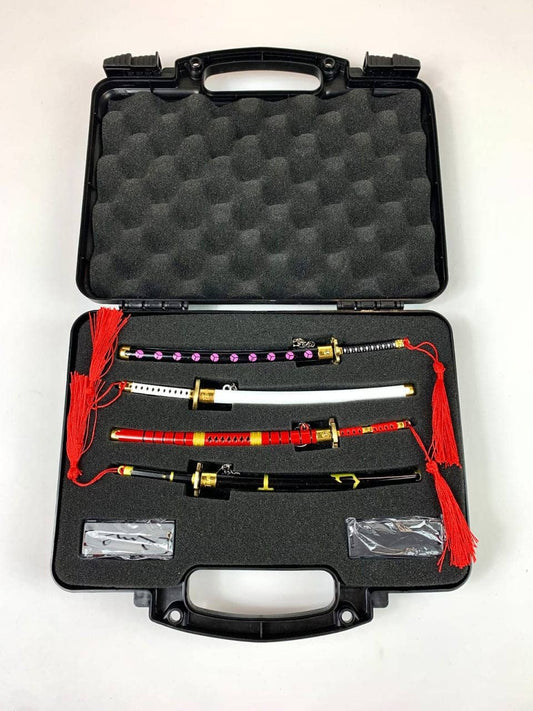


Samurai and Katana
Samurai, warriors of feudal Japan, have fascinated for centuries with their ironclad code of conduct and their inseparable companion: the katana. This sword, forged with art and precision, was not merely a weapon of combat, but, above all, a symbol of honor, spirituality, and lineage.
In the life of a samurai, the katana represented their soul, their duty, and their place in the world.

The Way of Bushido and the Forging of Character
The philosophy of Bushido, or "the way of the warrior," was the central axis of samurai life.
More than a set of rules, it was a moral guide based on loyalty, self-control, honesty, and personal sacrifice.
These ideals were not only learned in the dojo; they were incorporated from childhood and manifested in every decision the warrior made.
From a young age, samurai trained in multiple disciplines: swordsmanship, horsemanship, archery, and war strategies.
Despite mastering various weapons, such as the naginata, the yari (spear), or the yumi (longbow), it was the katana that defined their status and spirituality.

The Katana: a Masterpiece with a Soul of its Own
Each katana was unique. The forging process involved repeatedly folding the steel to give it flexibility and hardness, a technique that reflected not only skill but also devotion.
Traditional blacksmiths were seen as almost mystical figures: their work required concentration, spiritual purity, and respect for tradition.
The result was a curved blade, with a lethal edge, designed for quick and precise cuts.
The decorated hilts, in many cases, with ray skin, the lacquered scabbards, the custom engravings, and the tsuba (handguard), specially designed for each katana and its bearer, made each sword an artistic object imbued with symbolism.

The Daisho: Katana and Wakizashi, the Inseparable Pair
Every samurai carried the daisho, the set consisting of the katana and the wakizashi, a shorter sword.
While the katana was used in open combat, the wakizashi served for defense in confined spaces and for performing seppuku, the ritual suicide that sealed the warrior's honor in case of disgrace.
This pair of swords not only distinguished the samurai from other social classes but also represented their responsibility and commitment to the bushido code.

The Ronin: Honor Without a Master
Not all samurai remained in the service of a feudal lord. Some became ronin, wandering warriors after losing their master.
Although marginalized, many ronin maintained their values intact and continued to revere their katana as a symbol of their noble past.
Celebrated examples such as the 47 Ronin, who avenged their lord's death before performing seppuku, embody the depth of the bond between the warrior, honor, and their sword.
Being a ronin did not imply renouncing bushido, but living it in solitude, with the katana as the sole witness to their legacy.

The Eternal Symbolism of the Katana
Today, the katana remains a revered object. Beyond its beauty and technique, it represents timeless values: courage, sacrifice, integrity, precision, and the constant pursuit of perfection.
Its presence in cinema, martial arts, and private collections is no coincidence. To possess a katana is to inherit a fragment of history.
It is not a simple sword, but the echo of a civilization that elevated the use of the sword to a form of art and discipline to a spiritual path.
The katana not only cuts the air; it cuts time and connects us to an era where honor was more important than life.