


América
Astronomical Knowledge of the Mayans: Predictions, Calculations, and Meanings
Systematic Sky ObservationThe Mayan civilization, which flourished from approximately 2000 BCE to the 16th century, d...




The naginata is one of the most emblematic traditional Japanese weapons, a symbol of discipline, honor and samurai tradition. Its design, with a long shaft and curved blade, made it...
The naginata, a traditional Japanese weapon, has transcended centuries as a symbol of Japanese military history, strategy, and the martial discipline of samurai and onna-bugeisha, playing a key role in warfare, self-defense, and Japanese martial arts. Its unique design, with a long shaft and curved blade, combines range, speed, accuracy and versatility, making it a respected weapon in the Japanese arsenal. In this article, you'll discover the historical origins of the naginata, its characteristics and essential parts, its role in samurai society, and how this Japanese weapon has survived to this day, preserved as a martial arts tool, a cultural legacy, and a symbol of discipline, technique, honor, and Japanese tradition. The historical origin of the naginata in Japan The naginata is one of the Japanese weapons with the greatest history and symbolism. Its origin dates back to the Heian period (794-1185), although some studies suggest that its first forms may have appeared earlier, as an evolution of Chinese and Korean spears adapted to the Japanese combat style. Initially, the naginata was used by samurai and dismounted warriors, offering a tactical advantage over horsemen thanks to its long shaft and curved blade, capable of reaching enemies from a distance. However, it was during the Edo period that the naginata became primarily associated with samurai women. As a tool of self-defense, it became a symbol of feminine strength and honor. (Photo of the Hand Forged Naginata, with a hand forged and folded blade ) Characteristics and parts of the naginata The naginata stands out for being a long pole weapon with a curved blade, combining range, speed, versatility and effectiveness for both attacks and defenses. Its main parts include: Blade (Kama or Ha) : Curved and sharp, made of tempered steel, designed to cut and hook the opponent, it can measure from 30 to 60 cm. Antler (Nagae or Ebu) : Alder or oak wood, which provides reach and strength to attack heavily armored enemies. Mount (Koshirae) : Hardware that secures the blade to the shaft, including a guard (Tsuba) and collar (Fuchi). Pommel (Kashira) : End of the shaft, used to balance the weapon and deliver powerful blows. Its length varies between 2 and 2.5 meters, ideal for foot combat and strategic defenses, combining light, resistant materials and allowing fluid movements and quick attacks in samurai training. The role of the naginata in samurai society The naginata was not only a combat weapon, but a symbol of status, discipline, cultural identity and tradition. During the Kamakura (1185-1333) and Muromachi (1336-1573) periods, its use was associated with military strategy and the martial education of samurai families. Among dismounted samurai, the naginata offered a tactical advantage over horsemen and enemies with short swords, being ideal for maintaining distance and executing precise attacks. Their training reinforced concentration, coordination and discipline, essential values in samurai culture. Furthermore, onna-bugeisha, female warriors of the samurai class, used the naginata to defend homes, temples, and family territories, making it a symbol of female empowerment and family protection. (Photos of the United Cutlery M48 Naginata Spear ) The naginata today: In martial arts and as a cultural legacy Its practice is kept alive in disciplines such as naginatajutsu and sports naginata, recognized in Japan and internationally. These modern forms combine traditional techniques, structured training, discipline, coordination, and respect for the history of the weapon. In Japanese schools and dojos, both men and women learn to handle the naginata with precision and fluidity. Their presence in cultural exhibitions, festivals, and historical reenactments reinforces Japanese cultural significance, samurai identity, and traditional craftsmanship. The naginata's legacy is also reflected in literature, film, and the visual arts, evoking honor, bravery, and refined martial technique. Preserving and practicing the naginata is not only an act of historical preservation, but also a way to keep the values of Japanese warriors alive for centuries. The naginata is much more than a simple polearm; it is a symbol of the military history, craftsmanship, and cultural value of feudal Japan, becoming a symbol of Japanese cultural heritage. Its sophisticated design, strategic use in combat, and emblematic role in women's defense make it a fundamental piece for understanding samurai tradition. Today, the naginata remains relevant, not only as an object of historical study, but also as a weapon used in a martial art practiced and admired around the world.
Read more
The swords Tizona and Colada, attributed to El Cid Campeador, are much more than war relics: they represent honor, bravery, and the legacy of the Spanish Middle Ages. From their...
The swords Tizona and Colada, attributed to El Cid Campeador, are part of the tradition and historical memory of Spain. More than just weapons, they represent the courage, honor, and legacy of one of the most iconic figures of the Middle Ages. Throughout history and legend, these swords have come down to us as symbols of identity and cultural heritage. Who was El Cid Campeador and why are his swords so famous? El Cid Campeador , Rodrigo Díaz de Vivar (c. 1043–1099), was a prominent Castilian knight and military strategist of the 11th century. His figure was linked to the service of both Christian kingdoms and Muslim rulers, embodying the complex dynamics of the medieval Iberian Peninsula. Their most famous weapons, the swords Tizona and Colada, acquired legendary fame for their deep symbolic meaning in Hispanic tradition. His memory transcended historical chronicles to become a literary myth thanks to the Cantar de mio Cid , an anonymous epic poem that, by mixing real events with fictional elements, established these swords as inseparable emblems of the Cid's legacy and of medieval Spanish culture. Tizona : the most famous sword of the Cid Campeador The Tizona, the most famous sword of El Cid Campeador, symbolizes the power and authority of Rodrigo Díaz de Vivar during the Spanish Reconquista. Although there is no definitive historical evidence that El Cid used it in combat, Tizona has traditionally been linked to him as an emblem of chivalric honor, bravery, and military strategy. Today it remains a symbol of war tradition and one of Spain's most emblematic historical swords. The sword is 93 centimeters long, 4.5 centimeters wide and weighs 4.5 kg. Its history is shrouded in mystery: it is said to have been in the possession of the Catholic Monarchs and was later acquired by the Marquis of Falces, who sold it to businessmen from Burgos for 1.6 million euros in 2008, and it was subsequently transferred to the Regional Government of Castile and León. It is currently on display at the Burgos Museum. On the literary level, the Cantar de mio Cid presents it as a booty taken from King Búcar of Morocco in Valencia, consolidating its legend and its status as an inseparable symbol of the Cid's legacy. It is important to note that, by mixing historical fact with fiction, this work does not constitute evidence of actual use in battle. (Photo of the decorated Tizona Sword of the Cid, 4100 ) Colada: origin, battles and legend La Colada is one of the most famous swords associated with El Cid Campeador and is part of his literary and cultural legend. Although its existence is documented primarily in El Cantar de mio Cid and later chronicles, there is no contemporary historical evidence to confirm that El Cid used this sword in actual battles during the Reconquista. The fame of this sword was consolidated in medieval literature. In the literary field, El Cantar de mio Cid mentions the Colada as one of the two swords used by Díaz de Vivar in his campaigns, taken as part of a loot: according to the work, it was given to him by its owner, the Count of Barcelona Berenguer Ramón II, during his rescue in Valencia. Later, the poem relates that the Colada was donated, along with Tizona, to the infantes of Carrión - literary characters with no historical record - and, after the affront of Corpes, an episode of humiliation narrated in the Cantar, it returned to the Cid Campeador, who gave it to one of his men, Martín Antolínez, for use in future campaigns. Today, replicas and pieces attributed to the Colada exist in museums and private collections, reinforcing its cultural and historical value, although always within the context of its literary legend. La Colada remains an inseparable emblem of the myth of El Cid, evoking the heroic and strategic figure of the Castilian knight and maintaining a prominent place in Spain's historical and cultural memory. (Photo of the Colada Sword of the Cid, 101 ) The legacy of Tizona and Colada in history and popular culture The swords Tizona and Colada transcend their military function to become cultural and literary symbols of the Spanish Middle Ages. His fame, consolidated in the Cantar de mio Cid and later stories, has inspired chronicles, exhibitions, reproductions and artistic representations that evoke the Cid's bravery, honor and military strategy. Today, both swords are symbols of Spanish historical memory and popular culture, connecting medieval epics with Spain's cultural identity. You can find these replicas and many more in our Swords and More Store.
Read more
Discover the Mongolian saber, the weapon that accompanied Genghis Khan's warriors on his conquests across Asia and Europe. With its curved blade and agile design, this saber allowed for quick...
During the 13th and 14th centuries, the world witnessed the unstoppable rise of the Mongol Empire, an unprecedented military force led by Genghis Khan. The success of their campaigns was not only due to their tactical discipline or their knowledge of the terrain, but also to the equipment carried by their warriors, among which the Mongolian sabre stands out, also known as the Mongol sabre or curved steppe sabre. This weapon was key in the rapid horseback maneuvers and hand-to-hand combat that characterized the Mongol cavalry. Origin and evolution of the Mongolian saber The Mongolian saber derives from the curved swords used by the nomadic peoples of Central Asia since ancient times. The Scythians, Huns, and Turks already used similar weapons, but it was the Mongols who standardized and perfected this weapon of war. The development of the Mongolian sabre was consolidated during the reign of Genghis Khan (1162–1227), adapted for fast-paced mounted combat on the steppe. The slightly curved blade allowed for effective slashing without the rider losing speed. Over time, these swords influenced by the Chinese Dao, in turn influenced the evolution of others, such as the Japanese katana, and even the Caucasian shashka. Technical and material characteristics The traditional Mongolian saber had a single-edged, curved blade, with a length ranging between 70 and 90 centimeters. Its moderate curvature facilitated both swift cuts and effective thrusts. It was forged from fold-hardened steel, giving it flexibility and strength, ideal for withstanding the rigors of combat and the extreme continental climate. The pommel was often simple, with minimal or no handguards, as the Mongols prioritized functionality. The handle was covered with leather or rope for a better grip. Some high-ranking specimens were decorated with silver or bronze inlays, although most maintained an austere design. Carriers and tactics The saber was carried by almost all elite warriors in the Mongol army. It was part of the basic equipment along with the composite bow, spear, and knife. Its use was especially effective in cavalry charges, lightning attacks and skirmishes. The Mongolian rider, trained since childhood in the art of equestrianism, could draw, attack and resheathe his sword without having to stop. This type of saber was also adopted by other peoples subjugated or allied to the Mongols, such as the Tartars, the Manchus, and various Turkic tribes. Its design even reached Eastern Europe, influencing Hungarian and Polish swords. Archaeological finds and museums Numerous Mongolian sabres have been found in archaeological sites in Mongolia, China, Russia and Central Asia. One of the most notable discoveries was made in the Karakoram region, the former capital of the Mongol Empire, where remains of weapons were found alongside remains of armor and warrior graves. These specimens can be admired today in the National Museum of Mongolia (Ulaanbaatar), the State Hermitage Museum (St. Petersburg) and the Chinese History Museum (Beijing). There are also reconstructions and authentic pieces in private collections and European universities. Influence and legacy The Mongolian saber was not only a functional weapon, but also a key piece in cultural transmission. Its shape and efficiency directly influenced the design of oriental weapons such as the Ottoman yatagan and the Turkish kilij, and European cavalry sabres. Furthermore, their legacy is felt in traditional Mongolian and Chinese martial arts, as well as in modern depictions of Mongolian warriors in film, video games, and historical literature. The Mongolian saber was more than a weapon: it was the instrument that allowed a nomadic people to conquer half the world. Its simple yet effective design, forged in the vast steppes of Asia, is today a symbol of the military ingenuity of one of the greatest empires in history. Thanks to archaeological discoveries and their preservation in museums, we can understand how a curved blade helped shape the course of history. Did you know these weapons? If you liked them, don't forget to check out our Sables collection .
Read more
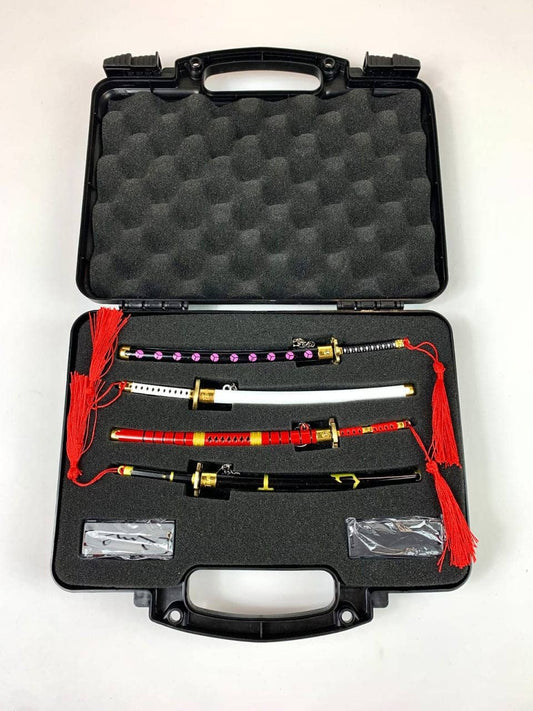
Mini katanas are miniature replicas of traditional Japanese swords, valued for their craftsmanship and cultural symbolism. Made from materials such as carbon or stainless steel, and with details faithful to...
Mini katanas have gained popularity among both collectors and fans of Japanese culture thanks to their detailed design and symbolic significance. These miniature replicas of traditional katanas not only capture the essence of the original weapon, but also function as decorative or collectible items. Despite their small size, many are made from quality materials and reflect the same craftsmanship as real swords. (Image of the Mini-Katana "The Last Samurai" ) What is a Mini Katana? Concept, origin and historical development A mini katana is a scaled-down reproduction of the Japanese katana. These retain the morphology, characteristic curvature, proportions of the handle and guard, as well as the polished finish of the blade, but all adapted to dimensions that generally range between 15 cm and 40 cm. Its current function is primarily ornamental and educational: it allows one to appreciate the metallurgical engineering and aesthetics of the original weapon without the licensing, space, or maintenance requirements that a full-size sword entails. The phenomenon emerged in the early 20th century as a tourist souvenir in Kyoto and Nara, made by artisans using carbon steel and simple tempering techniques to satisfy the demand of Western visitors. With the expansion of specialized collecting in the postwar period, these models evolved into high-end pieces, forged in multi-layered metal, with lacquered skirts and chiseled brass fittings, faithful to the style of historical schools such as Bizen or Soshu. Over the past few decades, the growth of Japanese pop culture fairs, along with the spread of sword-themed anime series and video games, has cemented the mini katana as a global cult object. Contemporary designers incorporate stainless steels, cryogenic treatments, and laser engraving to add aesthetic value and ensure corrosion resistance, while museums and dojos use it as an illustrative tool in seminars on Japanese military history. Thus, the mini katana has transformed from a simple souvenir into a statement piece that combines traditional craftsmanship, metallurgical engineering, and modern design trends. (Image of Trafalgar Law's Mini-Katana ) How to choose a mini katana? Selecting a quality mini katana involves more than just an aesthetic decision. It's a process that requires attention to technical and functional aspects that ensure both historical accuracy and durability. These pieces, despite their small size, must reflect the artisanal precision and symbolic values that characterize the original katana. The first key aspect is the steel composition. The best ones are forged with materials such as tempered carbon steel, high-grade stainless steel (such as 440C), or even composite steels (san-mai), which provide hardness and corrosion resistance. The quality of the metal influences not only durability but also the sharpness of the finish, the polish of the blade, and the fidelity of the lines. Secondly, the degree of authenticity and craftsmanship must be assessed. Professional reproductions often include many details similar to the original, must maintain correct proportions, and respect regional styles, for example, Edo koshirae or Shinto ; they even offer certificates of provenance or limited editions. (Image of the Mini-Katana Wado Ichimonji ) Technical maintenance and conservation The mini katana, like its full-size counterpart, requires rigorous maintenance to preserve its condition over time. The steel, even treated, is still vulnerable to moisture and contact with natural skin acids. It's recommended to clean it periodically with microfiber cloths that won't scratch the blade's polish. Afterward, apply a thin layer of camellia oil, or choji oil, traditionally used on Japanese swords, to prevent rust. No abrasive products should be used and direct handling without gloves is essential if the original finish is to be preserved. As for conservation, it should be stored in dry, ventilated places and away from direct sunlight. It is preferable to use horizontal supports to distribute the weight without damaging the skirt and to keep the piece protected from dust and moisture with fabric covers or acrylic display boxes. The value of owning a mini katana Each mini katana is, in itself, a tangible representation of values such as discipline, respect for tradition, and technical perfection. For collectors, designers, and lovers of Japanese art, owning a quality mini katana represents an investment in knowledge, history, and beauty. Furthermore, their portability and versatility make them ideal objects for thematic exhibitions, educational practices, or contemporary artistic inspiration. Don't forget to check out our collection of Mini Katanas .
Read more
The Spartan sword from 300 , inspired by the Greek xiphos, combines history and cinematic stylization. Its curved, rustic design reflects the brutality and honor of the Spartan warrior. Used...
The film 300 (2006), directed by Zack Snyder and based on the graphic novel by Frank Miller, transformed the image of the Spartan warriors into a visually striking legend. Among the many elements that defined these fighters, the Spartan sword stands out as a direct extension of their discipline, ferocity, and tactical brutality. In this article, we explore the historical origins of this weapon, its cinematic reinterpretation, and the powerful symbolism it holds, both on the battlefield and in popular culture. (Image of the Sword of Leonidas from 300, aged, hand-forged, functional ) Origin of the Spartan Sword Historically, the Spartans used a sword called a xiphos, a short, double-edged blade designed for close combat. It was a secondary weapon, used when the warrior could no longer fight with his dory spear. The xiphos measured between 40 and 60 cm and was ideal for direct collision in the hoplite formation. Unlike longer swords, the xiphos allowed the Spartans to maneuver within the phalanx with precision, seeking out the enemy's weak points, such as the armpits, neck, or groin, after the initial clash of spears and shields. Features of the Sword in the Movie 300 The sword featured in the film 300 is a stylized and dramatized version of the historical xiphos. In the film, its menacing appearance is enhanced with a rougher, more curved and visually intimidating design. Its characteristics: Length: Approximately 60 cm Design: Slightly curved, double-edged blade with a pointed end Material (in fiction): Blackened steel, with a rustic appearance Grip: Simple, enveloping, easy to handle even with gloves This design isn't meant to be historically accurate, but rather to convey brutality and effectiveness. The overall aesthetic of the weapons in 300 follows the logic of the comic: extreme stylization for visual impact. (Image of the Official Sword of 300 ) The Use of the Spartan Sword in 300 Leonidas and his 300 Spartan warriors make extensive use of this sword in the film's many battles. The sword becomes a lethal tool for close combat, where a shield and swift movement are essential. The film spectacularly choreographs the cuts, stabs, and dismemberments this weapon can cause, showing the sword as an extension of the Spartan warrior instinct, where its small size facilitates its continuous use without compromising the warrior's mobility. Symbolism of the Sword of 300 Beyond its effectiveness in combat, the 300 sword becomes a narrative symbol. It represents: Resilience: the will to fight until the last breath Honor: The Hoplite Code, Where Shield and Sword Do Not Surrender Warrior Identity: The Spartan Pride of Dying Fighting for Freedom War minimalism: the weapon is simple but deadly, without unnecessary embellishments This weapon epitomizes Spartan philosophy: efficiency, functionality, and discipline. In the context of cinema, it also functions as a visual icon that defines the protagonists as relentless forces. (Image of Spartan Sword from the Movie 300 ) Influence on Pop Culture and Video Games The Spartan sword from 300 isn't just a combat tool; it's a symbol of resilience, valor, and cinematic style. Inspired by the historic xiphos but adapted to the film's visual language, this weapon has established itself as one of the most recognizable icons of modern epic cinema. Its strength lies as much in its history as in its visual impact, making it a must-see for lovers of ancient weapons, Greek culture, and action films with an aesthetic identity. This has been replicated in video games, merchandising and collectibles. Games like God of War, Assassin's Creed Odyssey, and Spartan: Total Warrior have reinterpreted similar weapons, blending historical accuracy with the film's brutal style. There are also official and unofficial replicas of this sword, forged for collectors and fans of epic cinema. Its design has made it a very popular decorative item in film, history, and geek culture stores. Without a doubt, Leonidas' sword represents the fighting soul of Sparta, brought to the screen with fury, fire, and glory. Don't forget to visit us at Swords and More, where you can find more "300" movie merchandise and much more.
Read more
Muramasa swords have transcended the boundaries of Japanese history to become authentic symbols of mysticism, power, and artisanal excellence. Forged by one of the most enigmatic blacksmiths of feudal Japan,...
Since time immemorial, swords have been symbols of power, honor, and skill in Japanese culture, with katanas being particularly prominent. Among the many legends of blacksmiths, especially Japanese swordsmiths, none resonates as much as that of Muramasa, a name that evokes both admiration and fear. Muramasa swords are not just weapons; they are pieces of art, history, and mysticism that have endured throughout the centuries. I invite you to explore the legacy of these swords, their unique characteristics, the stories surrounding them, and their value in today's world. Distinctive Features of Muramasa Swords · Muramasa-ba (Leaf Pattern) The uniqueness of Muramasa swords begins with the Muramasa-ba, the hamon or tempering pattern that adorns their blades, a very characteristic of katanas. These distinctive lines, which can resemble dancing flames or moving waves, are not merely decorative. They act as an indicator of the different levels of hardness along the blade, resulting in greater cutting ability and durability. The Muramasa-ba has become a recognizable symbol of Muramasa's mastery. · Muramasa-nakago (Tang) The nakago, or tang, is another essential feature of these swords. Although hidden in the handle, its meticulous craftsmanship reveals much about their history. It often features engraved markings and a finish that combines functionality with aesthetics. Experts can sometimes date the sword based on the shape of the nakago and its markings, providing a deeper connection to its time of manufacture. Cursed Reputation The infamy of Muramasa swords stems from their supposedly cursed nature. Throughout the ages, legends have held that these swords tend to incite their wielders to acts of violence and aggression, or demand to be stained with blood, whether from the enemy or the wielder himself. Something that influenced many samurai to prefer not to possess them. This dark myth has contributed to their mystical aura, attracting admirers and fanatics, both believers and skeptics. Muramasa Swords in Today's Market Genuine Muramasa pieces are now rare and highly valued. This blacksmith's legacy has been passed down from generation to generation, but many of his works have disappeared during wars and political crises. Owning a Muramasa sword was once considered almost criminal, which has only increased its rarity and, consequently, its value. Nowadays, an authentic sword can fetch prices in the tens of thousands of euros at auction. The story behind a Muramasa sword isn't just about its quality; it's a journey through time, unparalleled craftsmanship, and a legacy that continues to defy history. Muramasa: A Legacy That Endures Although Muramasa's figure is shrouded in mystery, the impact of his swords on Japanese history is indisputable. From samurai warriors to contemporary collectors, his works capture the imagination of those seeking to understand the essence of Japanese culture. The legendary aura surrounding Muramasa not only highlights the quality of his work, but also the importance of the symbolism that swords possess in Japanese narrative. Historians such as Oscar Ratti and Adele Westbrook have argued that the dark reputation of these steels may have influenced their continued absence from classification as "National Treasures of Japan." Perhaps, with evolving cultural perceptions and greater recognition of their historical and technical significance, appreciation for Muramasa's work will change in future generations. Legendary Muramasa swords and their wielders Muramasa swords are renowned for their mysticism and their connection to legendary warriors. Known as "swords that transcend time," their fame has endured through generations, capturing the imagination of many. Here are just a few: · Muramasa no Kaze: The Sword of Wind by Yamato Takeru Belonged to Yamato Takeru With a lighter blade than ordinary swords, this sword is designed for swift and elusive combat. Its edges are as sharp as the wind, allowing for precise and lethal cuts. Yamato Takeru, a heroic figure from Japanese mythology, is known for his bravery and resourcefulness in battle. He is said to have been able to overpower powerful enemies thanks to the spirituality emanating from the sword Muramasa no Kaze. This blade was not only a tool of war, but also a companion that guided him on his quest and protected him in times of adversity. · Muramasa no Hōō: The Phoenix Wielded by Yoshitsune Belonged to Minamoto no Yoshitsune This sword is famous for its blade decorated with phoenix symbols, representing rebirth and renewed strength. Its hilt is sturdy, providing a firm and powerful grip. Minamoto no Yoshitsune was one of Japan's most legendary warriors, whose strategies and bravery have been admired for centuries. It is said that by wielding Muramasa no Hōō, Yoshitsune not only became a formidable leader, but was also endowed with unparalleled fearlessness, capable of facing entire armies at the command of his faithful warriors. Muramasa's legacy is a testament to how art and history can intertwine to create pieces that not only stand out in their time, but also inspire and fascinate over time. Muramasa swords, with their unique characteristics and the mysticism that surrounds them, are more than just weapons; they are an enduring cultural legacy. For those who feel a connection to history, craftsmanship, or ancient myths, the story of Muramasa continues to offer a rich and immersive narrative that will endure for generations to come. The deep admiration they inspired in their time remains intact, reminding us that some legends never die. If you like katanas, antique swords (both Japanese and from around the world), and collecting, don't hesitate to visit our Online Store .
Read more
A journey through the history and evolution of the katana, from its origins influenced by Chinese swords to its consolidation as a symbol of samurai culture.
Swords have been symbols of power, honor, and skill throughout history, but few have captured the popular imagination like the katana. That elegant, curved blade, with its distinctive design and almost mystical aura, has come to represent the mastery of Japanese forging and samurai nobility. However, as we explore their past, we wonder: Are katanas truly unique to Japan, or have they been influenced by traditions from other countries, particularly China? In this article, we'll uncover its fascinating history, from its conception by masters like Masamune to its relevance in today's world. Historical origins and its Chinese influence The history of the katana begins approximately thirteen hundred years ago, during the eighth century. The swords that preceded it, such as the jian and the tang- dao , were Chinese swords that arrived in Japan long before the modern katana took shape. Although these ancient swords differed considerably in design—the jian is a straight, double-edged sword, while the dao is a curved, usually single-edged blade—talented Japanese swordsmiths learned and adapted. Through a gradual process of innovation and improvement, a weapon emerged that was both functional and artistic. During the Heian period (794–1185), Japanese swords began to evolve. Although the katana itself did not yet exist, long swords known as tachi began to become popular among the aristocracy and samurai. They had a curved shape similar to the katana, but were designed to be carried suspended with the blade pointing downward. As combat evolved, the need for a sword that allowed for quick draw and a smooth transition between attack and defense became apparent. It was during the threat of the Mongol invaders in the 13th century that the need for a sword that could cut through their thick leather armor began, giving rise to the katana, which irreversibly changed the way of fighting in Japan. Chinese influences on the evolution of the katana The influence of Chinese traditions on sword forging is undeniable. Early Japanese blacksmiths adopted Chinese forging and metalworking techniques, and although they adapted them to their own cultural context, it is possible to trace a link through the centuries that illustrates how these influences shaped what would eventually become the katana. In addition to Chinese swords, there are other types of Japanese swords that help contextualize the evolution of the katana. The wakizashi , a shorter sword often carried alongside the katana, also evolved out of tactical needs, specifically its usefulness in tighter spaces. Together, these swords formed the daisho , a samurai status symbol. The golden age of the katana Moving forward in time, we reach the Muromachi period in the 14th century, where the art of sword forging reached its zenith. It became a cultural and spiritual symbol. Unfortunately, the creation of quality katanas could not always be sustained. During the turbulent Sengoku period, when Japan was mired in internal wars, the demand for swords increased dramatically. This led to a more industrialized production, where quantity outweighed quality. Later, with the unification of Japan and the establishment of the Edo period (1603–1868), there was a fundamental shift in the perception of the katana. During this time of relative peace, the sword became more of an art object than a combat weapon. Forging techniques were perfected and Master swordsmiths like Masamune and Muramasa became famous for the quality and beauty of their swords. These swords were considered "living" and believed to possess a spirit that could offer protection or cause calamity. This era marked the heyday of the katana, a weapon that was not only a lethal instrument but also a work of art. While the Osaka masters created beautiful and ornate swords, katanas began to be used less on the battlefield and more as symbols of prestige. The Katana in the Modern Age: Japanese Tradition and Cultural Legacy The rise and fall of the katana continued into the 19th century with the Meiji Restoration, which brought with it a wave of Westernization that swept away many ancient traditions. Samurai swords, once objects of respect and power, became heirlooms. Despite the abolition of the katana in public and the emergence of firearms, there is a resurgence of interest in these swords. Today, enthusiasts and collectors seek to acquire authentic katanas, proving that the fascination with these objects has not diminished over time. Their popularity has spread beyond Japan and is recognized and imitated worldwide. The skill of contemporary smiths in keeping the traditions of katana forging alive reflects a deep connection with Japanese history. While the katana may have roots intertwined with Chinese influences and other traditions, its specific evolution and intrinsic symbolism are quintessentially Japanese, and it has come to represent not only the prowess and spirit of samurai warriors, but also a rich history of innovation, adaptation, and a cultural legacy that endures today. So are katanas really Japanese? Although its origins are intertwined with influences from other traditions, particularly ancient China, its evolution and perfection, leading to its distinctive sword form, occurred in Japan. The essence of the katana forging art, its cultural significance, and its aesthetic are undeniably Japanese. As we explore their history, the legacy of bravery and honor they represent is undeniably Japanese. It's a symbol that continues to inspire generations and undoubtedly still has much to tell. If you like katanas, or even want to see other types of swords, including Chinese ones, don't hesitate to visit our online store .
Read more
Legend, tragedy, and superstition have given life to the story of the legendary blacksmith Muramasa , whose creations have been considered cursed throughout Japanese history. We invite you to learn...
Throughout Japan's vast history, amidst honor and dishonor, legendary warrior figures and incomparable artisans stand out. But one shines with a dark glow: Muramasa. The katanas forged by this legendary Japanese blacksmith are considered cursed swords. They are symbols of a disturbing duality that continue to whisper tales of glory and tragedy throughout the centuries, placing him as the undeniable opposite of the legendary blacksmith Masamune. It is said that by wielding a Muramasa katana, one faces a legacy of curse, a legacy that has inspired fear and fascination in equal measure. Who hasn't wondered what secrets are hidden in the steel that cuts the lives of nobles and challenges destiny? The Myth of the Cursed Craftsman: Curse or Coincidence? Muramasa Sengo is one of the most enigmatic figures, it is believed that he was a master blacksmith of the Muromachi period (14th to 16th centuries) who lived in the province of Ise, Japan. His work is recognized for the beauty, quality and resistance of his katanas. It is said that his weapons were so sharp that they seemed to thirst for blood, which gave rise to the aura that surrounds him, as these have been the subject of numerous legends and stories that describe them as cursed weapons, bringers of misfortune to their possessors. Leaves with a will of their own? Legend has it that his violent and obsessive soul permeated every blade he forged, giving his swords their own will and an almost demonic character. Unlike famous katanas like Masamune 's, which represented harmony and justice, the Muramasa were considered unbalanced. It was once believed that they demanded to be drawn, and once out of their saya, they could not be drawn again without shedding blood, even that of the wielder. This led many samurai to refuse to use them, believing that they brought inevitable death. The Tokugawa Blood Curse Although there is no historical evidence that they were cursed, the accumulation of tragic coincidences and their association with figures such as the Tokugawa fueled the legend. They were believed to be more than just weapons; they had an insatiable thirst for blood, especially the blood of the Tokugawa dynasty, the dynasty that ruled Japan for nearly 250 years. The relationship between Muramasa swords and these is both tragic and fascinating: Ieyasu Tokugawa, the first shogun of the dynasty, feared these legendary swords, convinced that they brought misfortune to his lineage due to numerous mishaps related to them. In 1535, his grandfather, Matsudaira Kiyoyasu, was assassinated by his own retainer, Abe Masatoyo, with a sword forged by Muramasa, one of the first incidents linking such swords with misfortune in the family. Later, the samurai Iwamatsu Hachiya, under the influence of alcohol, stabbed his father, Matsudaira Hirotada, using a Muramasa, reinforcing the belief in the curse within the clan. Finally, his firstborn, Matsudaira Nobuyasu, committed seppuku and his kaishakunin, Amagata Michitsuna, used a Muramasa katana to carry out the act, adding another tragic episode associated with these weapons in the Tokugawa family. Ieyasu is also said to have suffered an accidental injury with a Muramasa during his youth in Suruga, an incident that would contribute to his negative perception of these weapons. Due to the many tragic events associated with Muramasa katanas, Ieyasu decided to ban their possession, believing they brought misfortune to his family. This ban was extended to the entire country during his shogunate, making them a symbol of defiance against his rule. The Muramasas as a symbol of rebellion Popular belief held that Muramasa brought misfortune. Their use became an act of defiance. During the Bakumatsu period, shishi , opponents of the Tokugawa shogunate, sought out Muramasa swords, considering them symbols of resistance against the established regime, and turning them into emblems of political defiance. Thus, for example, Sanada Yukimura, during the Siege of Osaka, carried a Muramasa tanto, openly defying the Tokugawa clan. Or, as early as the 19th century, Saigo Takamori, leader of the Satsuma rebellion against the Meiji government, carried a Muramasa dagger concealed inside his war fan, symbolizing his defiance of the established power. A Living Legacy The legend of Muramasa's curse grew stronger over time, fueling a history of superstitions and myths that blended reality with folklore. Elements of the story, such as conspiracies and betrayals, were intertwined with the myth, creating an aura of doom around each blade. The cursed Muramasa katanas remain a symbol of power and tragedy in Japanese history. Their presence in popular culture and their connection to the samurai make them some of Japan's most enigmatic swords. Despite their dark reputation, they remained coveted. Viewed as objects of power, capable of granting the wielder unparalleled strength and skill, at a price: a tribute of blood. This dualism has made them sought after not only for their quality, but for the history they represent. It has also led to his immortality in Japanese and international culture, appearing in video games, anime, manga, and films, where his name continues to evoke images of power and tragedy. They have also become a symbol of resilience and defiance, resonating with those who seek to emulate the strength of warriors of the past. In this contemporary world, where it's easy to forget that behind every samurai sword lies a story, a life, and a legacy, Muramasa swords invite us to reflect on the essence of power and the responsibility it entails. Is steel simply an instrument, or is it a receptacle for the history and emotions of those who have wielded and forged it, and of those who have lost their lives beneath its blade? The Echo of the Cursed Swords Muramasa's katanas, shrouded in their legendary curse, are part of the history of samurai and swordsmiths in Japan. With their aura of mystery and legacy of power, they remind us that history is full of shadows and light. Although steel can be sharp and deadly, it is history and human context that truly shape its meaning. Thus, when contemplating a Muramasa, one not only sees a masterpiece of Japanese blacksmithing, one is confronted with an echo of the ancient samurai, a reminder that honor and tragedy are inextricably intertwined. And evoking the name of this forger invites us to think about the story behind each samurai sword, the lives it has touched, and the lessons that still resonate today. Whether for their perfect edge or the tragedies that surround them, they remain an essential part of the Japanese imagination, fascinating historians and folklore enthusiasts. And you, do you believe in curses or in the power of suggestion?
Read more
If you're interested in Japanese history and samurai culture, you'll surely find this introduction to Daishō helpful, as it teaches you about its meaning, history, and relevance to samurai.
In the fascinating world of katanas, one of the most emblematic practices is the use of daishō , a pair of Japanese swords generally composed of the katana and the wakizashi, being its most commonly known form, although it has also been formed by other duos of traditional Japanese swords . The daishō embodies the elegance, duality, and tradition of Japanese sword art, as well as being transcendent in samurai history. In this article, we'll take a look at the historical significance of daishō, its symbolism, and its application in combat. Origin of the name Daishō The daishō originated in feudal Japan, where it was primarily used by samurai as a symbol of their elevated social status and martial prowess. The term "daishō" literally means "large and small" and refers to the different sizes of the two swords it comprises. The word daishō comes from the combination of "daitō" (long sword) and "shōtō" (short sword). Initially, it referred to the practice of carrying a katana and a wakizashi together, without requiring them to be made by the same smith or have matching fittings. However, over time, the concept of daishō evolved to include two swords with coordinated designs and decorations. In the early samurai era, the tachi was paired with a tantō . Later, the katana was paired with a shorter version of itself, known as a chiisagatana . With the rise of the katana, the wakizashi became the preferred secondary weapon of the samurai, as, according to Kanzan Satō in his book The Japanese Sword , it was ideal for indoor combat. Often, samurai would leave their katana at the entrance of castles or palaces and keep the wakizashi with them. History and regulation of Daishō The use of the daishō became popular in the late Muromachi period (1336–1573) , although there are records of its existence from the 16th century. In 1629 , an edict was issued defining the duties of the samurai and including the daishō as part of their standard equipment. In 1683 , its use was restricted exclusively to the samurai class, making it a status symbol . Although samurai were allowed to carry decorative swords in everyday life, the Tokugawa shogunate regulated their use on formal occasions, such as castle audiences. For official events, the daishō was required to have a solid black scabbard, with the handle wrapped in white ray skin. During the Meiji period , restrictions requiring samurai to wear daishō were abolished in 1871. Finally, in 1876 , the majority of the population was banned from carrying swords in public, marking the end of daishō as a fundamental part of samurai identity. Symbolic meaning of Daishō The daishō symbolizes the duality of the samurai, combining the strength of the katana with the precision of the wakizashi . Traditionally, the katana represented the soul of the samurai , while the wakizashi symbolized his honor and loyalty . Together, these weapons embodied the balance between power and control, essential aspects of warrior philosophy. Use of Daishō in combat The daishō was designed to offer tactical flexibility in combat. The katana , with its long, curved blade, was used for ranged attacks, while the wakizashi , shorter and less curved, was ideal for close-quarters and close-quarters combat. According to most traditional schools of kenjutsu , only one of the daishō's swords was wielded in combat. However, in the 17th century, the legendary swordsman Miyamoto Musashi developed a fighting style in which both swords were wielded simultaneously. This technique, known as Niten Ichi-ryū , allowed one to attack and defend with both hands, revolutionizing the fencing strategies of the time. Ritual and etiquette of Daishō The use of daishō was subject to strict rules. Samurai were required to handle their swords with respect and caution , avoiding unnecessary contact between the blades. Furthermore, regularly cleaning and maintaining the daishō was a sign of dedication and discipline . Although the practice of carrying daishō has declined over time, its influence persists in Japanese culture. Today, these pairs of swords are displayed in museums and private collections as testaments to their historical significance. Furthermore, the idea of duality and balance between power and control remains present in many Japanese martial arts. The eternal magnificence of Daishō The daishō represents the essence of the art of the katana and embodies the spirit of the samurai . Its symbolic meaning and application in combat are fundamental pillars of Japanese culture. Exploring the legacy of the daishō allows us to understand the richness of this ancient tradition. Whether you are a fan of Japanese martial arts or simply admire samurai culture, daishō remains a timeless symbol that fascinates and inspires generations.
Read more
