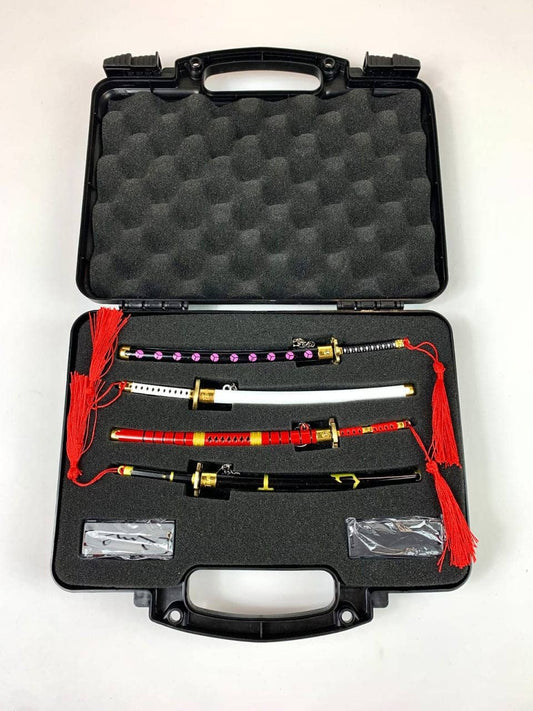


The Tachi
The tachi was one of the most important swords in feudal Japan, widely used before the katana became the emblematic weapon of the samurai.
This long sword, with a curved blade and single edge, was not only an instrument of war, but also a symbol of prestige and tradition.
Its evolution reflects the social and military changes that occurred in Japan from the Heian period to the Sengoku period, leaving an invaluable historical and artistic legacy.

Origin and characteristics of the tachi
The tachi appeared towards the end of the Heian period (794-1185) and reached its peak during the Kamakura (1185-1333) and Muromachi (1336-1573) periods.
Unlike the katana, the tachi was primarily designed for mounted combat. Its blade was more curved, facilitating precise cuts from horseback.
It generally exceeded 75 centimeters in length, with a curvature that allowed for effective handling in quick and powerful attacks.
A distinctive feature of the tachi was the way it was worn: suspended from the belt with the edge facing down, unlike the katana which was worn with the edge facing up.
This facilitated drawing the sword during a charge and allowed for fluid movements during combat.
The tachi blade was forged from tamahagane steel, a material produced through traditional processes in bloomery furnaces using iron sand, which gave it great strength and flexibility.

Forging technique and artistic details
Japanese swordsmiths dedicated special care to the manufacture of the tachi.
The forging included advanced tempering techniques, which created unique patterns in the steel known as hamon. These patterns not only had an aesthetic function but also reinforced the blade's structure.
Legendary master swordsmiths such as Sanjō Munechika, Masamune, and Muramasa produced tachi that have become true national treasures.
The koshirae, or the sword's exterior fittings, was also a fundamental element.
The saya (scabbard) was lacquered and often decorated with gold or black motifs, while the tsuka (hilt) was covered with ray skin and braided silk.
The tsuba (handguard) featured mythological or symbolic engravings, reflecting the wearer's status and personality.
These details not only served practical functions but also showcased the rich culture of the era.

Archaeological findings and their historical value
Various tachi pieces have been discovered in archaeological sites and ancient burial mounds in Japan.
An outstanding example is the Inariyama sword, found in Saitama Prefecture and dated to the 5th century, which bears an inscription with the name of an ancient emperor.
Such findings confirm the importance of the sword as a ritual object and symbol of power, beyond its martial use.
Additionally, numerous tachi are part of collections in museums such as the Tokyo National Museum and the Sword Museum in Sumida.
These institutions safeguard pieces considered National Treasures, preserving not only the blade but also the cultural and spiritual context embedded in each sword.

The legacy of the tachi in Japanese history
Although the katana displaced the tachi on the battlefield during the Edo period, the legacy of this sword remains alive.
It represents an era in which war and art were closely intertwined.
The tachi not only marked a technical advancement in weapon forging but also symbolized the warrior spirit and refined aesthetics of feudal Japan.
In conclusion, the tachi is much more than an ancient sword.
It is a living testament to Japan's history, culture, and technical skill, whose influence endures in the symbolism and tradition of the samurai sword to this day.