

Kawaii
The word kawaii (可愛い or かわいい) is today synonymous with cuteness, innocence, and adorable aesthetics in Japan and around the world.
If you travel to the Harajuku district in Tokyo, you'll see that this term is part of everyday life in signs, shops, fashion, music, and even gastronomy.
But what does kawaii really mean? What is its origin and how has it become a global cultural phenomenon?
I invite you to discover it.

What is the origin of the word Kawaii?
The current meaning of kawaii is closely linked to the idea of "cute" or "adorable," but its history is more complex.
Its origin dates back to the Heian period (794-1185) with the word kaohayushi, which described a face blushing with embarrassment or guilt.
Later, in the Taisho era (1912-1926), it evolved into kawayushi, which could mean both "shy" and "cute."
This linguistic evolution later gave rise to the term kawaii, which combines innocence, sweetness, and vulnerability.
Today, kawaii is used to describe everything from a person to an object, an artistic style, or an attitude.
It is a concept that conveys youthful purity, connotations of shyness, and an aesthetic centered on cuteness.

The birth of kawaii culture
Kawaii culture began as an act of youthful rebellion in Japan in the late 1960s and early 1970s.
Students opposed strict social norms and sought to escape stress through childlike expressions.
One such manifestation was kawaii writing, with rounded characters, heart embellishments, and smiling faces, known as burikko-ji.
Companies soon saw a commercial opportunity in this style. In 1974, Sanrio created Hello Kitty, the quintessential kawaii character, who would eventually conquer the world.
Since then, kawaii went from being a student protest to an economic and cultural driving force in Japan.

The omnipresence of kawaii in Japanese culture
Today, the term kawaii is applied in numerous fields:
- Kawaii fashion: Colorful, with ruffles, lace, shiny accessories and derived styles such as Sweet Lolita, Gothic Lolita or Fruits Lolita.
- Kawaii music: With exponents like Kyary Pamyu Pamyu and the surprising genre of kawaii metal, represented by Babymetal.
- Kawaii cuisine: The famous bento kyaraben, lunchboxes decorated with adorable characters and shapes that turn food into art.
- Official mascots: Prefectures, companies, and even Japanese institutions have kawaii characters as a promotional tool.
In Japan, kawaii is not limited to entertainment: it is part of the national identity and daily life.

The global expansion of kawaii
Although born in Japan, kawaii has crossed borders.
Anime, manga, video games, and Japanese fashion have made kawaii a global phenomenon. Today, millions of young people in Europe and America adopt its aesthetic in clothing, makeup, and social media.
This international success reflects, on the one hand, how kawaii responds to a universal desire: to return to childhood, innocence, and play, in contrast to adult stress.
However, it also points to what is striking and beautiful, encompassing a wide variety of tastes: from the most ostentatious to the smallest details; textures, shapes, delicacy, and unlimited color palettes, although it usually combines some light tones, it does not prevent it from including even black, which makes it attractive for all generations.

Much more than "cute"
The word kawaii means much more than "adorable." It represents a Japanese cultural philosophy that mixes rebellion, cuteness, and colorful aesthetics.
From its historical roots to its current impact on fashion, music, and gastronomy, kawaii has gone from being a youthful gesture to becoming a global symbol of cuteness and optimism.
Thus, when you hear the word kawaii in Japan, you will understand that it not only describes something beautiful: it defines a whole way of seeing the world, where innocence and fantasy play a leading role.
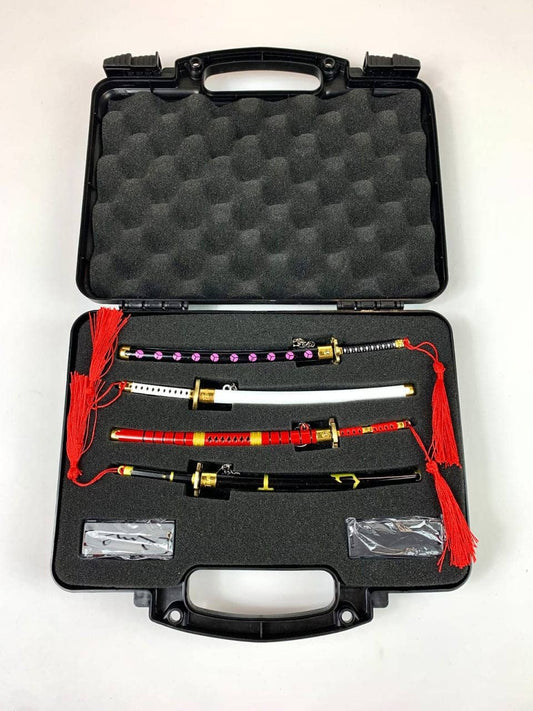
If you like "Kawaii," you can visit our Swords and More Store, where you will find a variety of Kawaii products and much more.